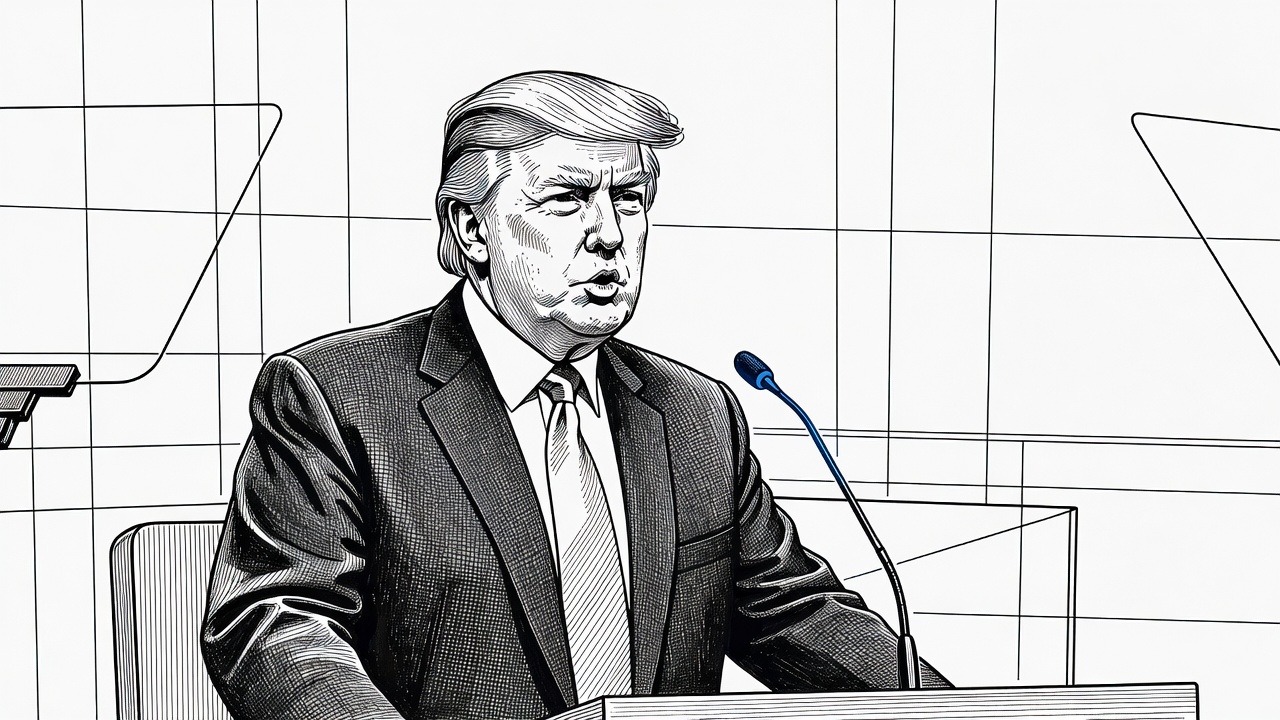
Let me say the unfashionable part first: if China really has agreed to sit down with Washington and Moscow over nuclear weapons, that is good news, and the Left should say so. Arms control is not a Republican or Democratic hobby. It is how a species with thousands of warheads tries to avoid its own extinction. The last treaty limiting American and Russian arsenals was scheduled to expire in early 2026, and Beijing has spent years refusing to discuss its own buildup. A real opening would matter.
But notice what we actually have: Trump's word at a podium. The Bare Story offers no text, no timeline, no agenda and no format. We have no confirmation from Beijing in the account. We have a president who says the Chinese were reluctant because their arsenal was smaller, and that it could catch up with ours within a decade. That is the rhetoric of a man announcing a result, not the work of a man building a negotiation.
This is the pattern. Trump announces a breakthrough and the details arrive later, if at all. Arms control is the opposite of that kind of politics. It is dull, technical, adversarial work: verification regimes, data exchanges, inspection rights, definitions of what counts as a deliverable warhead. It takes career experts who know the other side's systems better than the other side's diplomats do. This administration has spent its time gutting the State Department and treating expertise as disloyalty. In the same period Trump ordered the Pentagon to begin testing nuclear weapons again. He now wants credit for a process he has done little to prepare for.
Then there is the company he keeps. In the same remarks, Trump described Vladimir Putin as a friend. Volodymyr Zelenskyy answered with the plain truth: Putin is an enemy and a murderer. Trump's retreat, that the relationship is "beneficial," is revealing. Beneficial to whom? Not to the Ukrainians being bombed. Not to the Europeans whose security order Putin set out to break.
Nuclear diplomacy rests on credibility, and Ukraine is the cautionary tale. In 1994 it surrendered the nuclear weapons it inherited from the Soviet Union in exchange for assurances of its territorial integrity. Russia invaded anyway. Every government watching, from Pyongyang to Tehran to Seoul, drew the obvious lesson: the people who keep their bombs are the ones nobody dares to invade. A president who cheerfully calls the invader a friend and treats Ukraine as one item on a summit agenda teaches that lesson again. Trump mentioned dangers on the Korean Peninsula and did not say what they were. Whatever they are, they are not eased by showing that disarmament is for suckers.
The Right will say this is Nixon in China all over again: only a hardliner can make the opening, and the establishment's hand-wringing is just sour grapes. That deserves a serious answer. Nixon, though, had Kissinger, a mapped strategy, and allies who knew what was happening. He did not praise Moscow's aggression while negotiating. And the Nixon analogy assumes the opening is real. We don't yet know that it is.
So here is the test Democrats should set, loudly and without apology. Publish what China agreed to. Have Beijing say it. Bring in the Senate, which has a constitutional role in treaties, rather than a deal sealed between three men in a conference center. Keep Ukraine and our allies at the table where decisions about their security are made. Tie any talks to verifiable limits, not to a photo op.
The Left has no interest in sabotaging a safer world, and Trump deserves credit if he delivers one. But a safer world is built on documents, inspections and allies who trust us. It is not built on a president's description of his friendships. Until we see more than a press conference, applause is premature.