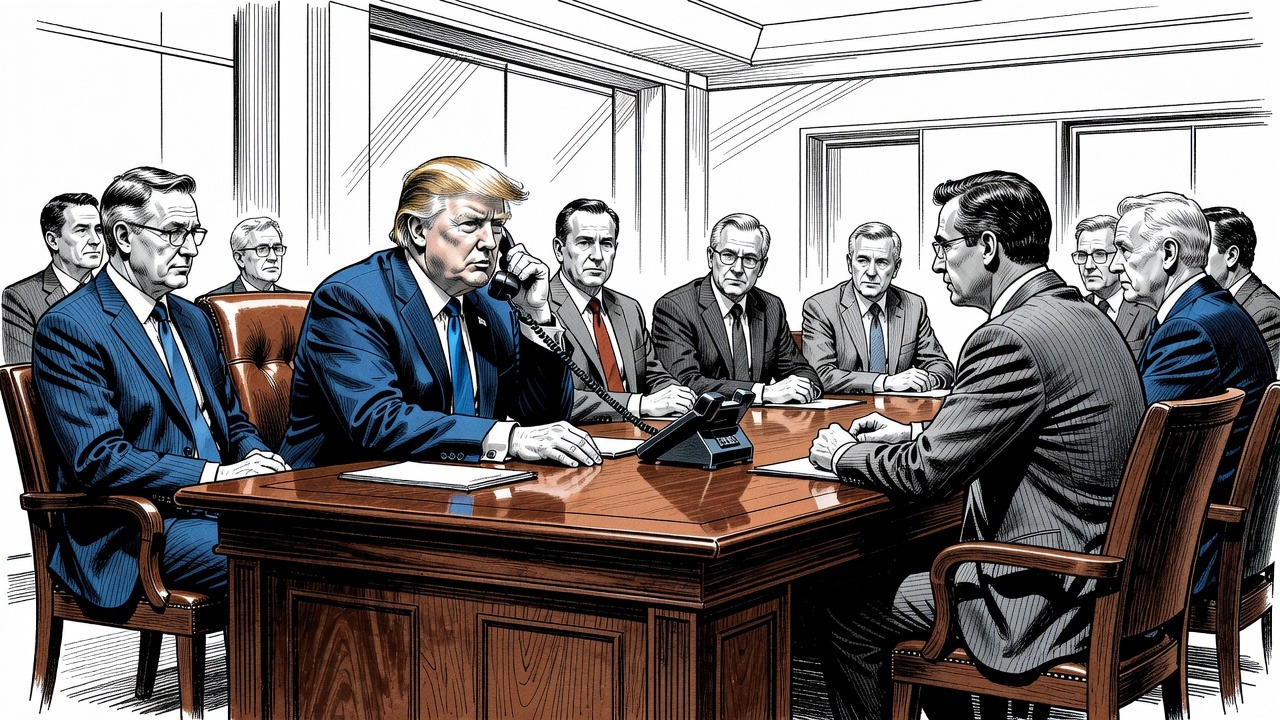
Look at who is in the room. Donald Trump, Vladimir Putin and Xi Jinping, three leaders talking on Chinese soil, with Japan's prime minister waiting for a phone call afterward. The announced participants are three. Everyone else gets briefed.
I'm not squeamish about talking to adversaries. Nixon went to Beijing. Reagan sat down with Gorbachev. Diplomacy with people you despise is how wars end, and Democrats who reflexively treat any meeting with Putin as treason are making a mistake. The question is never whether to talk. It is what you bring, what you trade, and who gets consulted before the trade is made.
On those questions, Trump's record is a warning. He has treated Putin as a counterpart to be charmed rather than a rival to be pressured. The Alaska summit last year was lavish in ceremony and thin in result. Putin is subject to an International Criminal Court warrant over the deportation of Ukrainian children, and he has still been rewarded with red carpets and photo ops. Each meeting hands Moscow what it craves most, which is proof that Russia is a great power whose crimes are negotiable. Trump says he expects "positive results." He has said that before, and Putin has never paid for disappointing him.
The summit arrangement itself is revealing. America's allies are sidelined and its adversaries are courted, and the setting is Xi's showcase city. Japan, whose security depends on how these three men settle their differences, is reduced to scheduling a call after the fact. That is not strength. It is a president who prefers a room of fellow strongmen to the dull, binding work of alliances.
Then there is the same trip's other headline. Trump told the summit his administration will oppose regulations that could restrict AI industry growth, while allowing that risks need "careful management." That phrase does almost no work. It is what you say when you have decided in advance that the industry's interests come first and the public's safety is a footnote.
The two stories are one story. In both, enormous power is being arranged at the top, among a few men, with the public as an afterthought. Great-power bargains are struck without allies or Congress. The rules for a technology that will reshape work, speech, surveillance and warfare are being waived at the urging of the companies that profit from it. Nobody voted for either arrangement, and nobody who bears the risk gets a seat.
The usual defense of AI deregulation is that we are racing China. Fine. But Trump flew to China, sat with its leader, and announced we will hold our own companies to almost no limits. If the race is real, winning it requires chips, research, energy and a workforce that isn't being displaced without a plan. It does not require a promise that no one will ever be accountable when a system fails, discriminates or is turned against its users. Washington doesn't lead by deregulating. It leads by writing the rules other democracies adopt.
Democrats should resist the lazy response here, which is to shriek about the meeting. The better answer is to demand terms. What is Washington offering Russia, and what is it getting? Will Ukraine's fate be decided by anyone Ukraine can't veto? Will Congress see any commitment before it's announced? And who exactly in the AI industry asked for this speech, and what do they want in return?
A president can meet anyone. But a democracy is entitled to ask, loudly and in advance, whom he is really working for when he does.