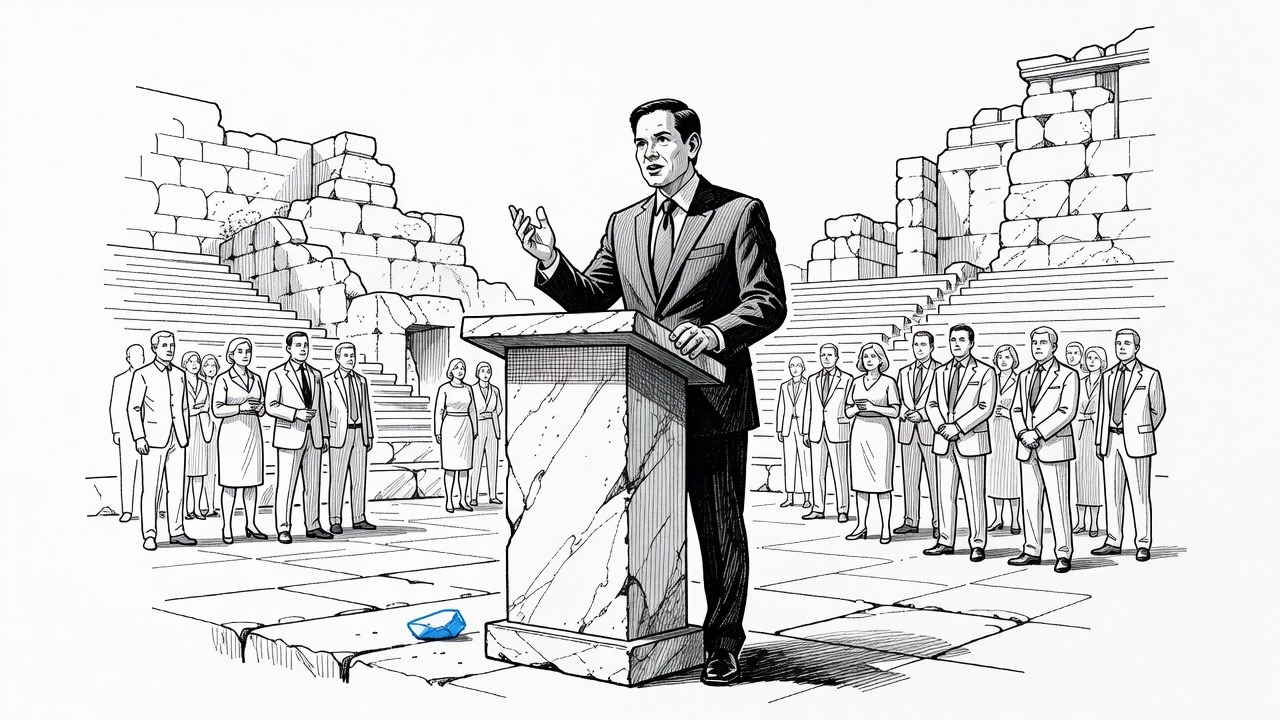
Marco Rubio chose his stage well. The Pnyx is the rocky hillside where Athenian citizens gathered to argue, vote, and sometimes regret their votes. It was where ordinary people, in theory, held power over generals and aristocrats. Rubio stood there and delivered a speech about national strength, secure supply chains, borders, and sovereignty. He invoked democracy as an inheritance to be defended rather than a practice to be exercised.
That contrast is the story. Democracy, in Rubio's telling, is a heritage, something the West possesses like a cathedral or a flag. In Athens it was a method: the many deciding, publicly and contentiously, how the community's resources would be spent and whose sons would die. A speech that treats the West's civilization as a brand to protect, rather than a distribution of power to deepen, tells you what kind of alliance is being imagined.
To be fair, parts of the agenda deserve a serious hearing. Europe long free-rode on American security, and Russia's war in Ukraine made that indefensible. The pandemic showed how dangerous brittle supply chains can be, and a world in which one rival dominates critical manufacturing is not a safe one. Progressives should not retreat into a reflex that treats every industrial or defense priority as militarism. The left, after all, has argued for decades that markets will not rebuild productive capacity on their own and that the state must direct investment. On that point Rubio is borrowing from our playbook.
But industrial policy is a means, and the political question is who it serves. "Rebuild domestic industries" can mean good union jobs in regions gutted by offshoring, with public money coming with strings: wage standards, bargaining rights, equity stakes, and limits on buybacks. It can also mean a subsidy conveyor belt to firms that privatize the gains and socialize the risk. Defense is the sharper case. Few sectors are as dependent on public money and as concentrated in a handful of contractors. When governments announce they will spend more, the first and surest beneficiaries are the companies selling the weapons, not the communities told to feel safer. Nothing in the speech as reported says who will own, govern, or profit from the buildup. That omission is where the politics hides.
Then there is the tradeoff nobody on a hillside with a view of the Acropolis wants to name. Every euro or dollar committed to defense is a euro or dollar not committed to housing, health care, childcare, or the energy transition. Greece knows this better than most. It was pushed through brutal austerity after the debt crisis, when creditor governments insisted that public goods yield to fiscal discipline. It now spends heavily on defense relative to its economy. Europe is entering a period in which security spending is treated as sacred while social spending is treated as discretionary. If that becomes the pattern, the people who pay will be the ones with the least say in the matter, which would make a bitter irony of a speech delivered at the birthplace of popular sovereignty.
Finally, the phrase "shared history and culture" as the foundation of the transatlantic alliance deserves scrutiny. Alliances built on interests and commitments can be negotiated, renewed, and held accountable. Alliances built on civilizational kinship tend to define themselves by who is outside. Pairing that language with an emphasis on borders and national sovereignty suggests a West defined less by universal principles, such as rights, rule of law, and equal citizenship, than by lineage. Ancient Athens is an uncomfortable model for that. Its democracy excluded women, enslaved people, and foreigners, and the city ran an imperial league that extracted tribute from allies. The Athenian lesson is not that strength secures democracy. It is that a democracy that defines its citizens narrowly and its security expansively can hollow itself out.
A decade of decision, as Rubio put it, may indeed be coming. But decisions made at that scale should be made in public, with workers, taxpayers, and legislatures at the table, not announced from a scenic podium as destiny. The Athenians at least had to show up and vote.
How it may affect me
For ordinary people, the practical stakes are about who gets the benefits and who gets the bill. If reindustrialization comes with real labor standards, public stakes, and local hiring, it could rebuild stable jobs in hollowed-out regions. Without those conditions, it risks becoming corporate subsidy, with the largest gains going to defense and technology firms. Higher military budgets on both sides of the Atlantic may squeeze housing, health, education, and climate spending, and past austerity in Greece and elsewhere suggests the squeeze falls hardest on those with the least political leverage. An alliance framed around culture and borders could also deepen suspicion of immigrants and minorities, with consequences for rights and everyday security. The key test is whether workers and legislatures are given a real say in setting these priorities, or whether urgency is used to shut debate down.