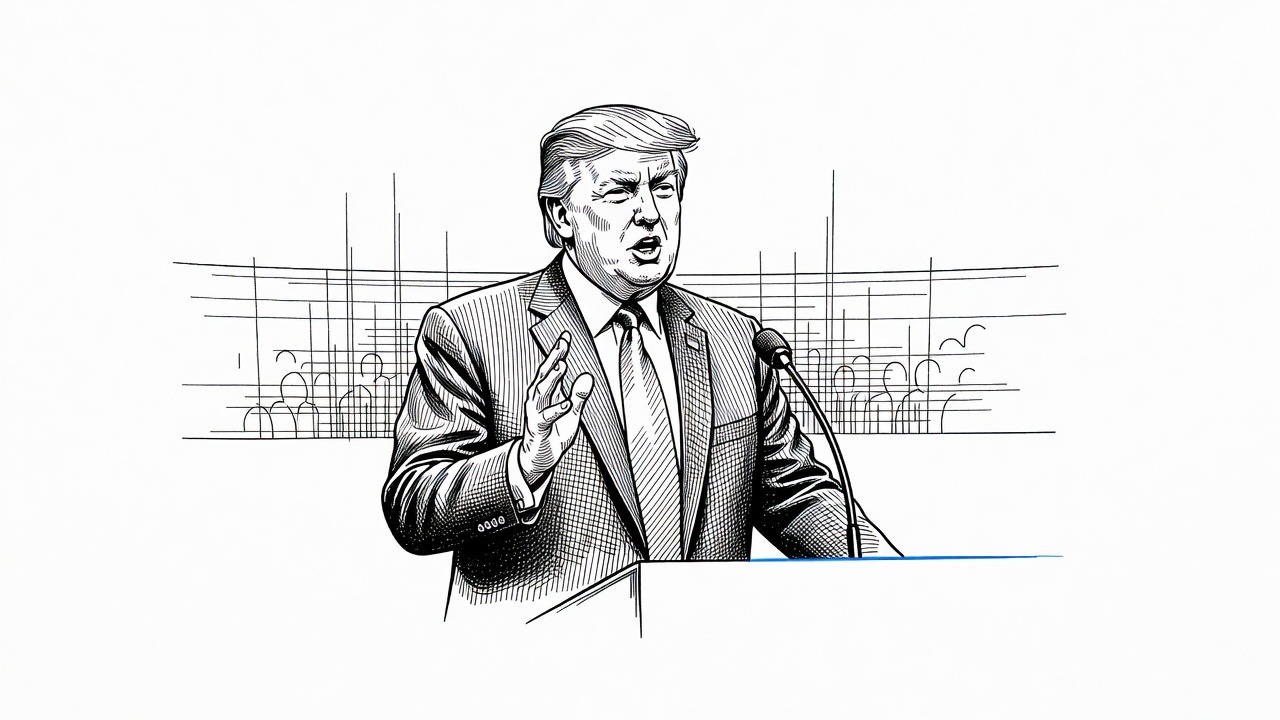
Every president says things at rallies that sound worse in print than they did in the room. Before getting indignant, give Donald Trump the most generous reading available. Perhaps he was gesturing at Iran's capabilities, or making a point about deterrence, or just riffing for a crowd in Nebraska. We have only accounts of his remarks, not a full transcript, and a fair columnist should say so. But even on the kindest reading, the sentence is revealing, and what it reveals matters more than the gaffe.
Consider the grammar. Iran could "take out" Los Angeles and San Diego. The verb is the language of video games and board games. The objects are two of the largest cities in the country, home to millions of people: nurses, dockworkers, line cooks, Navy families, schoolchildren, and the immigrants who keep both economies running. In a rally riff they become pieces on a map. The speaker gets applause, and the people in the pieces get only the risk.
That asymmetry is the real story. In any war, the people who decide, the people who talk, and the people who pay are rarely the same. A president can say something dramatic about a hypothetical attack at no cost to himself. A San Diegan, whose city hosts a major military presence, lives with the fact that rhetoric about confrontation is never abstract at home. Mayor Todd Gloria's line that his city is not expendable is more than a political retort. It names the moral problem with casual war talk: it treats some Americans as acceptable collateral in an argument about someone else's behavior.
The venue sharpens the point. Saying this in Nebraska about California cities invites an audience to contemplate danger as something happening elsewhere, to other people, in places they may not like. I can't know that was the intent, and the facts don't establish it. But a president's job, as Mayor Karen Bass put it, is to protect the country, all of it, including the parts that didn't vote for him. A leader who speaks about threats to American cities in the tone of a spectator has put his audience's feelings ahead of his constituents' safety.
Progressives shouldn't get comfortable, though. Newsom's "deranged and dangerous" is good copy, and he knows it; a national-profile governor attacking Trump is not a heroic act in 2025 or any other year. Outrage on X is cheap, and the same goes for the president's remarks. The harder questions are institutional. If Democrats believe talk of war with Iran is reckless, where is the push for Congress to reclaim its constitutional authority over war, which has been surrendered to presidents of both parties for decades? And if they believe these cities are vulnerable, what are state and local governments doing, and what are they demanding from Washington, on emergency preparedness, public health capacity, and infrastructure resilience? Defending a city's dignity with a post is easy. Defending it with budgets and votes is the actual job.
The larger lesson is about how a political culture becomes numb to the scale of what it discusses. When leaders can toss off the destruction of major cities as a talking point, and the response is a news cycle of dueling statements, we have normalized something that should still be shocking: the idea that war is a performance. A country that takes seriously the lives at stake would insist that its leaders speak about them with gravity, and that those who send Americans into harm's way, or provoke harm to come to them, have to answer in a forum more binding than a rally or a tweet.
How it may affect me
For ordinary people in Los Angeles and San Diego, the immediate effect is mostly psychological: being told, in passing, that your home could be a target and that the person in charge is discussing it as applause material. That can deepen anxiety and distrust, especially for military families, immigrants, and anyone who already feels that Washington regards their region as an adversary rather than part of the country.
The longer-term stakes are practical. Loose talk about confrontation with Iran may raise tensions in ways that fall hardest on people with the least say, including service members and residents of cities with significant military or economic importance. It also shifts attention from the things that actually protect people: emergency planning, public health capacity, resilient infrastructure, and clear congressional oversight of any move toward war. If the response stays at the level of social media sparring, residents get heat but no added security. The test for officials in both parties is whether they convert outrage into votes, funding, and accountability, because that, rather than the rhetoric, determines how safe and how represented the people of these cities are.