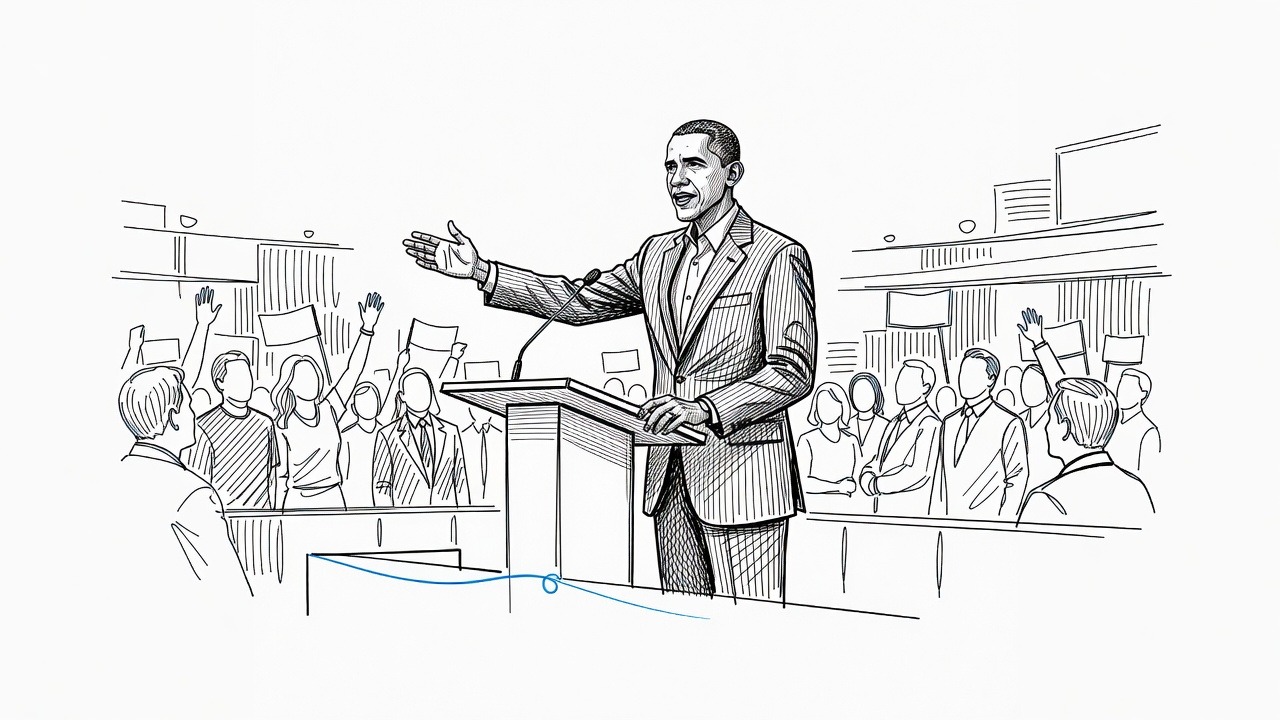
The easy reading of this story is nostalgia: a popular ex-president comes home to the party's most reliable big city and says nice things about the nominees. The date on the calendar suggests something more revealing. Obama is scheduled to appear on the first day of Michigan's early in-person voting, which means the rally is less a persuasion event than a recruitment drive for voters who have to be physically moved from enthusiasm to the ballot box. In Detroit, that has long been the hard part.
Democrats do not win Michigan by changing minds in Detroit. They win it by making sure that a working-class, majority-Black city, which has been told for decades that its interests matter, believes the claim enough to show up. Detroit has absorbed deindustrialization, bankruptcy, and a long record of public promises. Voters there are not irrational for asking what a vote buys them. A rally cannot answer that, but a nominee's agenda can. That is why the pairing on stage is interesting. Abdul El-Sayed, a physician and former Detroit health director, comes from the party's insurgent, economically populist wing. Jocelyn Benson is a statewide official from its institutional wing. Obama, a symbol of the party's last unifying era, stands between them.
That tableau shows what Democrats are trying to prove. Their coalition has often looked like a loose arrangement of constituencies held together by fear of the other side. Fear is a weak organizing principle, and it is weakest among people who feel little changes under either party. The stronger case is material. Voters should hear what a Senate seat and a governorship could do about health costs, wages, housing, and the quality of public services. The party's stars can't carry that message alone. If the rally is only an Obama highlight reel, it will fall short of the moment.
A skeptic would say the party leans on a former president because it lacks a current figure with comparable drawing power, and that celebrity does not turn out voters. There is truth in both points. Dependence on one beloved face is a sign of thin bench strength, and the other Obama activity, the Texas events, the Iowa ad, and the DSCC fundraiser, suggests he is being asked to cover a lot of ground. The fundraiser also reminds us that the same party that invokes ordinary voters runs on a money machine in which donors in the Washington area help decide which races get resources. A progressive should notice that tension, not excuse it.
Still, the rally's logistics point to the right lesson. Michigan's early voting period exists because voters in 2022 approved it, and it works only if parties treat it as a field operation and not a photo op. The Obama appearance will be worth something if it is attached to canvassing, rides, and a clear economic message for people who may feel they have heard the pitch before. Democrats should not mistake a warm crowd for a won election. A good measure of this event will be what happens in the ten days after it, in neighborhoods where nobody holds a microphone.
How it may affect me
For Detroit residents, the practical question is whether the rally leads to real access to voting or only to a day of attention. Early in-person voting helps people who cannot easily take time off on a single Tuesday, including shift workers, caregivers, and those without reliable transportation, so a strong turnout push could widen participation among exactly those voters. For Michigan more broadly, the outcome of the Senate and governor's races will shape health policy, labor rules, school and infrastructure funding, and the state's economic priorities. If the party leans mostly on celebrity and big-donor fundraising, it risks repeating a pattern in which working-class voters are courted for their votes but not clearly offered anything in return. If it pairs the spectacle with concrete commitments and sustained organizing, the payoff could be a more engaged electorate and a stronger claim on the policies that follow.