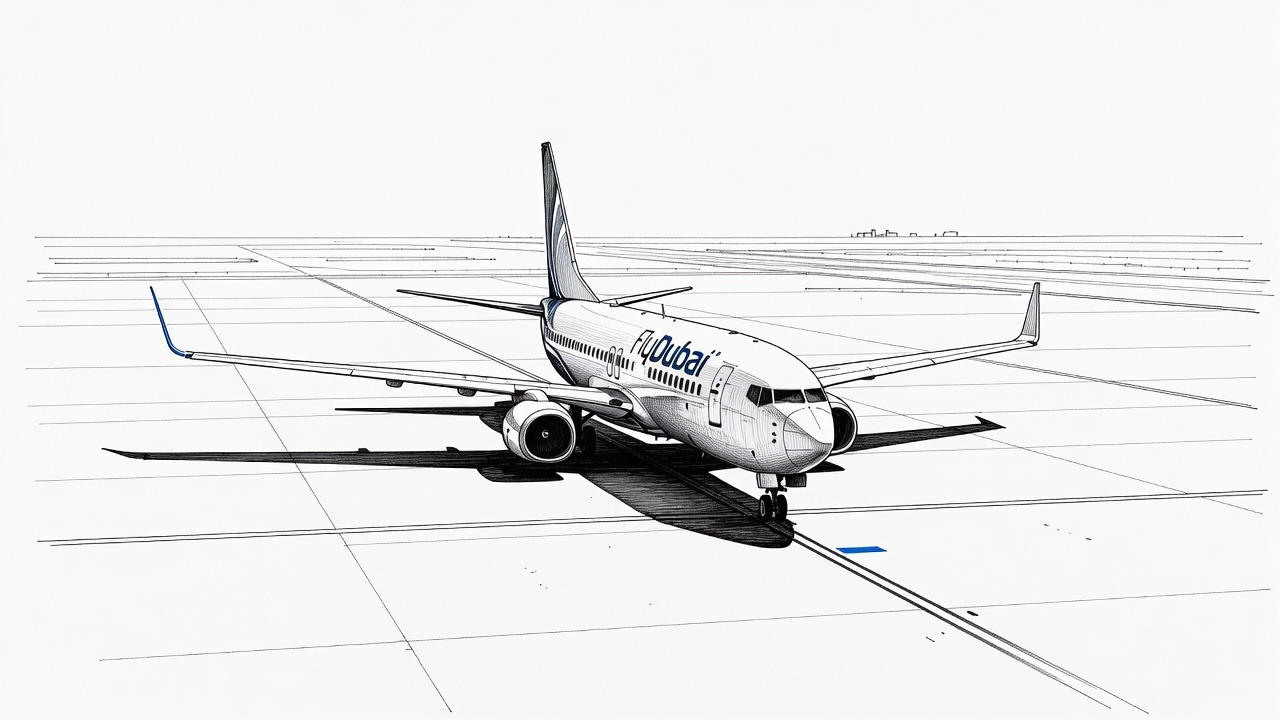
Captain Smit Machchhar did the one thing two decades of aviation security were designed to make unnecessary. He unlocked the cockpit door.
He unlocked it, on the accounts now public, because the FlyDubai Boeing 737 he was flying from the United Arab Emirates to Tel Aviv had already been turned into an emergency by the man in the other seat. The Omani co-pilot attacked him. The aircraft entered a steep dive. Only after the captain opened the door could passengers enter and help restrain the co-pilot. The flight diverted to Tabuk, in Saudi Arabia, where the captain received medical treatment. UAE officials have called the incident a terrorist act. Benjamin Netanyahu says investigators are examining the co-pilot's motives and any possible link to Iran.
Hold those last two sentences at the distance they deserve. They open an inquiry; they do not close one. What does not require a completed dossier is the failure already visible in the sequence.
Since the attacks of September 11, commercial aviation has been rebuilt around a single picture of the enemy: he is in the cabin, he wants the flight deck, and a reinforced, locked door is what stands between a hijacking and a disrupted afternoon. The picture was not foolish. It was incomplete. A locked door is a wall, and walls do not know which side the danger is on. Germanwings, in 2015, showed what happens when a co-pilot is the danger and the door does its job too well. This flight, if the captain's account holds, showed the neighboring failure. The architecture that keeps passengers out also keeps them from the only intervention that matters once the fight is already between the two people qualified to fly the airplane. Protocol did not save that cabin. A decision did. The captain broke the seal. Passengers went forward and helped restrain the man who had attacked him. The airplane reached a runway.
That is a harder lesson than the one the coverage is primed to file, which is a lesson about villains. Villains may yet be named. If a foreign service or an ideological network had a hand in this, the public is owed that finding without varnish. Iran has made no secret of its hostility to Arab-Israeli normalization, and the ordinary commercial links that normalization produced, including flights into Tel Aviv, are part of what that hostility is aimed at. Investigators would be negligent if they did not ask whether this assault belongs to that campaign. They would be just as negligent if they treated the question as the answer, or treated an Omani passport as a motive. Nationality is not evidence. A steep dive is.
The point worth keeping is where safety actually lives. We have tried to make it a product of concentrated expertise: regulators, watch lists, door manufacturers, airline compliance offices. Some of that work is the legitimate business of government, which does not have to be weak in order to be limited. Vetting the people who sit in the right-hand seat, medically, psychologically, ideologically, and financially, is a core public function, and on routes that politics has turned into targets it is a security function. An airline that would rather not ask uncomfortable questions of crew, because the questions are bad for recruitment or for diplomacy, is not practicing tolerance. It is transferring risk to passengers who cannot see the cockpit and were assured they would never need to.
The landing at Tabuk is a rebuke to the further fantasy that the function can be fully delegated. When the checklist failed, order was restored by individual nerve: a captain clear-headed enough, while under attack, to open a door the system exists to keep shut, and passengers willing to take on a danger the safety briefing had assigned to someone else. It is not a small additional fact that the runway was in Saudi Arabia, a state still formally outside the normalization this flight represents. Geography and necessity outran the unfinished politics. That is the region as it is, not as the communiques describe it, and it is the same region in which a commercial schedule can become a battlefield without anyone in the cabin having voted for the war.
Social order is not the opposite of individual agency. In the minute that matters, it is made of it. A public taught to freeze until an institution arrives will eventually meet a crisis in which the institution is on the wrong side of a locked door, and losing.
There is a stake beyond this airplane. Flights from the Gulf to Israel are among the few pieces of regional normalization an ordinary person can actually board. They are markets doing quietly what summits announce: moving customers, families, and goods across a political fault. That is worth defending because it is mundane, and it is vulnerable for the same reason. It will not survive if the right-hand seat is treated as a staffing slot rather than a trusted position with the power to kill everyone aboard in seconds. It will not survive a politics that needs the story to be about Iran before the evidence is in, or a politics that refuses the plain character of an in-flight assault if a convenient manifesto fails to appear. Institutions stay legitimate by following the facts past the narrative they prefer. The people on the next flight are entitled to both the investigation and a security culture that has stopped pretending the only threat worth designing for is the one that begins in the cabin.
How it may affect me
The practical meaning, for anyone who flies, is that the safety attached to a ticket still rests on two things no boarding announcement mentions: whether the people already inside the cockpit can be trusted, and whether someone will act if they cannot.
The immediate effects are not theoretical. The passengers on this FlyDubai flight did not land in Tel Aviv. They landed in Tabuk, after a steep dive and a violent confrontation in the space that was supposed to be sealed for their protection. The captain required medical treatment. Families at both ends of a route sold as ordinary commerce were reminded that ordinary is not the same as uncontested. A normalized flight is still a flight someone may regard as a political fact.
What travelers feel next depends on which lesson the airlines and the governments take. If they take the serious one, the change will show up as friction that actually tracks the risk: harder screening of crews on politically exposed routes, medical and psychological oversight with consequences, and a willingness to keep a pilot on the ground when the answers are incomplete. That costs money, time, and in some cases careers. It is still the cheaper purchase. Insurers and regulators notice insider failures, and markets eventually reprice them. Passengers pay either in the fare or, if the lesson is skipped, in something much worse.
If the lesson taken is theatrical, another statement, another locked door, another assumption that danger arrives from the cabin, then the traveler is worse off than before. The visible machinery of security will keep advertising a protection it did not provide on this flight. A passenger cannot vet the co-pilot, cannot see the struggle, and cannot open the door. His safety is almost entirely institutional until the moment it is not. This incident suggests that moment still falls to whoever is near enough, and steady enough, to move.
A free society should not build its plans on heroism. It also should not tell citizens that heroism has been regulated out of the job. The everyday implication is plainer than the headlines about Iran, and more demanding. Before you board, the airline and the states that certify its crews owe you competence of a kind that assumes the threat may already have a uniform. If that competence fails, the strangers in the cabin may be the last institution left. Both obligations belong to an order worth keeping. Neither is kept by filing a near-catastrophe as a diversion with geopolitical rumors attached.