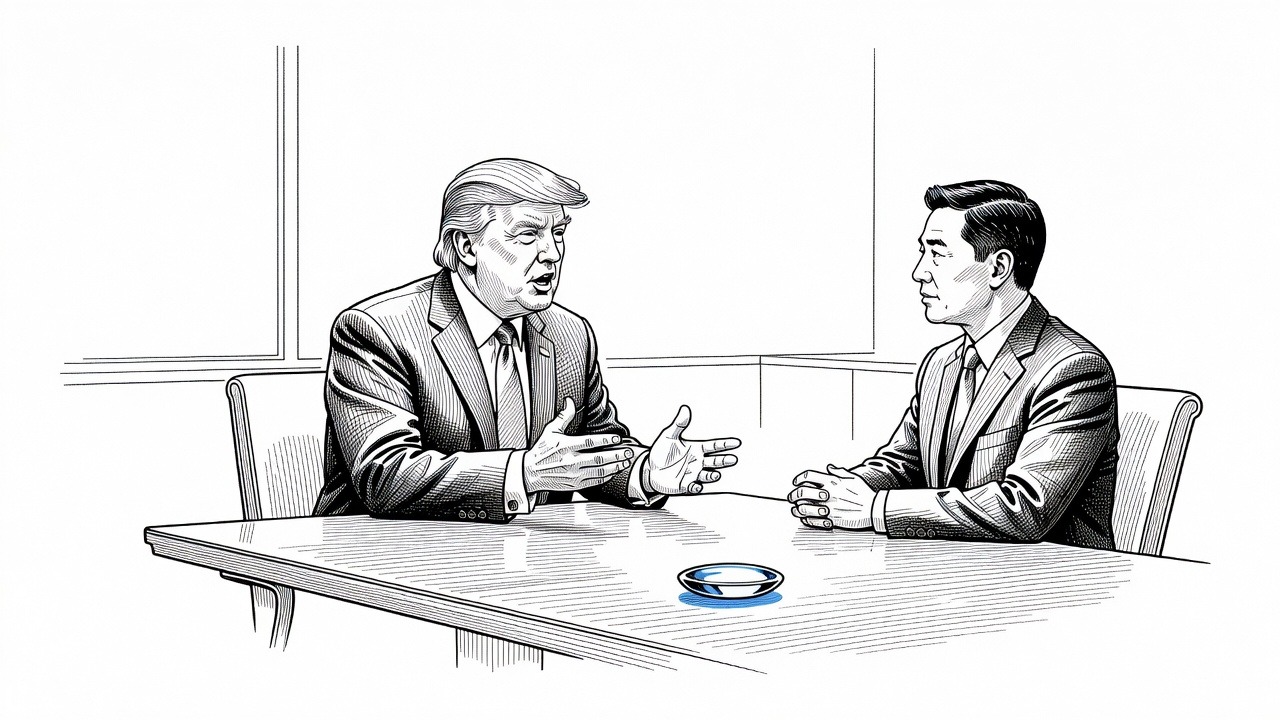
Donald Trump says China will buy 250 more Boeing airplanes. That follows a preliminary 200-plane deal from his Beijing trip, and talk of an eventual 750. Notice what is missing from all of these numbers: a signed order, a delivery schedule, a price. Three figures, no contracts. That is a sales pitch, not trade policy.
The most important context is one the president would rather skip. Boeing's China business did not collapse on its own. China ordered airlines to stop taking Boeing deliveries in the spring of 2025, as the tariff war escalated. Beijing used the planes as a weapon because Trump had handed it one. So the pattern is: start a trade fight, watch the exporters take the hit, then return months later and celebrate the reopening of the market you shut. A man who sets fire to the barn doesn't get a medal for bringing a bucket.
We also have a track record. After the 2020 Phase One deal, China fell well short of its purchase commitments, by most analyses buying only about 58 percent of what it had pledged. Promised soybeans never arrived at promised volumes either, and American farmers ate the losses from the tariffs while waiting for the windfall. Beijing makes large purchase pledges when it is useful and honors them when it is convenient. Treating headline numbers as accomplishments is how you get played by a government that is far more patient than ours.
Then there is the question the Left should press hardest: what is being paid for these planes? China doesn't hand out a quarter-thousand-aircraft order as a gift. Every concession on export controls, technology or tariffs is a trade-off, and this administration negotiates in public theater and private favors. Congress and the public deserve to know whether Boeing's order book is being bought with something larger.
And Boeing is an odd corporation to build a diplomatic triumph around. This is the company whose 737 MAX killed 346 people in two crashes. It is the company whose door plug blew out of a fuselage in 2024, whose machinists had to strike for a fair contract, and whose criminal fraud case the Trump Justice Department agreed to drop. When a firm that profited from cutting corners on safety gets accountability waived at home and a political showcase abroad, that is not industrial policy. It is a bailout by other means, and the message to every other executive is that being big and politically useful beats being careful.
I want Boeing's workers to have steady, well-paid jobs. The Machinists in Washington and the suppliers across the country are not villains, and a real order book matters to them. But a real industrial strategy would mean enforceable contracts, safety oversight with teeth, and a stable trade relationship that doesn't whipsaw suppliers every time the president wakes up angry. Workers don't need a number floated from a podium. They need orders that clear, planes that fly safely, and a government that can't be bought off with a headline.
Democrats shouldn't just sneer at the figure. Ask for the paperwork. Ask what Beijing got. Ask why the same White House that broke this market is so eager to be thanked for patching it. If the orders materialize, fine, but count the planes when they are delivered, not when they are announced.