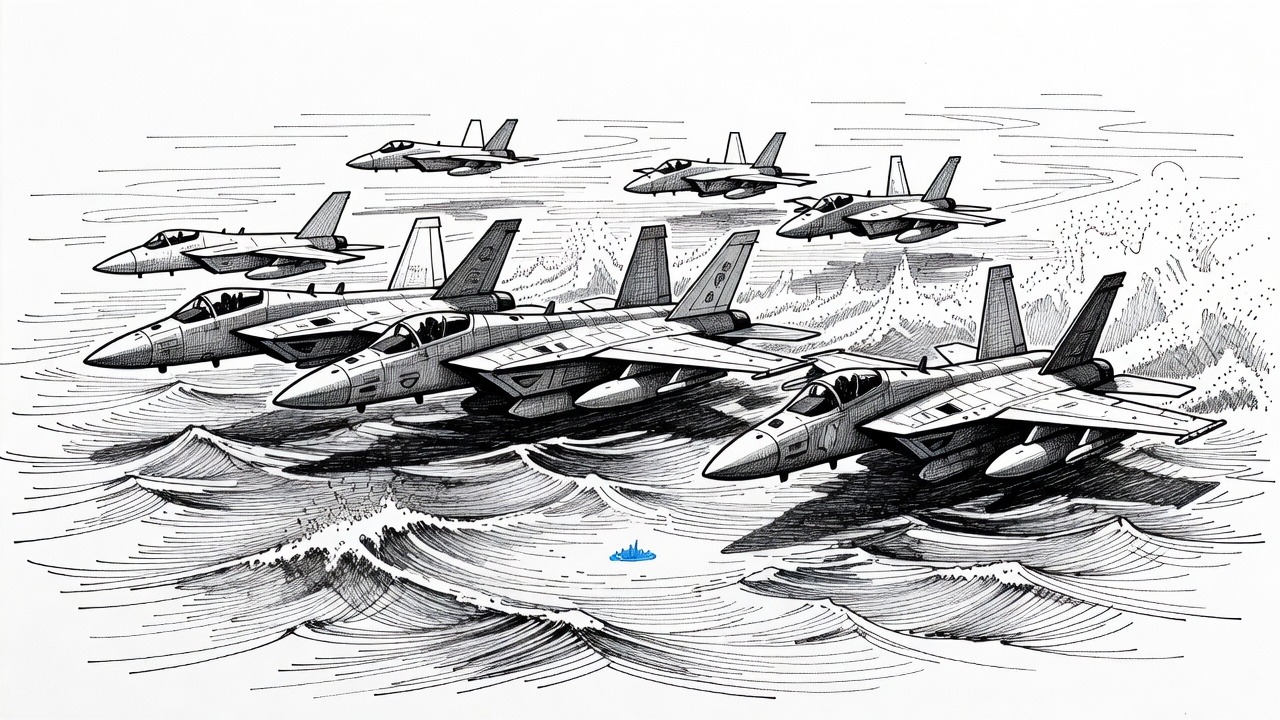
The Russian aircraft did what they have done many times before: they flew into South Korea's air defense identification zone, stayed outside its territorial airspace, and left. The part that went wrong was Seoul's own warning system.
Authorities told the residents of Ulleung Island that foreign aircraft had violated their territorial airspace. That was false. A separate local alert blamed suspected North Korean aircraft. That was also false. Both were withdrawn, but a withdrawal does not undo what people felt when a government told them an attack might be underway. In a country whose citizens grow up with civil defense drills and a neighbor that threatens to turn Seoul into a sea of fire, that message is not a typo. It is fear sent straight to people's phones.
The Korean Joint Chiefs handled the military side with the restraint the situation called for. They tracked the planes, flew jets to deter accidents, and made clear that no sovereign line had been crossed. The adults in uniform treated a routine provocation as a routine provocation. The civilian alert chain did the opposite and escalated a non-event into a perceived emergency. Anyone who thinks national security is mainly about hardware should consider that a defense system citizens cannot trust is a weaker one. Alerts that cry wolf teach people to ignore the next one, and the next one may be real.
The ADIZ also deserves plain explanation, because it is routinely misdescribed. It is not sovereign territory. It is a self-declared buffer where states ask for identification, and Russia and China treat it as an opportunity to signal, not as a boundary they must respect. These flights are meant to rattle Seoul and to remind it that Moscow and Beijing can show up near its coast whenever they like. The right response is to show nerve, not to panic.
None of this makes the context benign. Russia and North Korea have formalized a military partnership, with Pyongyang supplying Moscow's war in Ukraine and, by most Western and South Korean accounts, expecting something valuable in return. A Russia that owes Kim Jong Un favors is a more dangerous neighbor. I have no patience for a Left that waves this away, or that treats every warning about Moscow as a pretext for hawkish theater. Peninsular security is real.
But the Korean Left's long-standing insight is that real danger calls for disciplined, credible statecraft, not reflexive escalation. That means steady military communication channels so a mistaken intercept does not become an incident. It means diplomacy with Beijing and Moscow that does not depend on Washington's mood. It means pressing the North on whether its arms-for-technology deal leads somewhere worse. And it means a warning system run by people who check before they send.
The islanders of Ulleung are not abstractions in a great-power game. They are fishermen, shopkeepers and retirees who were told, wrongly, to be ready to flee. Their government owes them an explanation of how two separate alerts went out wrong and what has changed to prevent a third. A government that cannot answer that has no business asking citizens for trust in a real crisis.