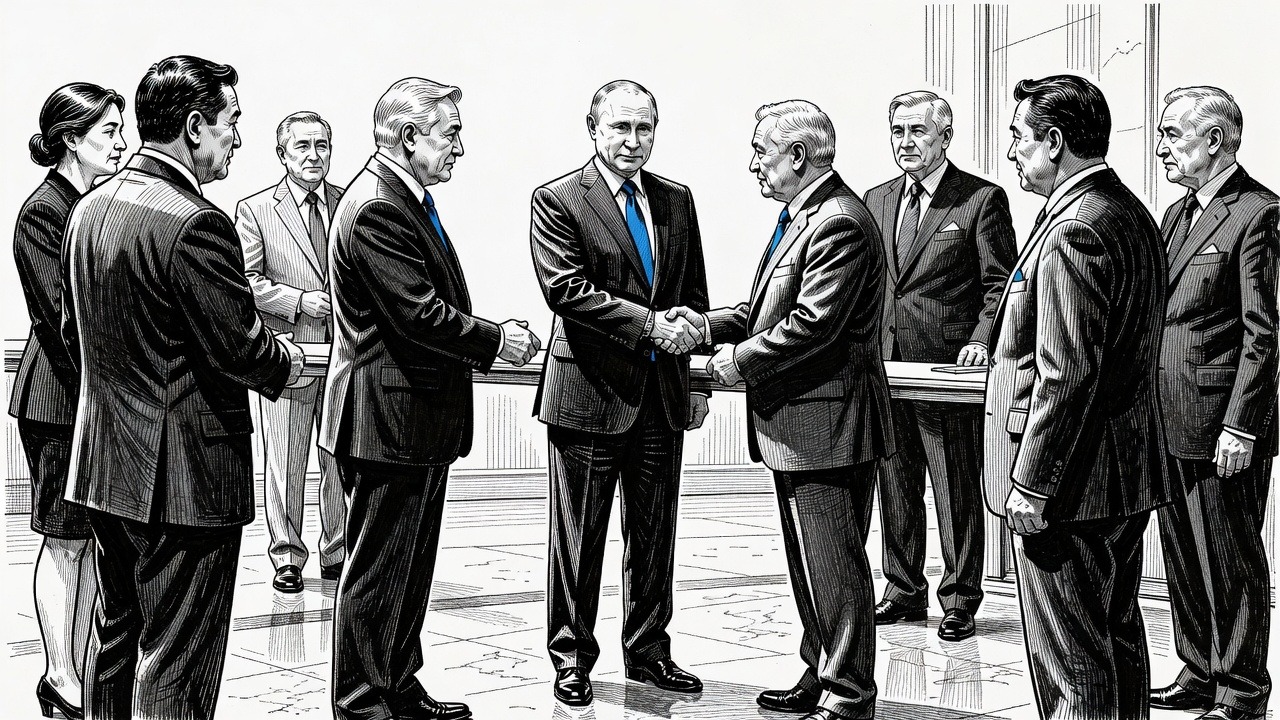
Emomali Rahmon has ruled Tajikistan since 1992. He has jailed opposition leaders, crushed independent media, and is arranging for his son to inherit the presidency. This is not a man discovering a principled objection to the politicization of international law. He is a client paying his patron, and the patron is wanted for taking children.
Say that first, because it is the point. The warrant against Vladimir Putin concerns the unlawful transfer of Ukrainian children to Russia. Moscow calls it evacuation. But children moved across a border by an occupying power, many reportedly placed with Russian families or institutions, are exactly the kind of case an international court exists for. Nobody in Dushanbe is weeping for the principle of sovereign equality. Tajikistan hosted Putin while still bound by the Rome Statute, and the withdrawal doesn't take effect until November 2027. Its obligation to arrest him didn't pause for the paperwork.
But the Left shouldn't stop at denunciation, because that would be the comfortable version of this story. Rahmon's deputy foreign minister says the Court has become a tool of political pressure. It is a self-serving line from a dictatorship. It is also a line that Western governments have spent the last two years making credible.
When the Court issued warrants for Benjamin Netanyahu and his former defense minister over Gaza, the response in much of the West was not 'enforce the law.' It was outrage at the Court. Washington sanctioned ICC officials. Hungary rolled out a red carpet for Netanyahu and then announced it was leaving the Court. European governments that demanded Putin's arrest hedged and fretted about whether they'd really comply with the other warrant. Hungary's exit, along with Sahel juntas heading for the door, makes Tajikistan's move part of a pattern, not an outlier.
Power has always bent justice. What is new is how openly the democratic world has said it believes in accountability for rivals and immunity for friends. Autocrats noticed. 'Selective justice' is a lie when Rahmon says it, because his real motive is protecting a patron and himself. But he didn't invent the material. Western leaders handed it to him.
The Court has real flaws. Its record has been thin, its prosecutor has faced serious misconduct allegations, and it has no police force. It depends entirely on states choosing to act. That is exactly why consistency matters. A court with no enforcement power has only moral authority, and moral authority drains away the moment powerful countries treat it as a weapon to be wielded against enemies and shielded from allies.
So here is the Left's case. Defend the Court against the Rahmons of the world, and defend it equally against the officials in Washington, Budapest and elsewhere who want the warrants applied only where convenient. Ukrainian families searching for children taken across a border and Palestinian families under bombardment are not competing for a scarce supply of justice. Both have a claim on the same principle, and that principle dies if it only works against Moscow's friends.
The EU reportedly pressured Dushanbe to detain Putin, and an analyst says that backfired. Perhaps. But a state that cares about the law doesn't respond to a request to uphold it by quitting. Tajikistan has told us what it is. The harder question is whether the democracies that claim to defend the rules-based order will show they mean it, even when the defendant is a friend.