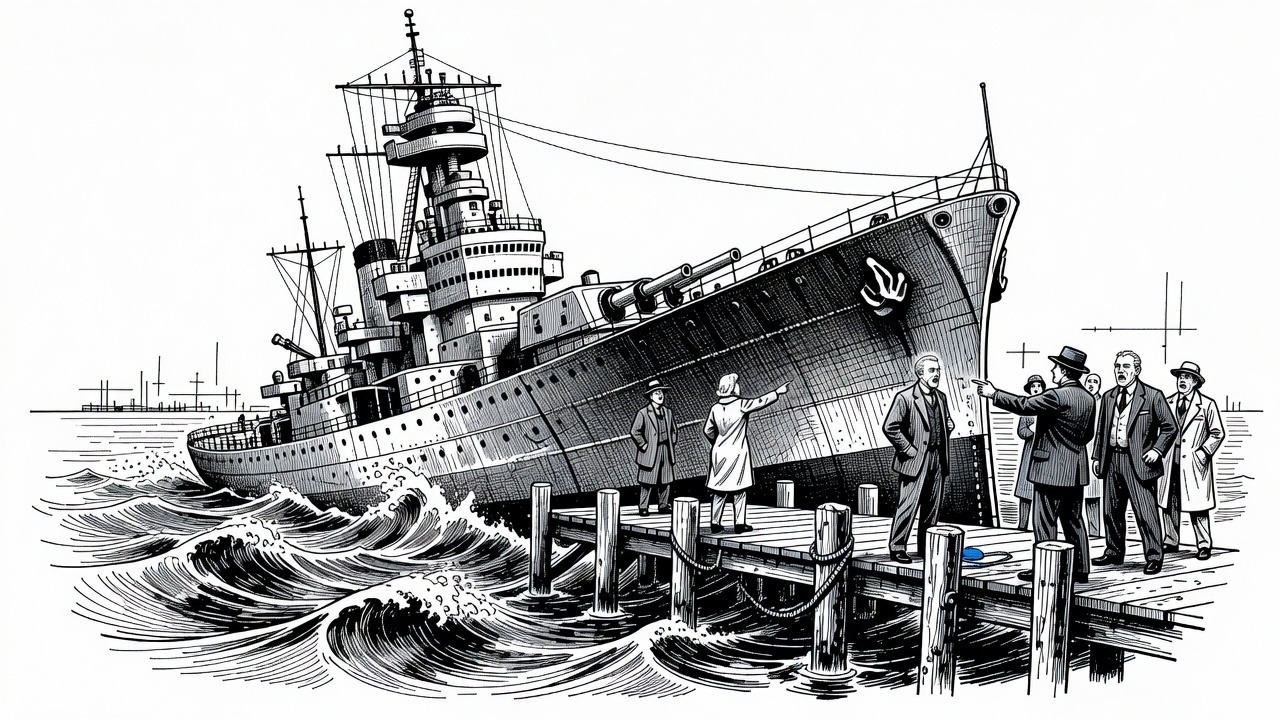
A government that says its enclave is perfectly fine does not spend 47 billion rubles on boats to avoid its neighbors. The two ferries Mikhail Mishustin announced for the Baltiysk–Ust-Luga route are Moscow's admission that Kaliningrad's isolation is permanent, or at least long enough to plan around until 2030.
The ferries will be paid for mostly from the National Wealth Fund, Russia's sovereign savings, built from oil and gas revenue and nominally held for pensions and rainy days. This is the rainy day. The war in Ukraine produced the sanctions regime, the sanctions regime produced Lithuania's tightened transit rules, and now the savings are being converted into steel hulls to sail around the consequences. Those who decided on the war are not the ones who will wait for parcels. Kaliningraders, about a million ordinary people living in a Russian exclave with no land link to the rest of the country, will.
The small detail in the story is the most revealing. Russian Post has moved parcels to sea because of Lithuanian transit conditions. Think about who sends parcels: grandmothers, small online sellers, families sending medicine and winter boots. That is the human scale of geopolitics. Sanctions aimed at a regime land first on mail containers and delivery times for people who had no vote in Moscow's decision. The Left should say so plainly. Sanctions are a legitimate tool against an aggressor, but they are not a moral abstraction, and their costs fall on people. Those who cheer every new restriction should be able to say who pays for it. The EU's own guidance, which allowed non-sanctioned goods to pass, was an acknowledgment of exactly this.
The Kremlin is the author of the predicament, and it bears the first responsibility. It launched a war of aggression and turned Europe's neighbors into adversaries. It then armed Kaliningrad as a military outpost, which is why Lithuania and Poland treat it as a threat rather than a quirk of post-Soviet geography. Moscow wants its citizens to see the enclave as a victim of Western spite. The real story is that a state chose confrontation and then handed the invoice to a Baltic port town.
There is one grim upside, and it deserves a hearing. The Suwałki Gap, the narrow land corridor between Poland and Lithuania, is the scenario defense planners lose sleep over. A Russia less dependent on overland transit through Lithuania has fewer reasons to turn a customs dispute into a crisis. Anyone who has watched escalation logic should want fewer pretexts for it. But no one should confuse that benefit with wisdom. It is a patch on a wound the Kremlin opened.
The rest is the question of priorities that Russian opposition voices, including its trade unionists and the small independent left, have asked for years and been punished for asking. National Wealth Fund liquidity is finite. Russia faces budget strain, a war economy running hot, and regions where roads, hospitals and wages lag. When a state spends its savings on logistics workarounds for a conflict it chose, the bill is paid by a generation of workers who will inherit a thinner safety net.
The lesson isn't that sanctions are free, or that Russia is a martyr. It is that empires create enclaves and then invent fortresses. The ferries will be built, and Kaliningrad's people will be told this is resilience. It is a siege economy, and those living inside it never got a say.