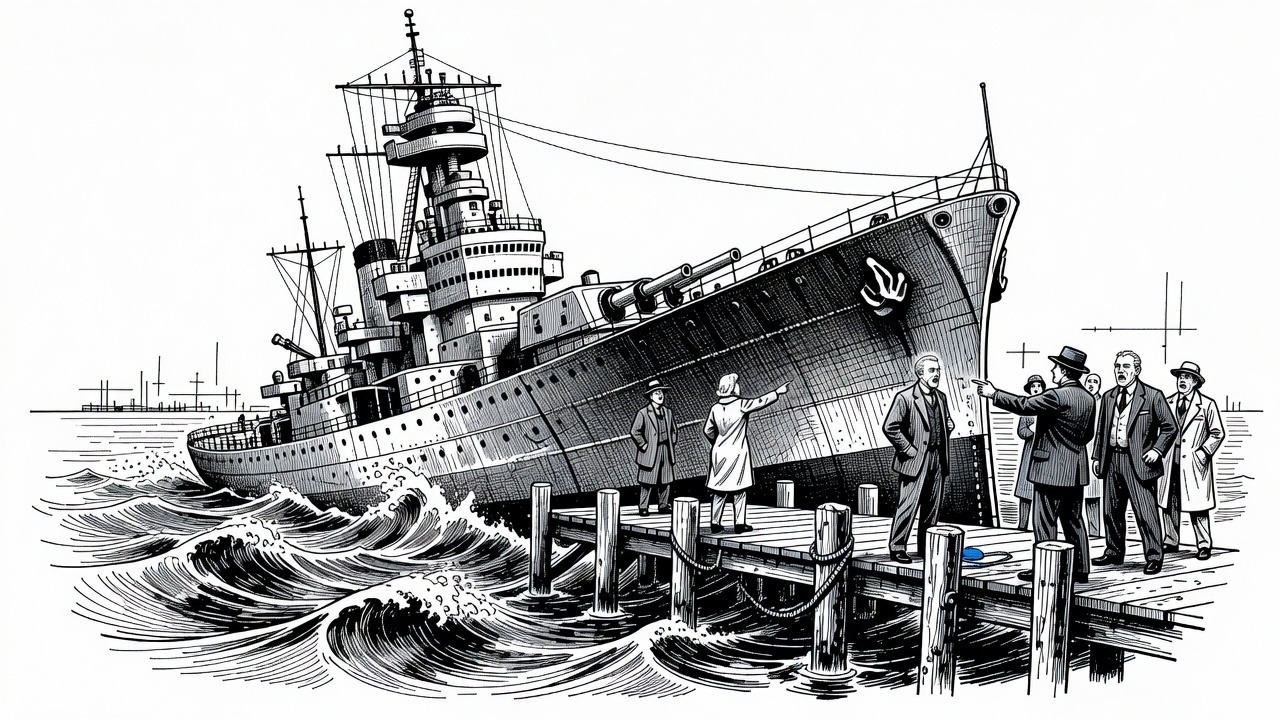
Start with what we don't know. A Russian warship sank in a Libyan harbor, two drone boats are blamed by eastern Libyan officials, and no one has produced public proof of who launched them. That uncertainty is the point. A war that began in Ukrainian wheat fields now reaches a Mediterranean port in a country that has been broken for fourteen years, and nobody who lives there was asked.
The eastern administration says it is not a party to the Russia-Ukraine war. That is a fine sentence, but the dock in Benghazi says otherwise. Khalifa Haftar's camp has long hosted Russian mercenaries and Russian ambitions. After Assad's fall put Russia's Syrian naval foothold in doubt, Moscow wanted a replacement, and eastern Libya was the obvious candidate. A warlord who rents out his coastline to a great power has made himself a target. He did it for the oldest reason: it pays, and it buys protection for his rule.
The usual cheerleading will follow. Hawks will treat a burning Russian ship as a scoreboard entry. I have no tears for Putin's navy, and Ukraine has every right to hit the machinery of an invasion. But a drone boat does not read flags. Within hours, one struck a Maltese-flagged commercial ship, and its crew had to be pulled from the water by Libyan forces. More than twenty drone boats were reportedly intercepted off the coast that evening. That is not a single surgical strike. It is a swarm, loosed in crowded waters, in a country with no unified government, no reliable maritime authority and no capacity to absorb a spillover war.
The people who pay for this are sailors, dockworkers and Libyan families, not the officials who sign off on it. A civilian crew was injured. Ports are Libya's economic lifeline, and insurers and shippers price risk fast. A single hit on a Maltese-flagged vessel also reminds Europeans that this is their sea, and that a war some of them treat as distant has a shoreline a short sail from Sicily.
The West has its own role in this, and the Left should say so. Europe's governments have spent years courting Haftar, as they court every Libyan strongman who promises to keep migrants off boats and oil flowing. They fund and flatter whoever holds the coast, then act surprised when that man also hosts Moscow. The 2011 intervention toppled Gaddafi with no plan for the day after, and the country split into two administrations, one recognized by the UN in Tripoli and the other ruling the east. Every outside power has treated that split as an opportunity. Russia, Turkey, the Gulf states and Europe have all taken turns using Libya as a parking lot for their interests.
So the UN mission's call for an independent investigation matters more than it sounds. Without attribution, every claim becomes propaganda. Haftar's side gets a pretext to play victim and tighten its grip. Moscow gets a story about Western terrorism. Ukraine's backers get plausible deniability they may not deserve. A war that expands without evidence or accountability slides toward escalation by rumor. Supporting Ukraine, as most of the Left does, does not mean signing a blank check for operations conducted in secret in third countries. If a state or its proxies sank a ship in a neutral port and endangered a European-flagged vessel, citizens in the governments that arm and advise Kyiv are entitled to know.
The lesson is not that Ukraine should stand down. Russia started this war and can end it. The lesson is that a war without political boundaries makes the weakest places the battlefield. Libya has already been shelled, partitioned and picked over for oil. It should not also become the stage where great powers settle scores. Demand the investigation. Demand that Europe stop buying stability from warlords. And be wary of anyone who says a burning ship in a failed state is simply good news.