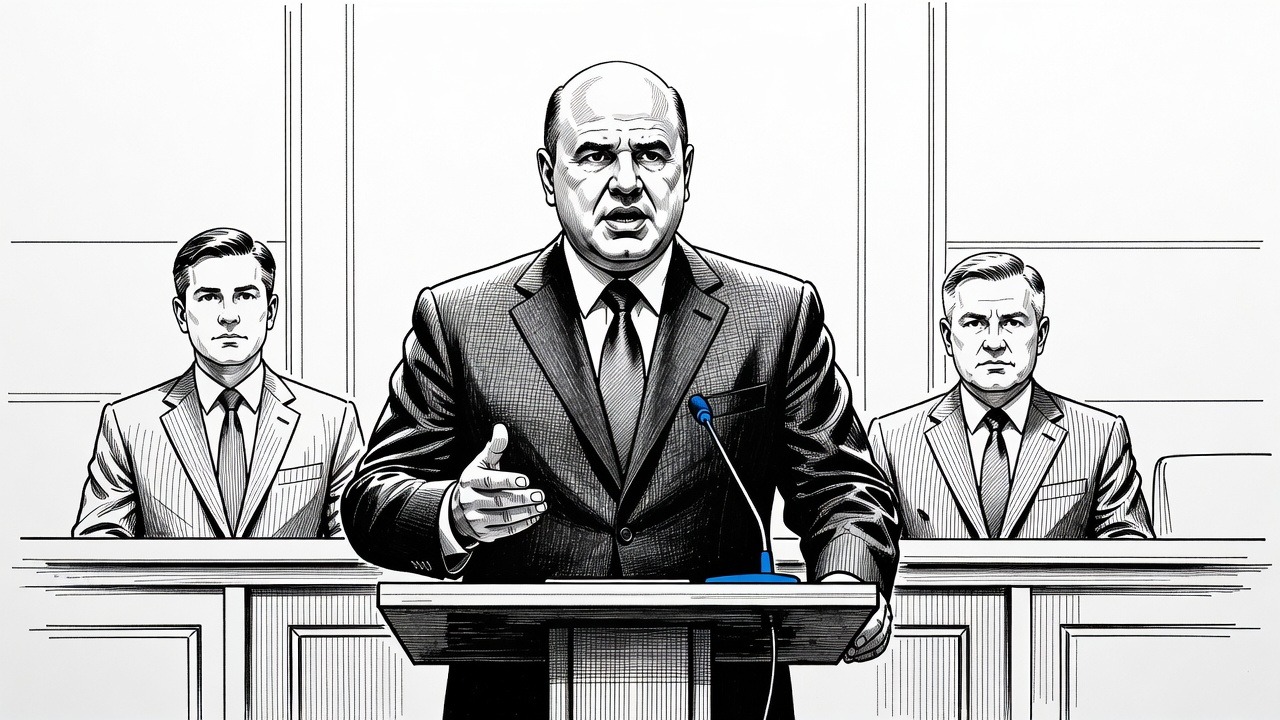
When a prime minister announces, in the same breath as a ferry contract, that he expects relations with NATO to get worse, he is not forecasting the weather. He is describing a policy.
Mikhail Mishustin's plan is modest on paper: railway ferries from Ust-Luga to Baltiysk by 2030, 47 billion rubles, most of it from the National Wealth Fund. That is roughly half a billion dollars, which is small beside what the Kremlin spends on its war. But the sum matters less than the premise. Moscow is now building infrastructure for a permanent state of siege and saying so openly. Peace is no longer the planning assumption in Moscow. That should unsettle everyone, including people who think they have already heard every warning.
Start with who pays. The National Wealth Fund is the cushion Russia built from oil revenue, in theory for pensions and shocks. It is being drained for a war economy that has pushed up interest rates, squeezed civilian budgets and raised taxes on people who never voted for any of this. Kaliningrad's million-odd residents are in a worse position still. They live on a strip of land wedged between NATO members and have become a bargaining chip in a standoff they did not choose. When the Kremlin talks about 'supply security,' it means it is preparing for those people to be cut off and sees them as acceptable collateral.
The responsibility is not ambiguous. The Left has to say this plainly, because a stubborn strain of it still can't. Russia's invasion of Ukraine did not happen to Moscow. It tore up the European security order and made every neighbor's fear rational. Anyone who treats Mishustin's gloom as proof of Western aggression is repeating Kremlin framing. A left that claims to care about working people and self-determination cannot flinch when a nuclear-armed state invades its neighbor and then complains about the consequences.
But the Left should be just as unwilling to let the Western hawk off the hook. Kaliningrad is one of the most heavily armed pieces of real estate in Europe, and a ferry route is the sort of vulnerability that tempts armchair strategists. Every think-tank fantasy about 'closing the Suwałki gap' or 'blockading the exclave' treats a nuclear-armed adversary's territory as a chessboard. In 2022 Lithuania's enforcement of EU sanctions on rail transit to Kaliningrad produced a crisis within days, and Brussels quickly softened the guidance. That was not weakness. It was an understanding that there are limits to what one can do to a cornered nuclear power without courting catastrophe.
The ferries are the logical result of a spiral in which each side's precautions confirm the other's fears. Russia hardens the exclave. The Baltic states and Poland fortify their borders and raise defense budgets. Undersea cables get cut, shadow fleets multiply, and the Baltic Sea slowly becomes a militarized lake. Deterrence is necessary, and Ukraine's survival is not negotiable. But deterrence without any political track behind it is just a countdown with better logistics.
That is where the center and the Right in the West have been lazy. They are fluent in procurement and nearly mute on arms control, crisis communication and any vision of a European order beyond permanent confrontation. The Left's contribution should be to insist that security means more than hardware. It also means channels that survive the worst moments, limits on escalation, and an end state in which ordinary people on both sides of that border are not hostages to geography.
Mishustin says things will get worse. He is probably right, because his government is working to make it so. The task for everyone else is to make sure that when the ferries are finished, they are still just ferries.