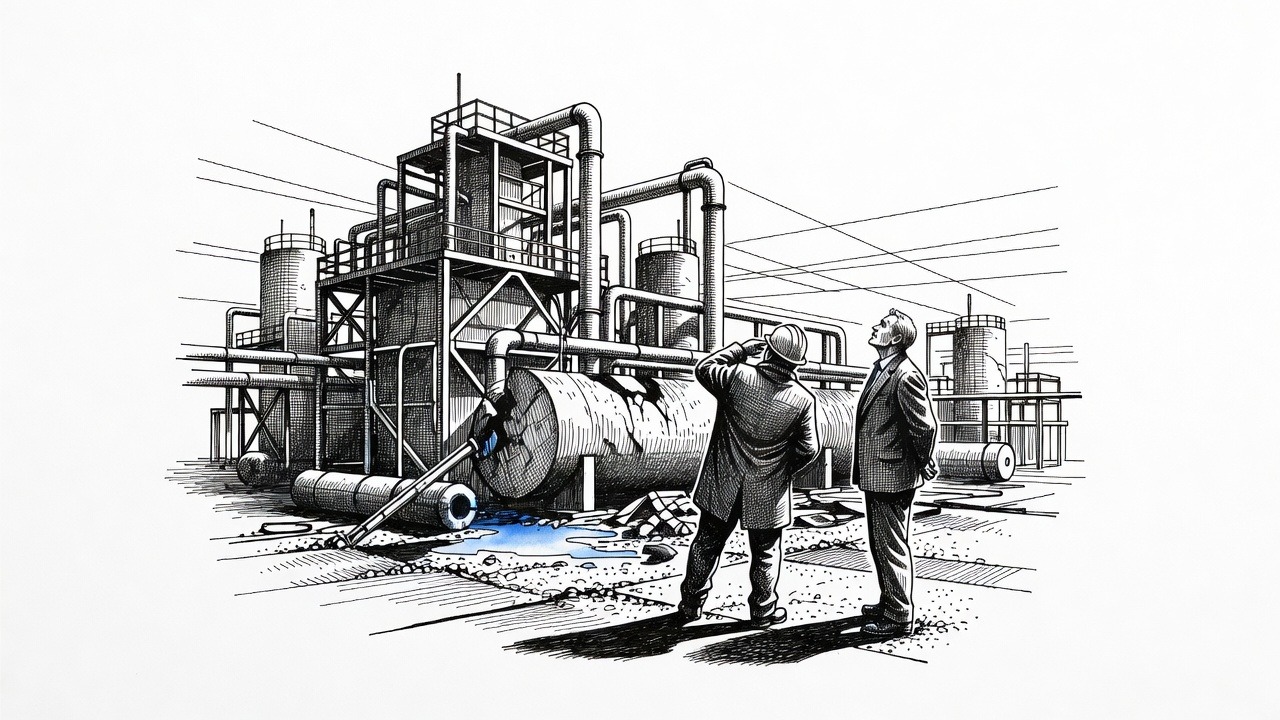
A governor reports one house damaged, an industrial site and an energy facility hit, and nobody hurt. Set that beside what Russia does to Ukraine every week, and the squeamishness some people feel about the Dorogobuzh strike looks like a failure of proportion.
Russia has spent years hammering Ukrainian power plants, heating systems, apartment blocks and hospitals. It did this deliberately, to make civilian life unbearable. Ukraine, meanwhile, is hitting a chemical plant in an invader's industrial base, one that makes nitrogen products with obvious dual-use potential. Ammonium-based chemicals are a staple of both farming and munitions supply chains. A country fighting for its existence that left such sites untouched would be fighting with one hand tied behind its back, and the people telling it to do so are rarely the ones who will live under the result.
Some on my side of the aisle get uneasy here. The anti-war Left has a reflex: escalation bad, negotiation good, everyone should calm down. It sounds humane. But it treats the invader and the invaded as symmetrical parties to a regrettable dispute. They aren't. Russia chose this war, and Moscow's strategy depends on Ukraine absorbing the pain while Russians feel almost nothing. Making the war cost something inside Russia is not warmongering. It is the only pressure that has ever made an aggressor reconsider.
Now look at the numbers. Dorogobuzh's revenue fell 47% in the first half of 2026, from 27.3 billion to 14.5 billion rubles, and a 1.64 billion ruble profit became a 3.21 billion ruble loss. I would not claim the drones did all of that. Input costs, export conditions, logistics and prices all matter, and the records do not break out the cause. But a plant hit twice in a few months, bleeding money, is exactly the kind of strain that eventually shows up in a war economy. That is what pressure looks like when it isn't aimed at civilians.
The Left should also be honest about who gets protected in this story. Plants like this belong to a small class of oligarchs who made fortunes in the privatized wreckage of the Soviet state and now prosper under Putin's order. The owners will cope. The workers, as always, bear the layoffs, the unpaid shifts and the damage. Their anger belongs with the regime that dragged their country into a war it cannot cleanly win, not with the people defending themselves from it.
There is a harder question the West keeps dodging. Fertilizer has been largely carved out of sanctions, rightly, because poor countries need affordable food inputs. But that carve-out also kept a steady stream of Russian export revenue flowing. If we care about food security, the answer is public money for fertilizer subsidies and alternative supply for the Global South. It is not a standing exemption that lets Russian producers keep earning from the war while Ukrainians die in it. We have been remarkably willing to ask Ukraine to be careful, and remarkably unwilling to ask Western treasuries to pay for a real alternative.
None of this makes the strike costless or removes the need for rules. Civilian harm in Russia matters, and a house damaged is a family's life disrupted. Ukraine should keep targeting disciplined and tied to the war effort. But the burden of proof lies with those who would deny a invaded country the right to strike the industrial machinery of its invader. The moral failure in this war is the invasion. A bad quarter for a fertilizer company is not it.