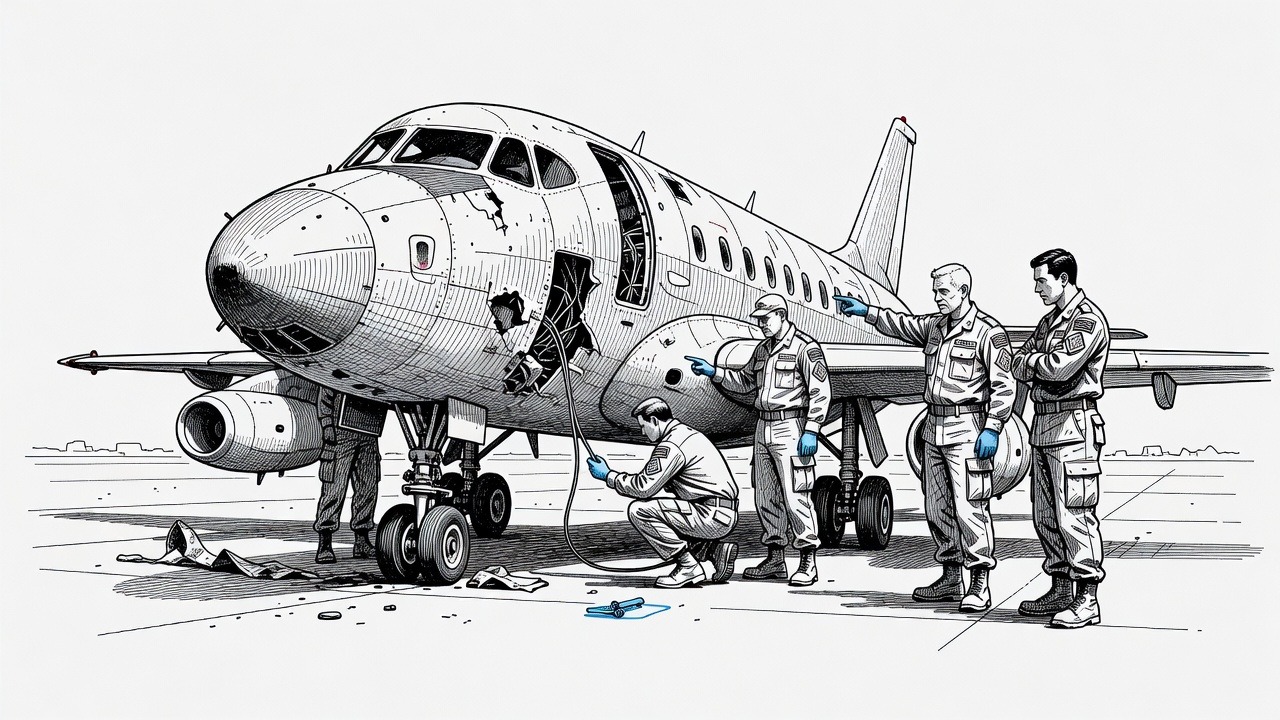
Let's start with what is easy to say. Taking an axe to a $60 million aircraft is a crime under Irish law, and the man charged, Daithi O'Corrain, will answer for it in court. If he did it, he knew the price of doing it. Those who commit conscience-driven property damage usually do, and they usually say so.
But the charge sheet is the least interesting thing about this story. The interesting question is why an American military plane was sitting at Shannon Airport in the first place, in a country that calls itself neutral.
For more than two decades, Shannon has been a refuelling stop for U.S. military traffic heading to wars in the Middle East. Successive Irish governments have defended the arrangement with the same formula: Washington assures us that no weapons or munitions are aboard, and we accept its word. That is not oversight. It is a handshake, and it has been the whole of Irish neutrality in practice since 2001. A country cannot hand its runway to the world's largest military and also claim to be standing apart from that military's wars. Irish people mostly know this. Polling has long shown strong public attachment to neutrality, and the political class has long ignored it.
This has happened before. In 2003, five activists known as the Pitstop Ploughshares damaged a U.S. Navy plane at Shannon on the eve of the Iraq invasion. An Irish jury acquitted them. Twelve citizens were shown the facts and decided that people who disable a war machine in order to prevent greater harm should not be treated as ordinary vandals. The law may not have said so, but ordinary Irish people did. That precedent will hang over this case, and it should.
The obvious objection is that democracy has channels, and individuals should not take an axe to a policy they dislike. It's a fair point, and I'd take it more seriously if the channels worked. People in Ireland have lobbied, marched, petitioned, litigated and watched Shannon from the perimeter fence for twenty years. Governments of both big parties have nodded, promised to look into it, and changed nothing. When the lawful routes have been exhausted for a generation, it is not surprising that someone eventually decides they are theatre.
There is a second question that should unsettle even those who have no sympathy for the accused: why are U.S. federal prosecutors charging an Irishman over what he allegedly did on Irish soil? The Irish state has its own charges ready, criminal damage and interference with airport operations. Washington's decision to add its own pursuit is a reminder of whose property this is, and whose interests count when the two collide. A neutral state that lets another country's prosecutors lay claim to its airport has a sovereignty problem bigger than any one axe.
The most telling feature of this episode is who will be held accountable. One man will face a courtroom. No minister will be asked to explain, under oath, what exactly has been flying through Shannon, what was on board, who checked, and how anyone outside the Pentagon would know. If the Irish government is as confident in its assurances as it says, it should welcome that scrutiny.
The Irish Left should not romanticise property destruction, and it should say plainly that it is a gamble that can discredit a cause as easily as advance it. But it should also refuse the framing that this is simply a story about a violent man and a broken plane. The scandal is the policy. Ireland can be neutral, or it can be a forward fuelling station for American power. It has been quietly choosing the second for twenty years while praising the first. A jury, if it comes to that, may well remind the government of the difference.