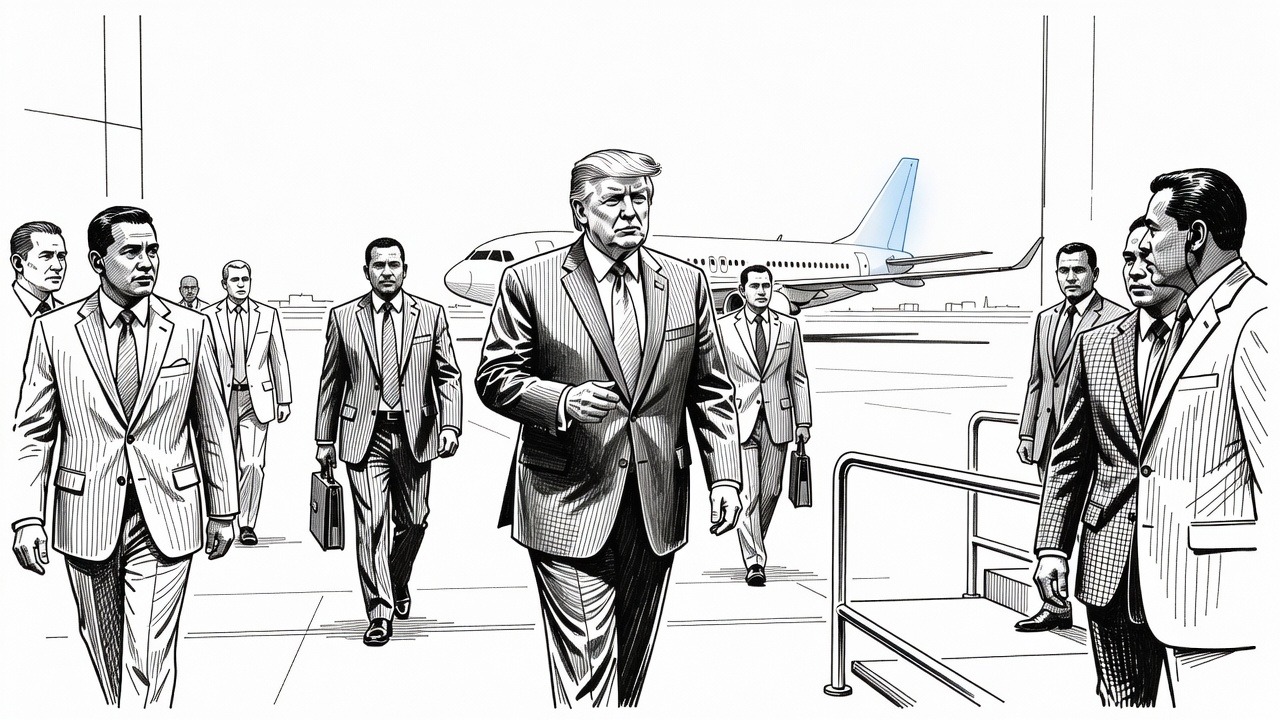
The detail the White House pool will remember is the fried chicken. Ferdinand Marcos Jr. picked it, we are told, to give Donald Trump a taste of Manila and restore his energy. It is a charming anecdote. It is also an accurate picture of what American diplomacy has become: a head of state handled like a cranky guest, and an ally auditioning for attention.
The real news is the itinerary. Trump lands in Manila on the way to Shenzhen, where he is expected to sit down with Xi Jinping, and, according to his schedule, Vladimir Putin as well. Think about what that means from Manila's side. The Philippines sits on the front line of Beijing's pressure in the South China Sea. Its coast guard crews have been hit with water cannon and rammed near Second Thomas Shoal. It has opened more of its bases to American forces and absorbed the political risk of that choice. It did so on the understanding that Washington's commitment was a strategy, not a mood.
Now the man holding that commitment is stopping for a meal before going to bargain with the adversary. Marcos has no idea what is on the table. Neither do we. Trump has treated alliances as invoices and tariffs as a personality trait, including tariffs on the Philippines itself. He has shown he will trade away leverage for the look of a deal. A fisherman out of Zambales cannot hedge against a presidential whim. He is just the one who ends up in the water.
This is where the Left should be blunt, and where some of our own reflexes need correcting. Skepticism of American military buildup in Asia is legitimate. Nobody should be eager to turn the Philippines into a staging ground for a great-power war. But the answer to a bad alliance policy is not a worse one, in which commitments are quietly negotiable and nobody outside the room knows which. If you want de-escalation, it should be built through institutions, treaties, ASEAN channels, and transparent bargains. Trump is offering de-escalation by vibe, and vibes expire.
The Putin meeting should unsettle anyone, whatever their view of Ukraine. A president who dismantled much of America's soft-power apparatus, from aid programs to diplomatic staffing, now shows up to the biggest regional summit in Asia with leverage mostly made of threats. Meanwhile Beijing is the host. Xi gets the stage, the cameras, and the home-court choreography. If Trump wanted to stand up to China, he would arrive with allies lined up behind a common position on trade and security. Instead he arrives with a series of bilateral relationships, each one told that its loyalty is being priced.
Nor is Marcos an innocent bystander. He is the son of a dictator, presiding over a country where the Duterte family feud has turned politics into a blood sport, and where Duterte himself now sits before the International Criminal Court. American presidents have long overlooked such things when the geopolitics were convenient. Trump goes further: he does not even need convenience, because he does not care. Human rights and democratic accountability do not appear anywhere in the schedule we have been given.
The danger is not that Trump will talk to Xi. Presidents should talk to rivals. The danger is that nothing he has done suggests he knows what he wants from the conversation beyond a headline, and that allies and ordinary people in the region will pay for the improvisation. Fried chicken is fine. Filipinos, and Americans, are owed a policy.