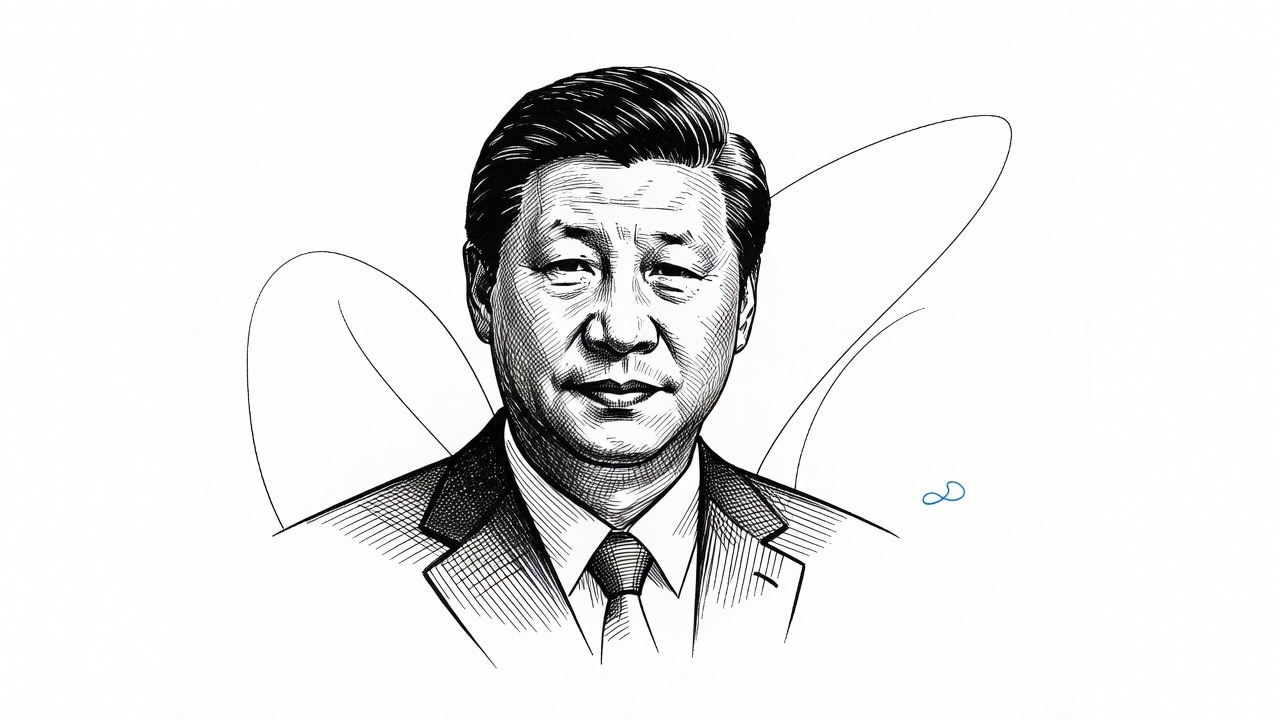
Two men hugged on a tarmac in Shenzhen, and the cameras got what they came for. Whether the American people got anything is a question the choreography is designed to keep us from asking.
Let me be clear about what I'm not saying. Talking to Beijing is not appeasement. The two largest economies and the two largest carbon emitters have to deal with each other, and a Democratic Party that treats every handshake with Xi as treason would be making its own mistake. Diplomacy is not the scandal here. Diplomacy with no discernible strategy is.
Consider the guest list the White House has apparently accepted: Xi, then a three-way session with Vladimir Putin. Trump flew to China, the world's most powerful autocracy, to sit with the man who ordered the invasion of Ukraine. Ukrainians are not at that table. Neither are Taiwanese, Uyghurs, or the Hong Kong democrats Beijing has jailed. Nobody in the readout is speaking for them. A great power that once claimed to lead a coalition of democracies is now one of three men in a room, and it is the one that hasn't spent years preparing for the meeting.
That's the real story under the embrace. Trump spent his first year back dismantling the things that made American leverage real: alliances treated as protection rackets, foreign aid gutted, scientific and diplomatic capacity shredded, and tariffs imposed on friends and rivals alike. Then he arrives to bargain with a government that has been playing a long game with industrial policy, patient state investment, and a clean-energy build-out that Washington is now sneering at while Beijing sells it to the world. You cannot defund your own competitiveness and then expect a photo op to make up the difference.
Republicans spent decades demanding toughness on China. They mocked Obama for bowing and Biden for weakness. Now the party's leader is the one being greeted warmly on Chinese soil, and the same voices who screamed about sovereignty are calling it a masterstroke. Their principle was never toughness. It was loyalty to the man.
Here is the question the Left should press: who pays for the deal Trump is chasing? It will not be the donors who cheered the tariffs. For two years, American importers, small manufacturers, and ordinary shoppers absorbed the cost of a trade war sold as patriotism, and farmers lost export markets they spent generations building. If this summit trades some of that pain away in exchange for quiet on Taiwan, on technology controls, or on Beijing's human-rights record, then working Americans will have been used as a bargaining chip twice. Once to start the fight, and once to end it.
And if the price of cordial relations is silence about Ukraine, then the word "peace" is doing dishonest work. A settlement drafted by Washington, Moscow and Beijing over the heads of the people being settled is not peace. It is a spheres-of-influence carve-up, the kind of arrangement the Left has opposed since Yalta.
Democrats shouldn't answer with reflexive hawkishness. They should answer with demands. Publish what is being offered. Put workers and farmers, not just corporate lobbyists, in the room where tariffs are discussed. Say plainly that no deal over Taiwan or Ukraine is legitimate without the people it affects. And stop pretending that a president who gutted American diplomacy can be trusted to run it by instinct.
The hug lasted a few seconds. The consequences will outlast it.
How it may affect me
Any U.S.-China tariff deal could change prices on imported goods and affect export demand for American farm products. Watch for announced tariff changes after the summit, since those usually reach shoppers and farm incomes with a lag.