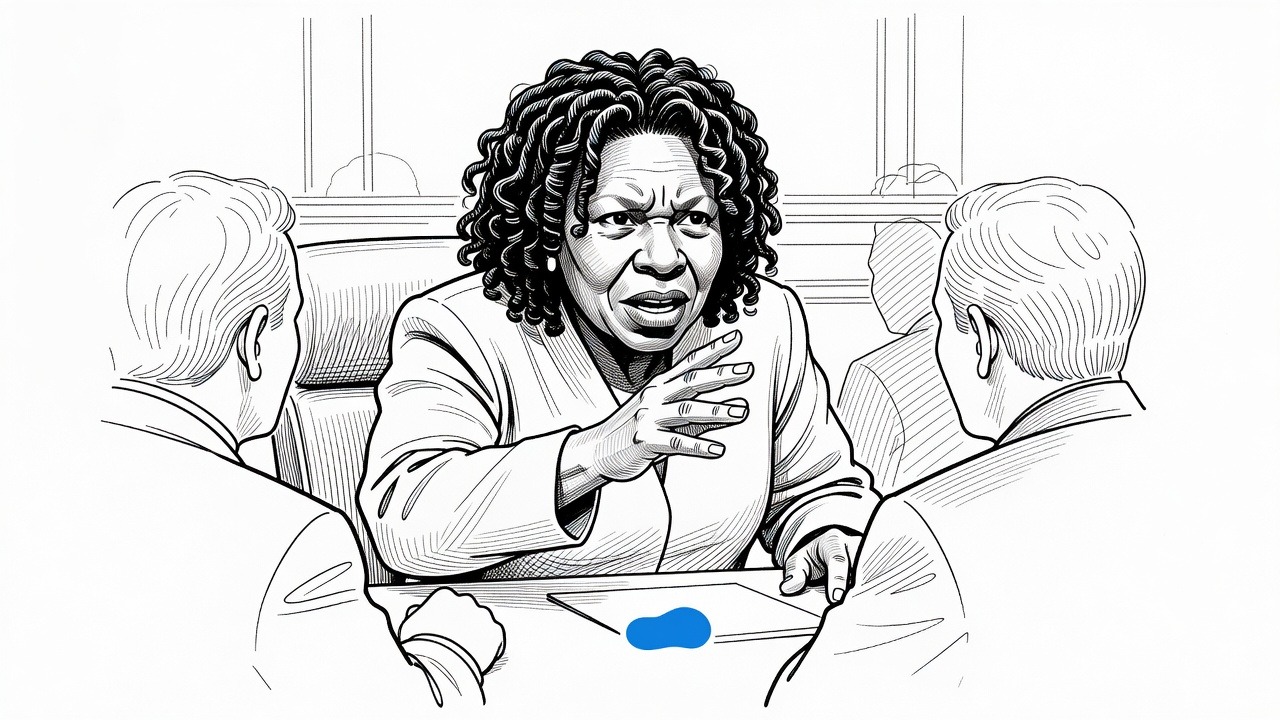
Whoopi Goldberg is right about what Democrats should be doing. She's wrong that arguing about who leads them is a distraction from it.
Her list is the right one: lower gas and grocery prices, restore SNAP benefits, reunite separated families. That's a governing agenda a lot of exhausted Americans would recognize as their own. But look at it as a test. Every item requires a party willing to fight, to use leverage, to take a hit, and to say no to Donald Trump when saying no is costly. Whether Democrats have leaders capable of that is not a side issue. It's the whole question.
"Stop the infighting" has been the establishment's answer to every demand for accountability. It's usually delivered by people who will never have to live with the result. It was the answer after 2016, and it's the answer now. The party's voters don't enjoy watching Democrats squabble. What they can't stomach is losing and then being told to be quiet.
Consider Chuck Schumer, whom co-host Sunny Hostin praised for his experience with shutdowns. Fair enough, he has plenty. But experience is not the same as results. In March 2025, he helped advance a Republican funding bill after warning his own members how dangerous it was, and the base never forgave him. When the long fall shutdown ended, it was because a handful of Democratic senators broke ranks, over a health-care fight the party had claimed was its moral line in the sand. Whether you blame Schumer for that or credit him for holding most of his caucus, you can't pretend it settled the matter. A growing number of Democratic Senate candidates have said they won't commit to backing him as leader. That isn't a far-left fringe. It's voters and candidates asking whether the person at the top has the stomach for the fights they were promised.
Alyssa Farah Griffin argued that Schumer should make way for younger leadership. Her point about the generational problem isn't wrong. Democrats are a party whose voters keep asking for new faces and getting seniority instead. But she's also eager to dismiss opposition to Hakeem Jeffries as a far-left phenomenon. That's convenient, and it's the kind of analysis you get when a panel of TV personalities, including a former Republican staffer, is asked to referee a Democratic family quarrel. Nobody on that set has to run in a swing district or explain to a constituent why SNAP money disappeared.
Here is where Goldberg and Kaivan Shroff have a real point. A leadership fight that drags on, that is conducted through anonymous quotes and cable hits, and that offers no alternative strategy is self-indulgent. If you want to challenge a leader, name the strategy. Say what you'd do differently on a shutdown, on a nominee, on the filibuster. Then hold the vote and move on. Quick, open, substantive contests are healthy. Whispering campaigns are not.
But that's an argument for settling the question honestly, not for refusing to ask it. The Republicans have not won by being polite. They've won by being relentless and by purging leaders who didn't deliver. Democrats don't need to copy their cruelty, but they might borrow the principle that leadership is a job, not an inheritance.
If the party wants unity, it can have it cheaply: choose leaders who will plainly fight for gas prices, groceries, food assistance and families, and then fight. Voters will forgive a messy primary. They won't forgive a tidy caucus that folds.