Let's dispose of the sex first, because it's the least interesting part. A married man was unfaithful. That is a matter for his family, not for the rest of us, and anyone on the Left tempted to relish it should remember how long we spent objecting to politicians' bedrooms being treated as public business.
The real story is that the faithfulness of one 63-year-old man now moves a stock, triggers a board inquiry and raises questions about U.S. national security. That should alarm us far more than any affair.
Start with what we don't know. The intelligence claim comes through reports, not public evidence. Beijing calls it a smear, and Nvidia says it has no reason to think secrets were compromised. Leaked intelligence assessments have a long history of serving whoever leaks them, so skepticism is warranted. Skepticism is also warranted toward anyone eager to turn a Taiwan-born executive's private life into a loyalty test. We have seen where that kind of suspicion leads, and it doesn't stop at the guilty.
The structural problem doesn't depend on whether the allegation is true. Nvidia sits at the choke point of the AI economy. Its chips are an instrument of American strategy, and Washington decides which countries and companies may buy them. Over the past year, the company's chief executive has lobbied hard against tighter export limits to China. He has also taken part in a remarkable arrangement in which the administration permitted certain chip sales in exchange for a cut of the revenue. Export policy was being negotiated, in effect, between a president and a CEO, in rooms the public never saw.
Now a counterintelligence cloud hangs over one of the two men in that negotiation. Nobody is entitled to conclude he acted on anyone's behalf. But that is exactly the point. Every position he took is now impossible to evaluate cleanly, and the cause is not any proven wrongdoing. It is that a single private individual held this much leverage over a public matter, with so little outside verification.
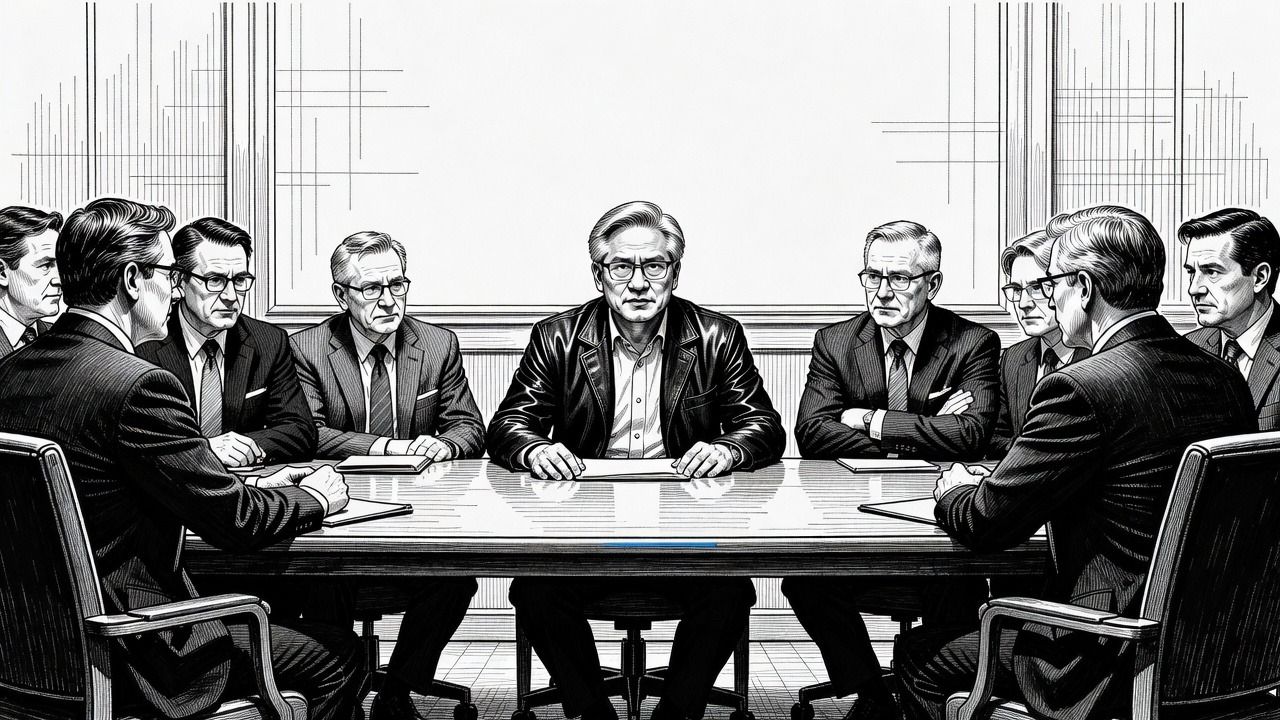
Then there's the board's response, which should embarrass anyone who has lectured us about corporate governance as a safeguard. The directors are investigating whether their chief executive was targeted by a foreign service, while he stays in charge. They announce they have no reason to believe anything was compromised, before the inquiry has found anything. This is a board of long-tenured insiders, enriched alongside the founder by a stock that has made them all wealthy, and it is grading its own homework. The company's own statement is more comforting than investigative.
The market's reaction tells the same story. Shares fell because one man appears irreplaceable and succession is an afterthought. A trillion-dollar enterprise, built on public research, university talent and billions in government support for the semiconductor industry, is treated as a personal monarchy. That is great when the monarch is a visionary and a disaster when he isn't.
The Democratic response shouldn't be a witch hunt or a lurid press release. It should be a demand for structure. Companies that control strategic technologies should face real disclosure to Congress about their dealings with foreign governments and their lobbying on export rules. They should have independent directors with security expertise, and there should be a documented succession plan. We should also ask why export policy for the most consequential technology of the decade is made through personal deals and not through public law.
If the allegation is false, Huang deserves to be cleared quickly and credibly by someone other than his own board. If it is true, the failure won't be his alone. It will belong to a political system that handed this much power to a private person and trusted him to police himself.
How it may affect me
Nvidia is among the largest holdings in major index funds, so a 401(k) or IRA tracking the S&P 500 or Nasdaq-100 has notable exposure to its stock. Expect volatility until the board's inquiry and any succession planning become clearer.