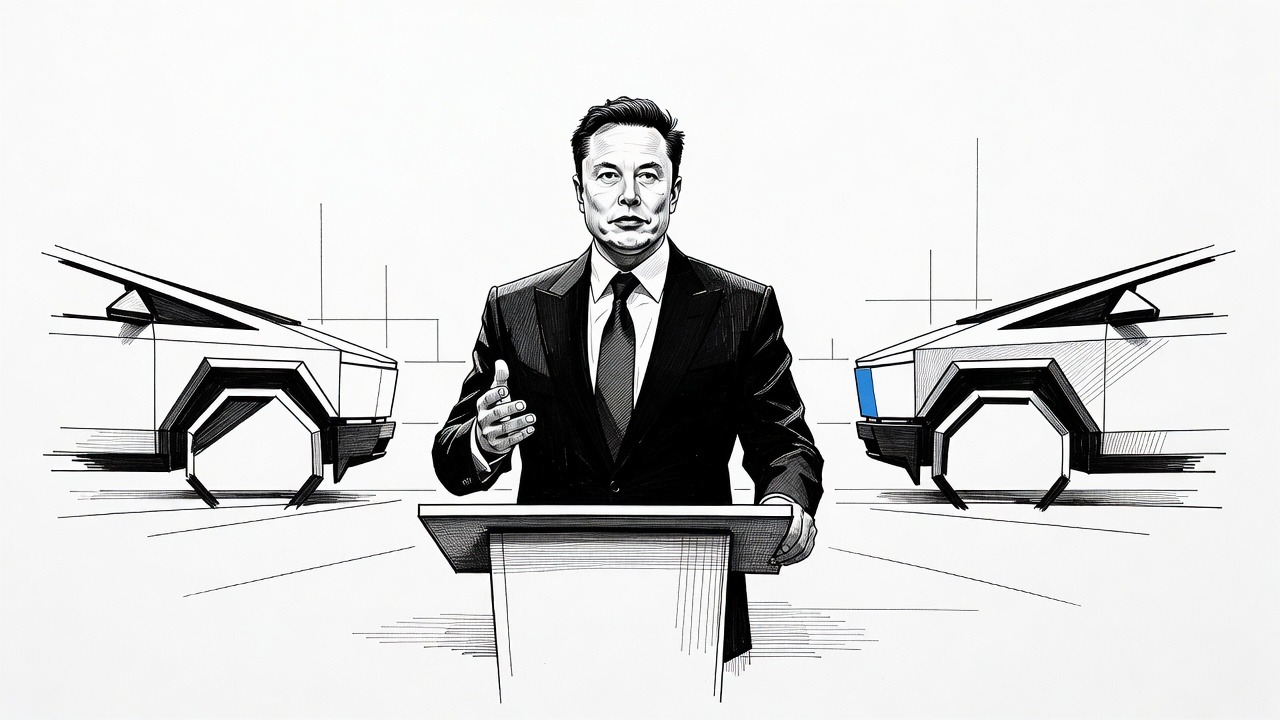
Elon Musk says the Cybertruck is not being killed. It is being retired because it is too popular. Orders, he says, exceed capacity, so deposits must go back to a large number of eager customers. Nobody should have to be told how funny that is, but it is worth noticing how easily the line was delivered, and how many people will repeat it.
Here is what we know. Tesla unveiled the truck in 2019 and said production would start in 2021. It arrived about two years behind that target, with a top trim north of $100,000. It has been recalled repeatedly, including for a detaching exterior panel and a stuck accelerator pedal. Even a sympathetic analyst like Dan Ives says demand was low and price was the problem. Musk once boasted of well over a million reservations. A reservation is a refundable placeholder. It is not a sale. The people who actually paid were a small fraction of that number.
So the story is not that Tesla is a victim of its own success. A vanity product has met a market that did not want it, and the market won. I'll take that win. The Cybertruck was a 6,600-pound stainless-steel declaration that the road belongs to the biggest, hardest vehicle on it. It arrived as American streets were getting deadlier for pedestrians, and it was sold as climate policy. It was never that. It was a luxury toy wearing a green badge.
The Left should resist two easy responses. One is gloating, though some of it is earned. The other is relief that the problem has solved itself. It hasn't, because the Cybertruck's replacement is the same pitch with higher stakes.
The Cybercab is a robotaxi with no steering wheel and no pedals, justified by the same kind of promise: the future is nearly here, trust us, and the paperwork will sort itself out. Tesla has promised full self-driving for roughly a decade. Its Austin robotaxi pilot has already drawn scrutiny over crashes, and the company discloses little. A Cybertruck that disappoints costs a buyer money. A driverless car that fails costs a pedestrian or a passenger more than that. The test lab is a public street, and the people who live there never signed up.
This is the pattern worth naming. Customers front the money through deposits and early purchases. Taxpayers front the roads, the emergency responders and, in Tesla's earlier years, the subsidies and a federal loan. Regulators are expected to bend, and Musk has spent the last few years making sure the people who oversee his companies are friendlier to him. Shareholders were recently asked to approve a pay package worth up to a trillion dollars, tied in large part to robotaxis and humanoid robots that don't yet exist at scale. The upside is private. The risk is socialized.
There is also a lesson for Democrats, who should say it plainly. For years, climate politics treated one billionaire's company as the face of the energy transition. That was always a mistake. A transition built on a single founder's moods and politics will wobble when he lurches, and he has lurched. Real decarbonization means cheap, boring, efficient vehicles, reliable charging, transit and manufacturing jobs that don't depend on any man's social media feed. The electric cars that matter will be small, affordable and made by many firms, with union labor wherever possible.
The Cybertruck's death should be filed as a market correction and a warning. When a company tells you demand is too high just as it shuts down the line, ask what it is selling you next. Then ask who is holding the risk.
How it may affect me
If you hold a Cybertruck reservation, expect a deposit refund rather than a truck, and check Tesla's terms and your account for timing. Current owners should keep up with recall notices, and with warranty and parts support, since a discontinued model can complicate repairs and resale value. If you were considering a Tesla robotaxi ride, remember the service is still new and lightly regulated.