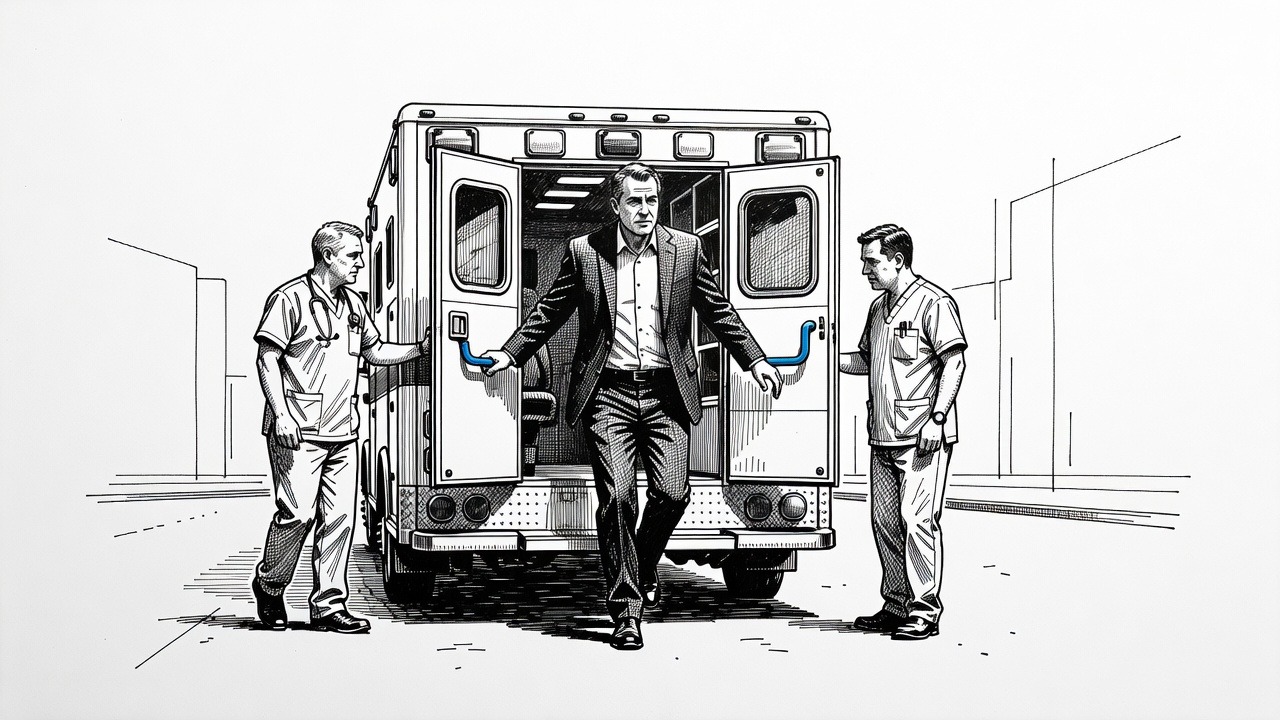
Senator Chris Murphy had a small hemorrhagic stroke, left the hospital for rehabilitation, and is expected to recover fully. He is 53. He called for help when the symptoms appeared. His doctors at Johns Hopkins say the bleed was small and the progress real. He will miss votes for several weeks while his office keeps doing the unglamorous work of constituent service.
That is the story. It does not get better if we force it through a partisan sieve.
So start with the thing that should not need saying and somehow does: I hope he gets well. I disagree with Chris Murphy about guns, about the size and habits of the federal government, about a good deal of what he thinks the Senate is for. Those disagreements will be waiting when he can stand up and argue them again. They are not suspended, and they are not relevant to a brain bleed. A politics that cannot wish an opponent a full recovery is not hard-nosed. It is sick.
It is also worth saying what this episode is not. It is not a plot point. The stroke came near an election in which Democrats took the Senate. That is a fact about the calendar, not a fact about causation. Anyone on my side tempted to treat a small hemorrhage as suspicious timing should sit down. We do not get to demand evidence and institutions and then wink at medical insinuation because the patient has a D next to his name. That impulse is how serious movements make themselves ridiculous.
What the episode does expose, quietly, is a distinction Washington hates.
There is the man Connecticut elected, and there is the office that keeps the lights on. Murphy’s staff can and should keep answering the phones, chasing agencies, and handling the casework that does not require his judgment. That is not a scandal. That is what a functioning office is for when the principal is in a rehabilitation facility, which is where a person who just bled into his brain belongs.
Legislative power is different. A senator’s vote is not a brand and not a delegation. It is a personal act, cast in person, for which one human being answers to voters. Murphy has said he will miss votes. Good. That is the honest sentence. “Participates remotely” can cover calls with staff and conversations with colleagues. It cannot cover the fiction that presence is a technicality. The House experimented with proxy voting in the pandemic, and Republicans were right to end it. The Senate, to its credit, never turned the floor into a permission slip. A few weeks of absence with a clear prognosis is an ordinary human fact. It is not a pilot program for government by chief of staff.
The harder standard is the one this case actually meets, and too many others have not.
Murphy noticed symptoms and called emergency services. He let his doctors speak in plain language. He told his constituents he would be gone for weeks and that the absence would show up on the roll call. That is what capacity looks like when it is temporarily interrupted: disclosure, a timeline, a limit. Compare that with the years in which both parties treated obvious decline as a staffing problem. Dianne Feinstein’s final stretch was not a private tragedy the public was obliged to ignore; it was a seat with power over confirmations, held by a senator whose colleagues whispered what voters could see. Mitch McConnell’s on-camera freezes raised the same question on our side, and too many Republicans answered it with loyalty instead of candor. Joe Biden’s party spent years insisting the public disbelieve its own eyes. The excuse was always institutional: the office continues, the staff is excellent, the vote still counts.
The office continuing is not the same thing as the senator governing. Parties cling to seats because seats are power, and they call the clinging compassion. It is not compassion. It is possession. Murphy, younger than that cohort and apparently honest about a real but limited injury, is not the exhibit in that case. He is the counterexample. The decent response is to say so — and then to keep the standard when the patient is one of ours.
Democrats now hold the Senate he will not be voting in for several weeks. His absence has weight precisely because a senator is not a rounding error. His colleagues should count the votes they actually have, not the votes they wish a rehabilitation schedule would produce. Voters can survive a short, disclosed absence. What they should not be asked to survive is another season of euphemism.
Get well, Senator. Then come back and make your case on the floor, where it counts. We will be there to answer it. That is the whole arrangement — opponents, not invalids; arguments, not avatars — and it is worth more than any news cycle we could wring out of a man’s recovery.