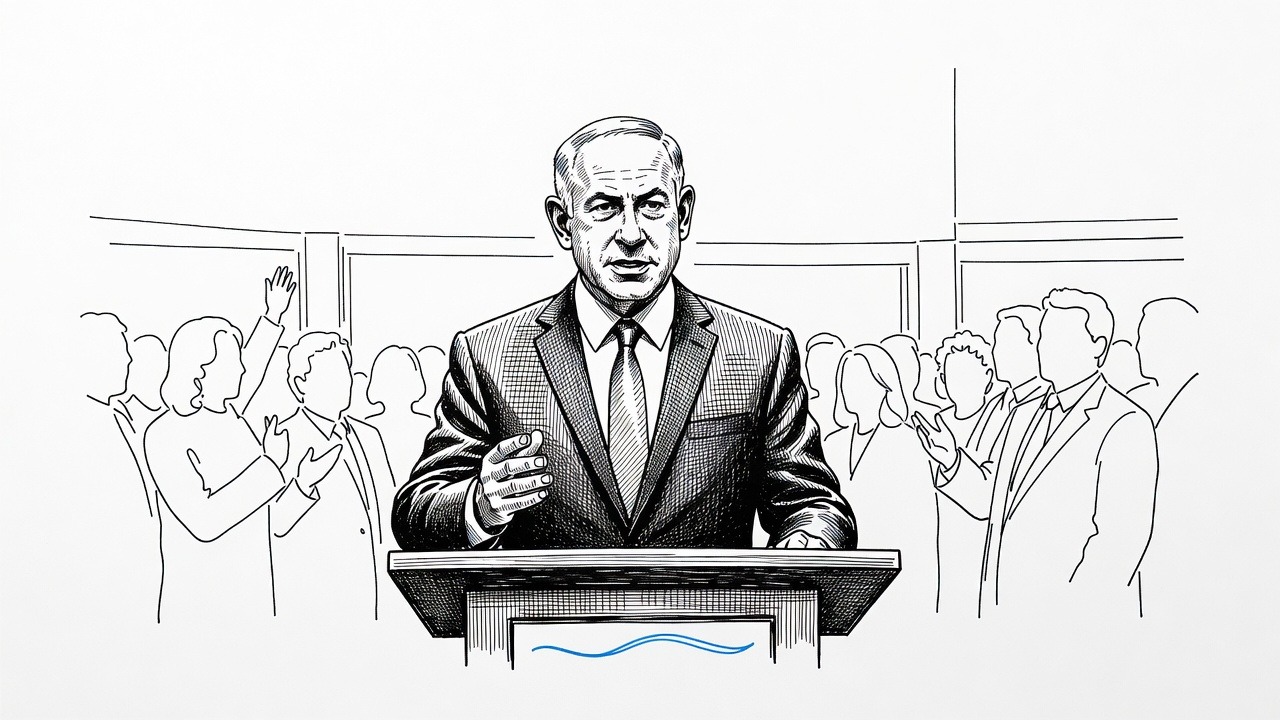
Both men claimed victory on election night, which tells you how little either has to say about the actual result. The result is arithmetic, and the arithmetic is uncomfortable for nearly everyone who claims to oppose Benjamin Netanyahu.
With about 70 percent of ballots counted, Netanyahu's bloc sits at 54 seats. The opposition has 47. The Arab parties have 19. Partial counts move, and I wouldn't bet the house on any of these figures. But the structure has held for years: there is no path to 61 that doesn't run through Arab citizens, who are roughly a fifth of the country. Netanyahu knows it. Gadi Eisenkot knows it. Mansour Abbas says both camps have already come knocking.
That is the story. Israel's opposition has spent years telling voters that Netanyahu is a threat to democracy: a prime minister on trial for corruption, who presided over the worst security failure in the country's history and spent the aftermath fighting the courts, the press and the generals. All of that is true, and I believe it. But a democratic majority against him can't be assembled by pretending a fifth of the electorate doesn't exist.
The cowardice is bipartisan. Netanyahu's camp treats Arab representation as treason by definition, then quietly shops for Arab votes when it needs them. Eisenkot's camp, a former chief of staff leading a centrist coalition, wants the benefit of Arab votes without the political price of saying so. Ask them whether they would sit in a government with Raam and you get throat-clearing about "all options" and "a Zionist government." That means: we'll take the support, but please don't make us look at it.
This is not just squeamishness. It is a choice about who counts. In 2021, Abbas did something remarkable. He led an Arab party into a governing coalition for the first time in Israel's history. He did it to win budgets for Arab towns plagued by crime and neglect, not to make a statement. The coalition was fragile and eventually collapsed, but it demonstrated that Arab citizens could be partners in governing rather than a permanent outside audience. Netanyahu's response was to make Abbas the villain of every campaign since. The center-left's response was too often to shrug and agree that it was politically unfortunate.
If Eisenkot wants to claim that voters rejected Netanyahu's leadership, he has to be willing to do what that claim requires. He must say plainly that Arab citizens' votes are legitimate and that their parties are legitimate negotiating partners, with a seat at the table and policy to show for it: serious action on violent crime in Arab communities, equitable budgets, planning and housing. Anything less treats them as a prop in somebody else's majority. Voters who turned out against Netanyahu should not have to wonder whether the people they elected will betray them again to preserve their own comfort.
The alternative is worse. If the opposition cannot find the nerve, Netanyahu gets another shot at assembling a bloc with the religious parties whose demands, from draft exemptions to the judicial agenda, are the very things that made the last government so corrosive. He remains prime minister until a replacement takes office, and every week of drift benefits him. Official results are due Nov. 4, after which President Herzog begins consultations. The real negotiation is happening now, in rooms where people are deciding whether Arab voters are citizens or leverage.
Israel has a democratic majority against its prime minister only if it is willing to count everyone in it. That is the test Eisenkot should be asked about at every microphone until he answers it.