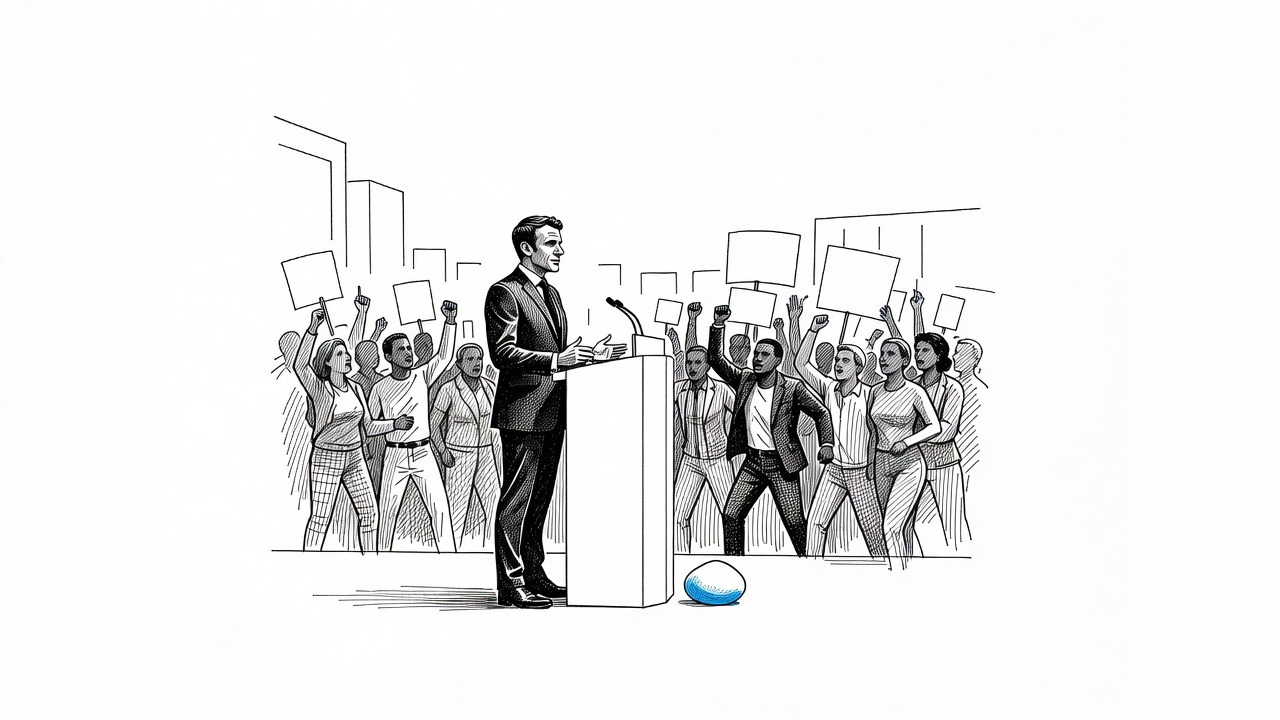
When a government answers a mass protest by naming the culprit before reading the placards, it is usually avoiding something. Prime Minister Sébastien Lecornu says ultra-left agitators are stirring disorder ahead of the presidential election. Some people did burn things and loot shops, and that deserves condemnation, not romance. But the crowd the government is describing is not the crowd in the streets. Students, farmers, climate activists and veterans of the Yellow Vests do not share a single ideological home. What they share is a bill they cannot pay.
Emmanuel Macron, to his credit, was franker than his prime minister. He conceded that fuel prices and living costs fed the unrest, and that France is absorbing the shock of a Persian Gulf conflict it isn't fighting. That is the heart of it. A war thousands of miles away has become a rent, heating and fill-up problem in Limoges and Lille. The people paying are the ones who had no say in the war and no cushion against its price.
Now look at what the state proposes in response. Macron flies to the Gulf to secure supplies, which is reasonable. Lecornu's 2027 budget, meanwhile, freezes civil-service pay and changes sick-leave reimbursement. In plain terms, the teacher, the nurse and the municipal worker, whose purchasing power is already projected to fall, are asked to take a real pay cut to close a deficit. The person who is ill is asked to carry more of the cost of being ill. Energy shocks are national emergencies, and the government is passing the invoice to those with the least room to absorb it.
This is not a new mistake. The Yellow Vests started in 2018 over a fuel tax, imposed by a government that seemed to believe every household could simply choose a cleaner commute. France has now spent years learning that cost-of-living pain is not an abstraction. Macron also abolished the wealth tax in 2017 and told the country it would trickle down. It is galling to hear that the deficit demands sacrifice from the person who earns €1,900 a month, while energy companies that profited handsomely from the last price spike, TotalEnergies's record 2022 earnings among them, are treated as untouchable. If we are all in this together, then a windfall levy on energy profits and a serious contribution from the largest fortunes should be in the first draft of the budget, not the last paragraph of the opposition's wish list.
The Left has its own problem here, and it should say so. Marching is not a program. Fires and smashed windows hand the government its preferred story and give the far right a gift: a picture of chaos to run against. Marine Le Pen's camp is already positioned to claim that it alone speaks for the squeezed driver and the anxious pensioner. If the Left treats this moment as a chance to protest, rather than a chance to propose, it will have staged the opening act for its own defeat in 2027.
The proposal is not complicated. Cap prices for the households that depend on a car or a gas boiler. Tax the windfall. Protect public wages and sick pay instead of treating them as the deficit's first line of defense. Invest in insulation, rail and renewable power so France is less exposed to the next war it does not choose. That last point matters most. Every energy crisis is a reminder that dependence on fossil fuels is also a dependence on other people's conflicts.
A government that calls this unrest an ultra-left plot is telling voters it has no answer. France deserves one before the next election, not a lecture about who set the fires.
How it may affect me
If you live in France, the 2027 budget proposals on a civil-service pay freeze and sick-leave reimbursement are not yet law. Public employees and anyone who relies on sick pay should watch how parliament amends them. Across Europe, expect continued pressure on fuel and gas prices while the Gulf conflict persists.