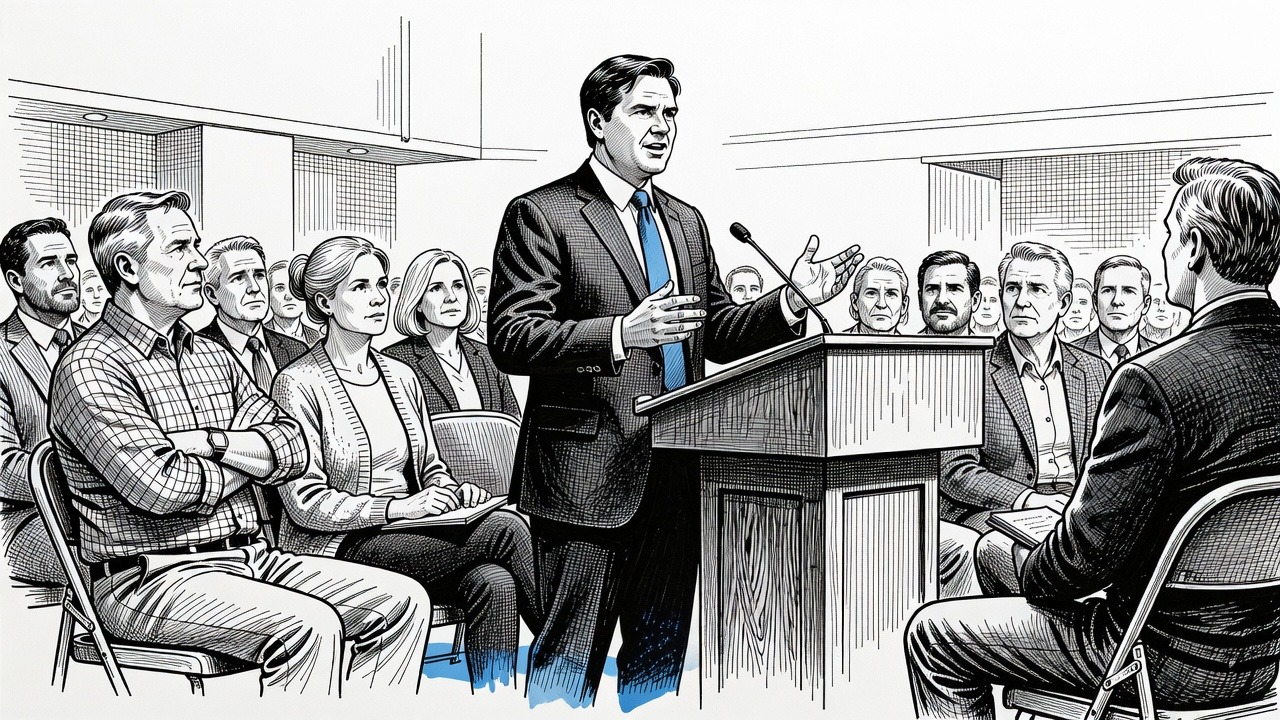
Give JD Vance this much: he is good at the town hall. He is calm, conversational and willing to concede a small point, like admitting his rhetoric on visas "had not always been precise." That is the oldest trick in the politician's kit. Confess to a style flaw so nobody asks about the substance.
Start with the substance Michigan voters actually raised: prices. Vance's answer on manufacturing was that reversing decades of decline "would take time." That is true, and it is also the whole problem. Workers in Michigan, who have heard promises about factories coming home for a generation, are being told once again to wait. Meanwhile the bill for the administration's choices arrives at the pump this week.
That is where the Iran answer becomes remarkable. Vance framed military operations as protection for oil shipments through the Strait of Hormuz, as if the war were a gas-price policy. Think about what that asks of a family in Macomb County. Prices are already squeezing them. The government has chosen a conflict in one of the most volatile energy corridors on earth, and the defense is that it will keep the damage from getting worse. A voter could fairly ask who started the fire. The people absorbing the risk are not the ones who chose it. They are the ones who fill up a minivan and watch the number climb.
The populist promise of this movement was that it would put the working class first. A real populist would tell those voters what the administration is giving up to make their lives cheaper. Vance offered patience and a war.
On immigration, he said mistakes by enforcement personnel "are investigated and addressed." By whom? The agency that made them. Anyone who has watched institutions grade their own homework knows what that sentence is worth. Due process is the thing that makes enforcement legitimate, not an obstacle to it. A government confident in its conduct does not need to ask the public to trust its internal review.
His criticism of corporate abuse of foreign-worker visas deserves a hearing. Employers using visa programs to suppress wages is a real grievance, and the Left made that argument long before it became fashionable on the Right. But criticism of corporations from an administration that has cultivated corporate donors and executives is cheap unless it comes with enforcement, wage floors and penalties. Talk is free. The workers undercut by those programs have heard plenty of it.
Then came ethics, the most revealing answer. Vance said he had "not seen corruption" in the administration. Notice the construction. He did not say there was none. He said he had not seen it, which describes where he chose to look. He pledged to comply with "lawful" congressional subpoenas, a qualifier that leaves room for exactly the fight over what counts as lawful. And he said people who sell access to the executive branch should face consequences. Fine. Who? When? Under which investigator, appointed by whom? A principle with no named defendant is a mood, not a commitment.
The contrast is stark. A man who rose by speaking for forgotten industrial America is now vouching for an administration whose answer to those same communities is delay, higher risk and self-review.
Democrats should not coast on this. Pointing out contradictions will not lower anyone's grocery bill. The party needs a concrete, believable plan on prices, energy and jobs, one that does not read like a press release. But the opening is real. When a vice president can sit before Michigan voters, ask them for patience, and call his own administration clean because he hasn't noticed otherwise, the question for November is simple: how long are working people supposed to wait while everyone else is treated as urgent?