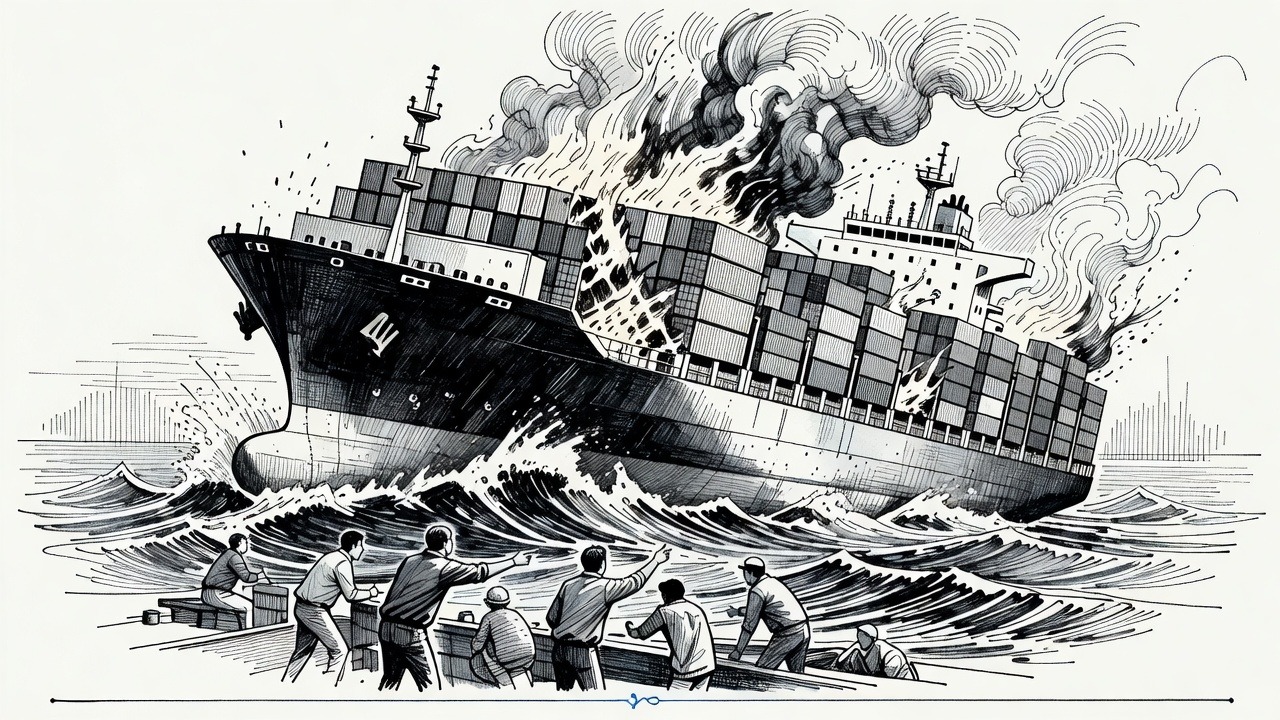
Twenty-one sailors got off a sinking ship alive on Wednesday. That is the only part of this story anyone can state with confidence, and it is also the part Washington will forget first.
Everything else is fog. Iran's Revolutionary Guard says the GFS Pride hit a mine. A maritime security firm says there is no evidence of that. The UK's maritime monitor says a verified source reported an unidentified projectile. A ship is on the bottom of the world's most important oil chokepoint, and the honest answer to who did it is that we do not know.
That should frighten us more than any confident accusation, because wars rarely start with clarity. They start with an incident, a rush to assign blame, and officials who have already decided what the answer must be. The Revolutionary Guard chief is now publicly threatening to hit U.S. warships approaching the strait. CENTCOM says it will keep operating there regardless. Two armed forces are staking out positions in a narrow waterway, each insisting the other is the aggressor, while the facts of the first casualty remain unestablished. A mine, a missile or a miscalculation could set the next move.
The Iranian regime deserves no sympathy here. The Guard is a repressive military-commercial empire that has harassed shipping and menaced neighbors for years, and its leaders' bluster is reckless. Saying so does not require pretending that America's hands are clean. The 2018 decision to tear up the nuclear deal, which Iran was verifiably honoring at the time, traded a working constraint for a "maximum pressure" campaign that produced more enrichment, more militia activity and more confrontation, not less. We are living in the world that decision built.
So here is the question the Democratic establishment keeps ducking: who authorized this? Congress has voted on Iran war powers resolutions before, but those votes came as isolated, often symbolic fights, and no vote has authorized a war with Iran. Yet U.S. ships are being steered toward a standoff in which an unattributed attack could become a casus belli overnight. The War Powers Resolution was written precisely to stop presidents from drifting into conflict through exactly this kind of ambiguity. Too many Democrats treat that duty as a messaging exercise to be performed after the shooting starts. If a vote is worth demanding after the first American sailor dies, it is worth demanding now.
Consider also who is actually exposed. We are not told the crew's nationalities, but crews on ships like this are overwhelmingly drawn from poorer countries, working for operators who register under convenient flags and carry the lowest insurance the market allows. They are the ones standing on the deck when the projectile or mine arrives. They have no say in the geopolitics and no seat at any table where it is discussed. Global trade runs on their risk, and shipping executives and defense contractors will do fine either way.
The rest of us will pay in quieter ways. Roughly a fifth of the world's oil moves through Hormuz. War-risk insurance premiums rise at the first rumor of danger, freight rates follow, and the cost lands on ordinary households as fuel and grocery prices, which is not something working families can absorb after the last few years.
What should a serious response look like? Open diplomatic channels to Tehran, including through Gulf states and Europe, to establish who did this and defuse the standoff. Insist that any independent investigation be public. Keep U.S. forces from provocative positioning until Congress has debated what they are there to do. And stop treating freedom of navigation as a slogan that justifies anything.
The crew of the GFS Pride was lucky. A policy built on luck is not a policy.
How it may affect me
If the standoff persists, expect higher war-risk insurance and shipping costs, which can feed into gasoline, diesel and consumer goods prices over weeks to months. Fuel-sensitive budgets, such as long commutes and delivery-dependent small businesses, would feel it first. A sudden spike would be most likely if the strait's traffic is disrupted.