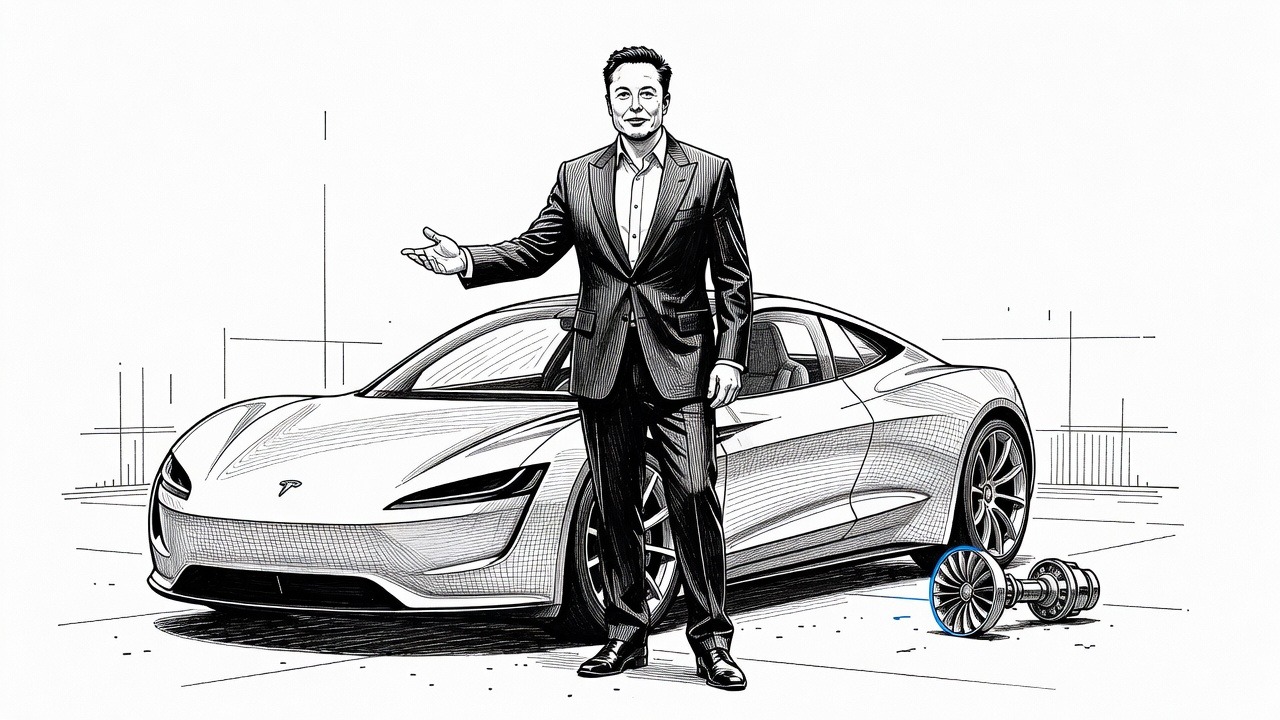
Somewhere in Texas tonight, a car that was promised for 2020 will be shown to the public for the umpteenth time, in airspace the FAA has cleared for the occasion. Tesla will call it a product launch. It is better understood as a fundraising technique that has worked for nearly a decade.
The Roadster was announced in November 2017 with the usual Musk cocktail of physics-defying claims. There would be a SpaceX package with cold-gas thrusters that could help the car accelerate, brake and even hover. Tesla took $50,000 deposits. Since then it has missed several delivery dates, and now it is reopening reservations at the same $50,000 in the U.S., Canada and China, before the public has seen final pricing, specifications or production targets. Think about that sequence. The customer pays first and learns what the product is later.
In any other corner of the economy, we would have a word for a company that takes large advance payments for a product it cannot deliver, then uses the interest, the publicity and the free cash while customers wait. Sometimes the word is fraud. Usually it is just a deeply unequal bargain. When the company is Tesla, we call it vision, because the market has decided that Elon Musk's missed deadlines are a feature of genius rather than a bill someone else is paying.
But the Roadster is not really the story. It is a $50,000-down toy for people who already have everything, and who cares if the rich wait longer for a second garage queen? The story is what the Roadster is for. Tesla's stock has long been valued less as a carmaker than as a bet on a series of miracles: the robotaxi, the humanoid robot, the hovering sports car. Each promise is rolled out when the last one comes due, and the spectacle keeps the narrative ahead of the accounting. Tonight's livestream comes from a SpaceX facility, a reminder that this is one man's interlocking empire, with the brand moving easily from company to company.
The politics should not be forgotten either. Musk spent 2025 helping gut federal agencies, funding the party that then ended the federal EV tax credit, and alienating the very buyers who made Tesla an emblem of the climate-conscious professional class. Those who still hold Roadster deposits are financing an enterprise whose owner has worked to dismantle the public policies that made electric cars attractive to ordinary households. That is a strange place to park $50,000.
The Left should resist two temptations here. One is to cheer the show because it is electric and shiny. The other is to treat Tesla's circus as proof the whole transition is a scam. It isn't. Electrification is real, and the cars that matter are the cheap ones, the charging networks, the buses and the grid, built with public money and public rules rather than by a founder's keynote. Industrial policy exists precisely so that the energy transition does not depend on one billionaire's mood.
And someone should ask the boring questions Musk never faces onstage. How does a car with rocket thrusters pass federal safety review? What are the refund terms for people who put down money in 2017? Who verifies the performance claims? If a startup run by anyone else sold hover-car dreams for nine years, regulators would be asking. A Tesla livestream is not a safety certification, and a no-fly zone is not a delivery date.
How it may affect me
If you're tempted by a Roadster reservation, treat the $50,000 as an unsecured advance to a company with a record of missing dates. Read the refund terms in writing, keep records, and consider whether paying by credit card offers any dispute rights. Don't expect hover mode to be legal on public roads.