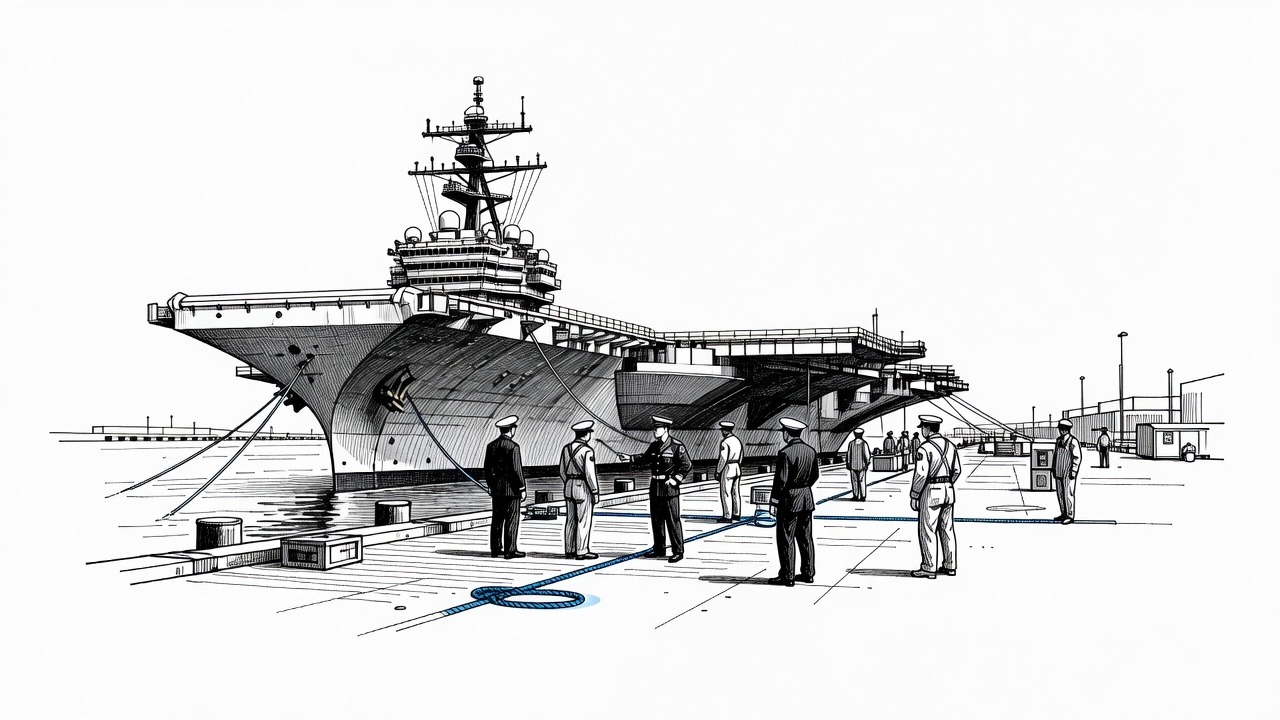
Start with a number the Navy chose to publicize: 265 consecutive days at sea without a port call, a service record. A record is what an institution announces when it wants a hardship to read as an achievement. Set it beside the number that came out only because lawmakers asked: eight sailors in the strike group attempted suicide during the deployment. The Navy offered the first figure as a triumph. The second it had to be asked for.
Neither figure is the real story. The story is how a country decides what its volunteers can be made to absorb, and who does the deciding.
Sailors on the Lincoln are workers in the most literal sense, and in an unusual position. They cannot quit, bargain, strike, or go home when the schedule changes. Merchant seafarers, a famously exploited workforce, are covered by an international labor convention that caps continuous service aboard a ship at eleven months, and it exists because the sea is a place where employers can quietly push people past what is humane. The military sits outside that framework for reasons that are partly legitimate. War is not a normal workplace. But the logic of the exemption is that someone senior weighs the cost to the people involved. When the one weighing is also the one demanding more ships on station, that protection is hollow.
The strongest defense of the Navy is worth taking seriously. This is a wartime deployment, the Lincoln's presence was presumably judged essential, and everyone aboard enlisted knowing it could mean this. Carriers are not run on shift schedules. A Presidential Unit Citation is not a cynical gesture, and the families on the pier in Coronado were not being fooled. I accept all of that. Sacrifice in war is real, and some of it cannot be engineered away.
But that defense only works if the sacrifice was necessary rather than a product of choices made upstream. A 321-day deployment is rarely an act of God. It reflects too few carriers for the commitments assigned to them, maintenance and shipyard backlogs that leave little slack, and a political class that treats naval presence as a free good. The Lincoln stayed out because relief was not there. Relief was not there because the fleet is stretched, and the fleet is stretched because the demand for force has outrun any honest accounting of what force costs. The sailors are the shock absorbers for that gap. Their sleep, their marriages, and their mental health are the slack in a system whose planners refuse to build any.
That is why Defense Secretary Pete Hegseth's response should bother people regardless of how they feel about the war. Reports of shortages, maintenance failures and strained morale were met with a flat rejection of the idea that the ship was dysfunctional. Perhaps the reports were overstated. But the man who sent the ship and then pinned a medal on it is the least credible auditor of its condition. Institutions that cannot hear bad news from their own people tend to find out about it later, in worse forms. A defense secretary insisting everything is fine, while the Navy briefs Congress on suicide attempts, is not reassuring.
The citation itself raises the same question. Honoring the crew is right. But recognition is the cheapest thing a government can give people it is asking too much of. Medals do not fix a berthing compartment, staff a counseling office, or shorten the next rotation. If the country wants to show respect for the Lincoln's crew, the proof is in whether anyone is held to account for the schedule that broke records and in how seriously sailors who struggled are treated after the cameras leave.
There is also a democratic question that the welcome-home coverage will skate past. The Lincoln spent most of a year in support of a war with Iran. The people who bore its burden are a small, self-selecting slice of the country, drawn disproportionately from families with fewer civilian options. The rest of us experienced this as a headline. A war that costs the public so little in attention and sacrifice is easy to extend, and a deployment that costs 4,500 people almost a year is easy to repeat. The first requirement of a serious debate about this war is that those who would send the next carrier be made to say what it costs, in human terms and not only in dollars, and to say it before the ship leaves rather than after it returns.
The families on the pier got their sailors back. Eight of those sailors reached a point where they tried to end their lives. That should weigh on the Pentagon's conscience more than any record it set.
How it may affect me
If you or someone you love is a service member or veteran in distress, the Military/Veterans Crisis Line is available 24/7: dial 988 and press 1, or text 838255. Families of deployed sailors can also ask their command's family readiness office or Fleet and Family Support Center about counseling and reintegration services, which are typically offered after long deployments.