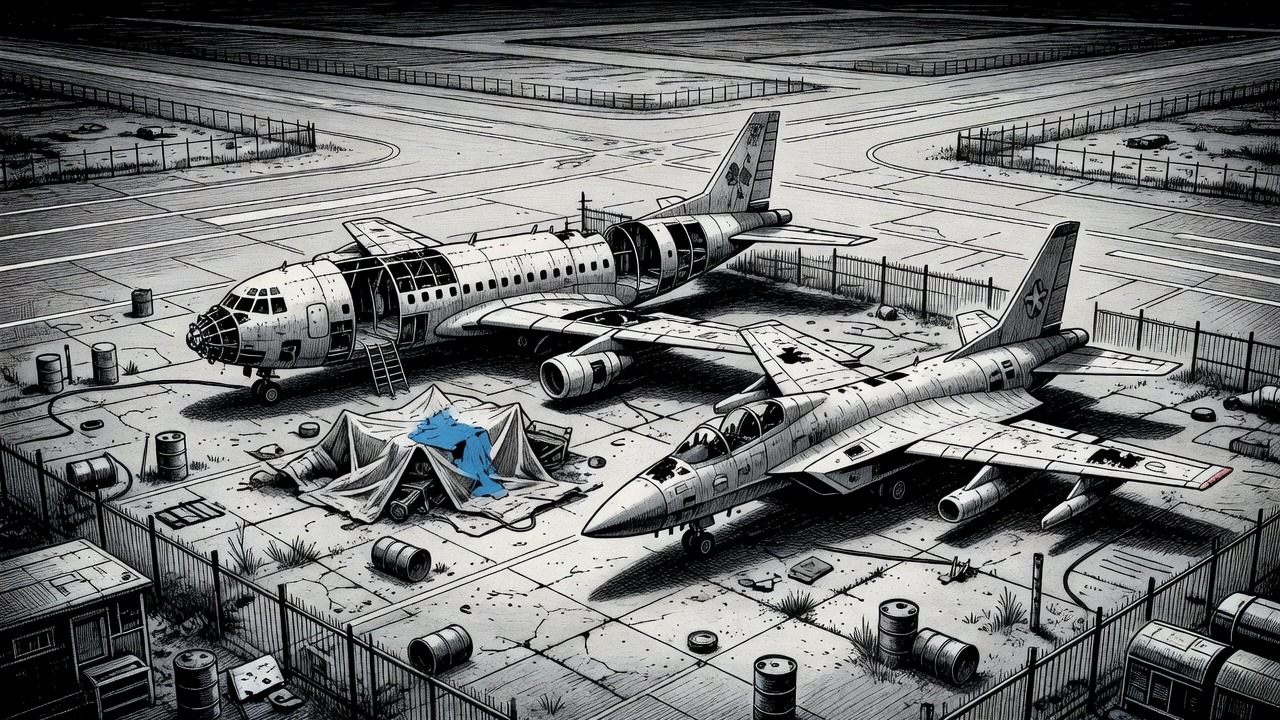
Consider the sentence in this story that sounds like good news: more than 90 percent of U.S. troops had been moved out of range before the Iranian fire began.
It is good news for those troops and their families, and the commanders who moved them deserve credit. But it also tells us something the headline's $3.7 billion figure obscures. The Pentagon knew what retaliation would look like, where it would land and roughly how bad it would be. It cleared the people out and left the buildings, aircraft and runways to absorb the blow. That is the behavior of an institution that expected the costs of this war and managed them, but apparently did not lay them out for the public that would pay them.
The cost-accounting we have now arrives after the fact, in an inspector general's report and a Congressional Research Service tally: about 60 aircraft, 81 assets lost or damaged since February, up to $3.7 billion. That is useful. It is also how democratic oversight works when it is working badly: an auditor counts the wreckage once the decision is already beyond recall. Whatever one thinks of the war's legality or necessity, I have seen no sign that anyone put this ledger in front of the public, or in front of a skeptical Congress, before the first strike. U.S. Central Command declined to comment on all of it.
The obvious rejoinder deserves a real answer. Iran attacked American installations, and a country that defends its forces is not at fault for being shot at. Equipment is replaceable, and by the report's account most of the damage was to equipment. Deterrence, in this view, did its job. I accept the first point and part of the last. But the argument proves less than it seems to. The question was never whether Iran would be responsible for its own missiles. It was whether a government that chose to escalate, knowing a network of bases across eight countries would be a target list, owed the public a clear-eyed estimate of what that escalation would cost. Forward deployment in Kuwait, Bahrain, Qatar, the UAE, Saudi Arabia, Iraq, Oman and Jordan was sold for decades as deterrence. In a war it works as a hostage structure: a permanent set of fixed targets that makes every decision for war also a decision to be hit.
That structure has another cost the report only hints at. Every one of those host countries was pulled into the line of fire by a decision made in Washington. Their populations, many of them migrant workers who build and service the region's infrastructure and have no political voice in any of these capitals, were not consulted either.
Then there is the lower bar we have learned to accept for American losses. At Camp Buehring, we are told, no one was killed by enemy fire, though injuries were reported. We have heard this formula before. After Iran's January 2020 missile strike on Al Asad air base, the public was first told there were no American casualties. More than a hundred service members were eventually diagnosed with traumatic brain injuries. Those injuries often surface days or weeks later, and the people who suffer them have had to fight for recognition and benefits. "Injuries were reported" should prompt a question, not offer reassurance: how many, how severe, and who is tracking them a year from now?
The six service members killed at the Port of Shuaiba are the number that matters most. A port is a logistics node, not a front line. That is a reminder that modern wars are fought and lost by the people who move fuel, ammunition and supplies, work that is rarely glamorous and, in the end, carries real risk. Their deaths will be a line in a report. The aircraft will be a procurement opportunity.
That is where the left should be most suspicious. A $3.7 billion loss is, for the defense industry, a customer order. Replacement spending will flow to the same handful of prime contractors that dominate Pentagon procurement, usually through supplemental appropriations that get far less scrutiny than the regular budget. Meanwhile the true bill, in veterans' care, in regional instability and in the strain on a military already stretched thin, comes due over decades, in forms nobody puts in a headline.
Credit is due to the inspector general's office for doing its job. But that office can only describe the damage. The decision about whether a war is worth this price belongs to the people who will pay for it, through their representatives, before the bases are hit rather than after. A government that evacuates its troops in advance because it knows the missiles are coming has already done the arithmetic. The public should have been shown it too.
How it may affect me
Expect the replacement bill to reach you as a supplemental spending request, which typically moves through Congress faster and with less scrutiny than the regular defense budget. If you have a family member stationed in the Gulf, note that brain injuries from blasts can appear days or weeks after an attack, so it is worth encouraging them to report any exposure or symptoms promptly to medical personnel rather than waiting to see whether problems develop.