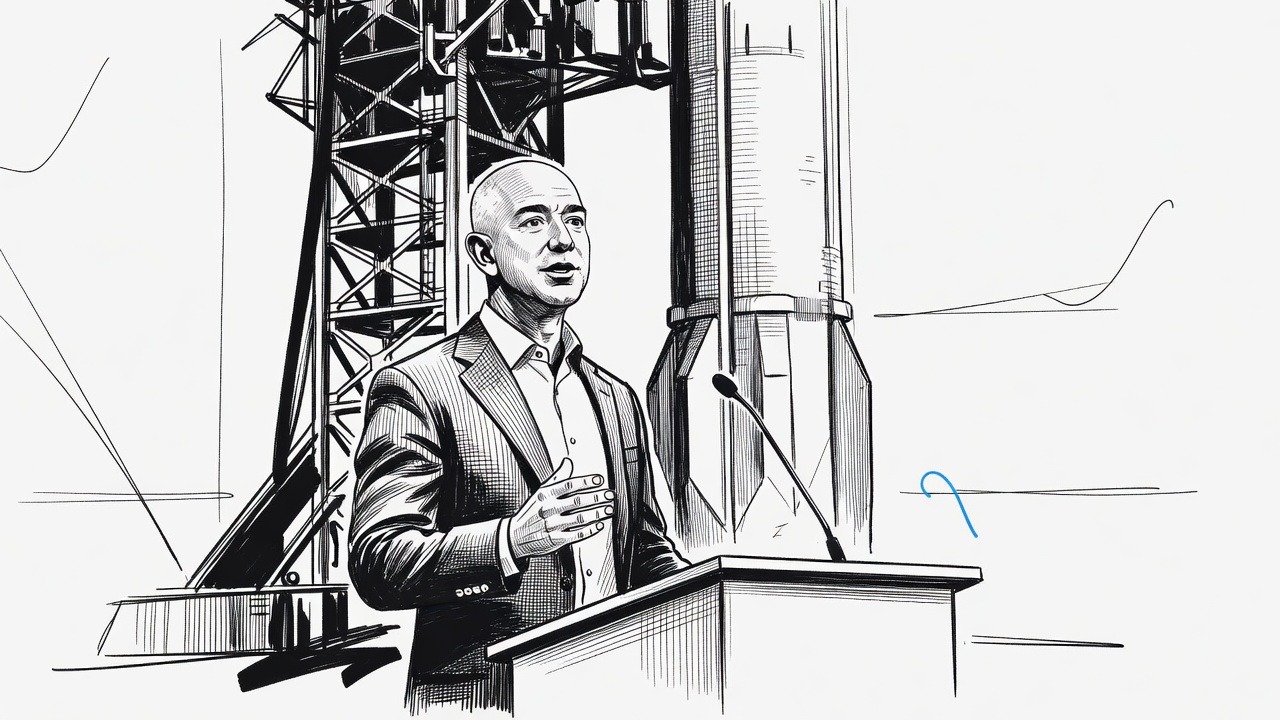
Somewhere in the middle of Jeff Bezos's tour of his future, between the lunar base and the Mars rockets, he said something almost kind. Artificial intelligence, he suggested, might raise productivity enough that some households could live on one income, or work fewer hours. Pleasant thought. It came from a man whose company's own engine test blew up in May, who is asking regulators to approve more than 50,000 satellites to serve as orbital data centers, and who thinks AI should face only limited government oversight aimed at "harmful uses and actors." Read together, the remarks make a coherent proposal. Technology will deliver the abundance, the owners will build the infrastructure, and the public will be asked to trust that the benefits arrive.
They have not arrived that way before. Keynes predicted a 15-hour work week for his grandchildren, and he was right about the productivity. American output per worker has grown for decades while typical pay has lagged far behind it. The eight-hour day and the weekend were not gifts from a farsighted employer. They were won through strikes, organizing and legislation. Whether AI produces a one-income household or a two-income household working harder to afford rent depends on who has bargaining power when the gains are divided, and that is a question of law and power, not of machine capability. Bezos knows this better than most. He founded one of the country's largest private employers, whose warehouse workers have spent years fighting for the kind of leisure he now describes as a natural by-product of progress. Promising shorter hours while your fortune rests on a company that has resisted the institutions that have historically delivered them is a little like promising rain while selling the reservoir.
The satellites are where the pleasant language runs out. Orbit is a shared resource. It is finite, it is hard to clean up, and it is already getting crowded, with astronomers, other operators and ordinary people looking up at the night sky all affected. A filing for tens of thousands of spacecraft is a bid to claim a large share of that commons for private computing. The purpose matters too. Orbital data centers exist because AI's appetite for electricity and land is running into public resistance and permitting delays on Earth. Moving the problem upward does not solve it. It converts a fight communities can join, over local water, power prices and zoning, into a licensing matter handled by a few federal agencies and the companies petitioning them. That is why the call for light-touch oversight deserves suspicion. "Harmful actors" is a standard that regulates other people. It leaves unexamined the business model of the company being asked to define it.
There is a serious case on the other side, and it deserves a hearing. Bezos is spending his own fortune, in large amounts and over a long horizon, on something other than yachts and buybacks. NASA's own heavy-lift programs have been a monument to cost-plus contracting, and commercial competition has cut launch costs dramatically. China's lunar program is real, and ceding the moon to Beijing is not a trivial prospect. I accept all of that. A public space program that depends on one contractor is fragile, and a second capable company is worth having.
But the case for competition is not a case for the terms Bezos prefers. Blue Origin's moon ambitions run through NASA contracts, which means taxpayers carry real risk and the public should expect real say. The lunar base he describes, with mined resources feeding solar cells and rocket fuel, is being built under an ambiguous legal regime. The Outer Space Treaty bars national appropriation but says little about who may profit from extraction. Who gets to use lunar resources, and on what terms, is exactly the kind of question that ends up decided by whoever arrives first with hardware. A race with China is an argument for public seriousness, including transparent contracts, enforceable safety and liability rules, and international agreements on orbital traffic and resource use. It is not an argument for clearing the field for a billionaire.
Bezos was honest about one thing: he allowed that AI investment could be a bubble. If it is, the cost will not fall on him. It will land on workers whose employers bet on automation that did not pay off, on towns that gave up tax revenue for data centers, and on public budgets that subsidized the buildout. A boom that makes owners richer and a bust that is socialized is not a law of nature. It is a regulatory choice.
I am not against going to the moon, and I am not against machines that save labor. I want the shorter week Bezos described. But a vision is cheap from someone who controls the means of delivering it. The test is whether the public gets enforceable rules on orbit and AI, whether workers get the power to claim their share, and whether the contracts are open to scrutiny before the rockets fly. Without those, "one income" is a slogan, and the moon is a very expensive place to plant a flag.