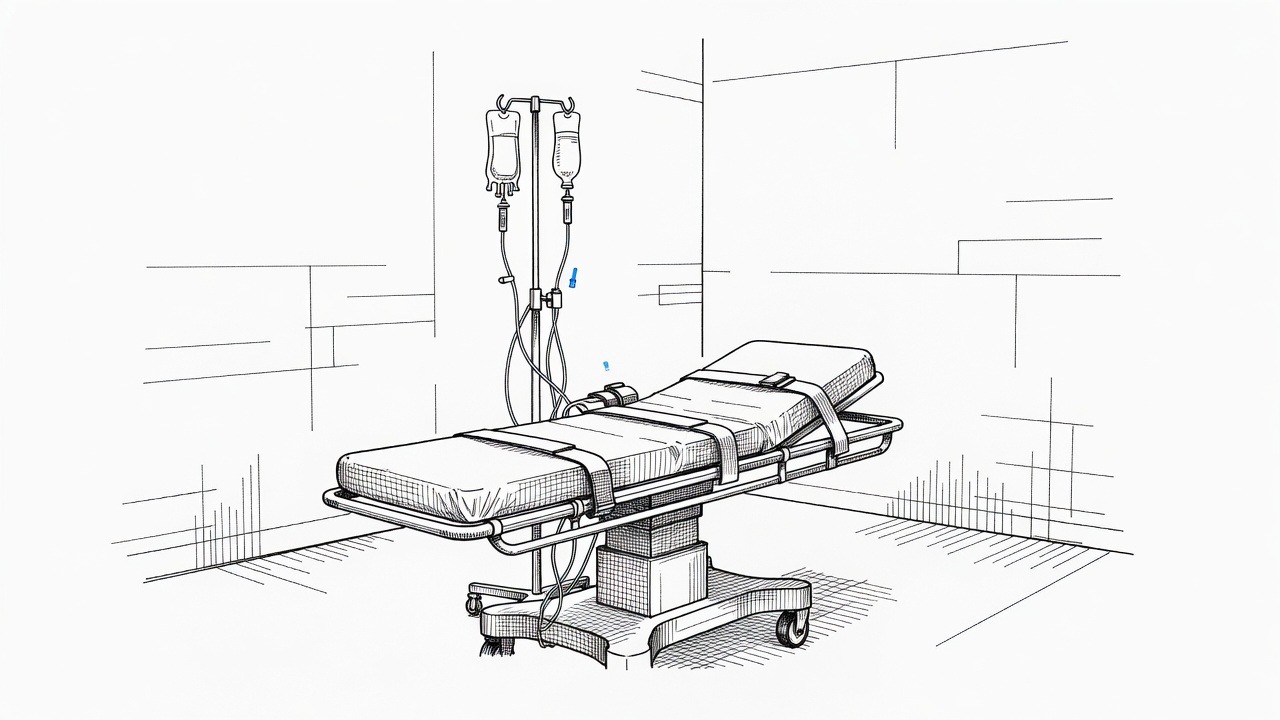
The most important sentence in this story is not about needles or pentobarbital. It is the state's assurance that established procedures were followed.
Take that at face value. If the procedures were followed, the failure was not a rogue technician or a bad afternoon. The system worked as designed, and what it produced was a woman who got two doses of a lethal drug, spent days in critical care, woke up confused, and now faces pneumonia, trouble swallowing, a blood clot and a long recovery. 'We followed the protocol' is usually offered as reassurance. Here it is a confession. Either the protocol is inadequate, or it was not really followed. The state cannot comfortably claim the first and has every reason to avoid proving the second.
That is why Judge I'Ashea Myles's order matters more than its dry list of medical waste, logs, drug labels and recordings suggests. The state holds all the evidence of what happened in that room. It also has the strongest incentive to let that evidence become ambiguous, and the order's instruction to try to recover material that may have been deleted or discarded shows the court knows it. In ordinary litigation, preserving evidence is routine. In an execution, where the witnesses are chosen, the participants are shielded by secrecy, and the only person who could testify to what it felt like was nearly killed by it, an independent order to hold on to the physical record is close to the only check there is.
The strongest case on the other side deserves a real answer. It says that Governor Bill Lee did the responsible thing: he stopped executions through the end of 2026 and ordered an independent investigation, which is the system correcting itself. It says a botched procedure is an argument for better procedure, not for abandoning the penalty, and that the victim's family is owed an outcome.
But Tennessee has run this loop before. Executions have been paused over lethal-injection problems already, a review followed, and the state came back with a new drug protocol. This is the result. Each cycle of fix and resume treats the death penalty as an engineering problem, when the deeper problem is institutional. The state wants the most irreversible power a government has, and it wants to exercise it behind secrecy, with drugs it has trouble sourcing, carried out by people it will not name, and reviewed by officials answerable to the same executive branch that runs the system. An investigation commissioned from inside the apparatus can be sincere and still be structurally weak. The judge's order is the part of this story that does not depend on anyone's good faith.
The silence on what comes next is also telling. State lawyers have not said whether they will seek another death warrant, and the assistant attorney general pointed to the Tennessee Supreme Court's authority over scheduling. That is a handoff of responsibility. Pike's lawyers have asked for commutation to life without parole, which would still leave her imprisoned for the rest of her life. The alternative is that a state keeps open the option of medically stabilizing a person so that it can try to kill her again. A government that does that has stopped asking whether the punishment is just and started treating its own failed process as an obligation to complete.
Progressives should be honest about what we are not saying. We are not saying the crime was minor, or that victims' grief is negotiable. We are saying that the legitimacy of punishment depends on the competence and transparency of the punisher. A state that cannot reliably carry out its most extreme sanction, cannot say plainly what went wrong, and needed a court to tell it not to destroy the evidence has forfeited the claim to be trusted with it. Life imprisonment is severe, certain and reversible if new facts emerge. This episode is the strongest argument in years that Tennessee should choose it.
How it may affect me
For Christa Pike, the immediate stakes are medical and legal: a hard recovery, uncertainty about whether the state will try again, and a commutation request that rests with the governor. For other people on Tennessee's death row, the moratorium through 2026 and the independent investigation could bring real scrutiny of drugs, staffing, training and secrecy, but only if the findings are public and the evidence the judge ordered preserved is actually kept intact. If it is, it may become the factual record for future challenges, in Tennessee and elsewhere. For ordinary residents, the practical issue is what kind of power the state is asking them to trust: one that carries out executions with limited transparency, whose errors are costly and uncorrectable, and whose paid-for review sits inside the government itself. The longer-term risk is that the pause ends, a revised protocol is announced, and the question of whether the state should do this at all never gets asked.