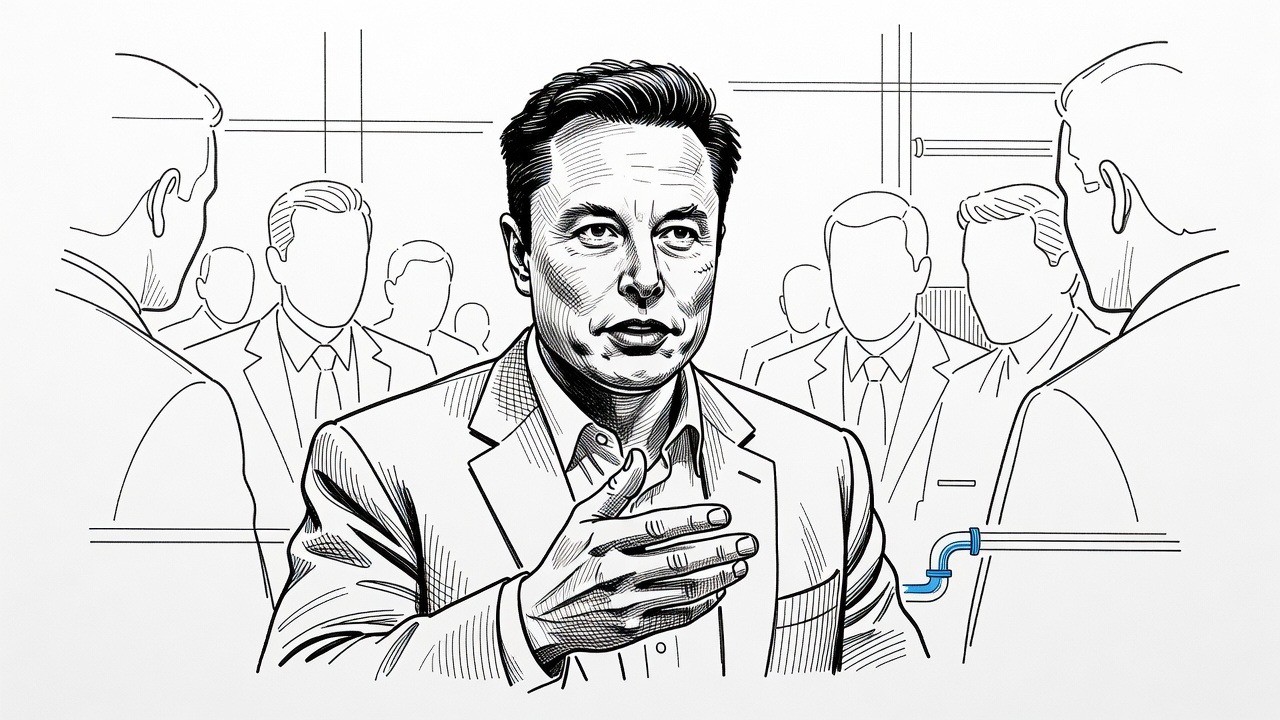
Read the Morgan Stanley note as a stock tip and it is dull. Read it as a map of where power sits and it is revealing. The analysts list the catalysts: AI product releases, cloud contracts, a Starship catch attempt. Further down the same story, almost as an afterthought, is the one that may matter most. The Pentagon has made Elon Musk a co-lead of Project Meridian, an effort to identify technologies for future military conflicts.
That means the person helping decide which technologies the U.S. military should want is also the controlling figure of a company that sells launch, AI and computing to the institutions that will want them. A conflict of interest is usually something an organization tries to wall off. Here it appears to be the org chart. When the vendor helps write the shopping list, "procurement" starts to look like a family dinner.
The strongest defense of this arrangement is serious and deserves a real answer. SpaceX has done things that legacy contractors, fattened on cost-plus contracts, did not. Reusable rockets are a genuine achievement. A Pentagon that wants frontier technology has to talk to the people building it, and expertise is scarce. Meridian is about identifying technologies, not signing checks. All true. But it is an argument about talent, and the problem is about structure. No one disputes that Musk knows rockets. The question is who checks him when his judgment about the future of war happens to coincide with his balance sheet. A government that has become dependent on one supplier loses the ability to say no, and a government that cannot say no cannot bargain. That is how the public ends up paying monopoly prices for what it helped create, since public contracts and public technical support are part of how this company grew.
Then there is the rebrand. Musk reportedly wants to call the AI division SpaceXSI, tying the name to branding associated with President Trump. A corporate naming decision is being used as a gesture of political tribute. Companies court governments in every era, but the courtship here is out in the open, and it is aimed at an administration that controls the contracts, regulators and military projects that make up much of the company's value. Investors can reasonably conclude that proximity to power is part of the business model. Morgan Stanley is not saying that. The market is pricing it anyway.
The corporate structure deserves the same scrutiny. By the analysts' account, SpaceX has absorbed xAI and Cursor and earns revenue renting computing capacity to Google and Anthropic. A launch company is turning into a conglomerate that spans rockets, AI models, developer tools, cloud capacity and national security work. Each piece may be defensible. Together they form a concentration of strategic infrastructure under one man's control, with the public holding shares only if it can afford to buy in and only to the extent the market lets it. Shareholder governance is a thin substitute for democratic accountability, especially when the controlling shareholder is also advising the Pentagon.
Finally, notice the rhythm of the note: buy before a test flight and before earnings. A rocket experiment is now an earnings event. That is a fine way to hype a stock, but it is a strange way to run a civilization's access to space, defense technology and AI compute. Ordinary investors who follow the $300 target are betting not just on engineering but on political favor, executive attention and the avoidance of failure in a business where failure is literal. The state, meanwhile, is betting its security planning on a single private enterprise.
The progressive answer is not to hate rockets or punish success. It is to insist that public power not be outsourced by default. That means recusal rules with teeth, public disclosure of what advisers like Musk touch and what they stand to gain, real competition and public capacity so Washington can walk away from a bad deal, and open procurement standards no brand name can bend. A country that can land a booster but cannot separate its war planners from its war suppliers has mastered the engineering and failed the politics.
How it may affect me
For ordinary people, the risks are about money, accountability and security. Retail and pension-fund investors who buy on a price target are exposed to a valuation that depends partly on political access and one executive's attention, not just on engineering. Taxpayers could face higher costs and weaker bargaining power if the Pentagon leans on a single supplier whose chief helps shape its technology priorities. If Meridian steers money toward products his companies sell, smaller rivals and public research efforts may lose out, and the public may never see how those choices were made. Concentrating AI compute, launch capacity and defense work in one firm also leaves essential infrastructure hostage to one person's decisions. Without recusal rules, disclosure and real competition, citizens have little way to know whether national security spending serves the public or a portfolio.