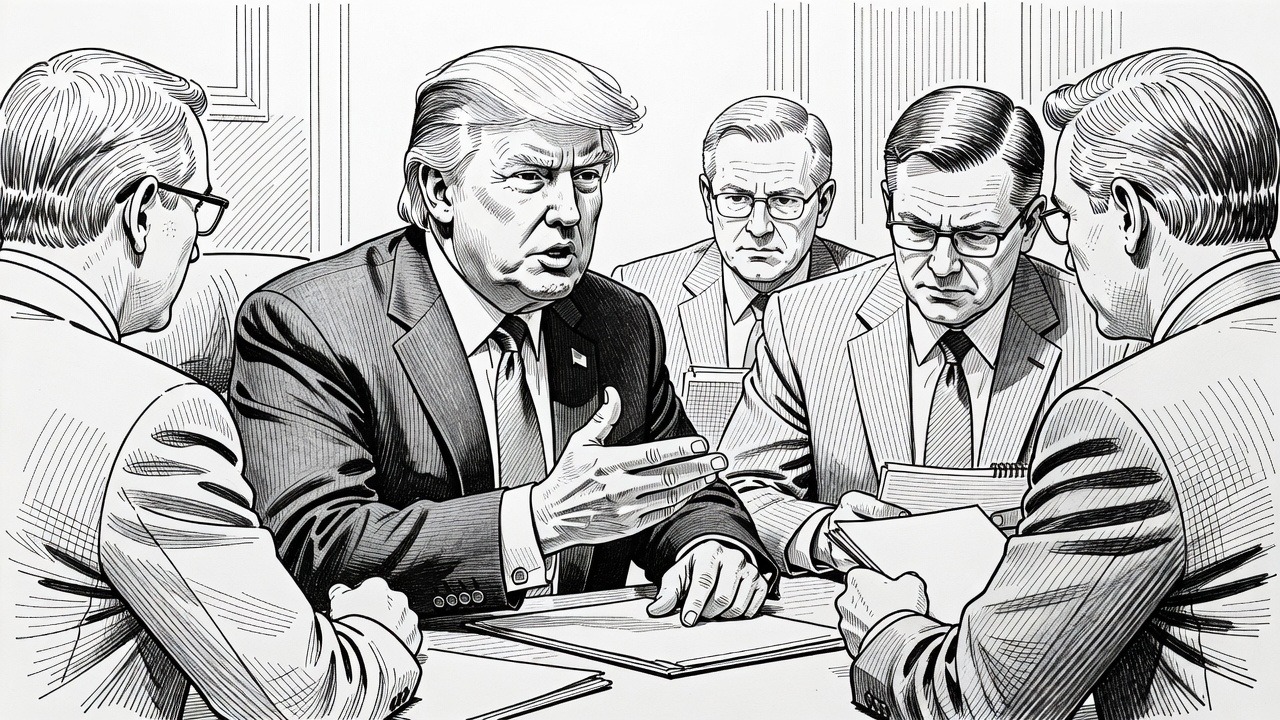
Ken Paxton did not sound, in Washington, like a man who had just taken a Senate nomination away from an incumbent. He sounded like a franchisee. At a Sept. 24 gathering he said national entities were determining the issues in his race, that his control over messaging and strategy was limited, and that he could not change the campaign's decisions. He added that a Republican midterm convention last month had hurt candidates' polling. His adviser, Nick Maddux, supplied the approved translation: this is what the law requires. Campaigns may not coordinate with super PACs. Paxton welcomes the outside help, is talking to Texas voters himself, and has started a statewide television campaign. Rival accounts of the meeting, Maddux said, were manipulated.
Grant the adviser his statute. The statute is the scandal.
The coordination barrier was built to keep money from purchasing a candidate's official acts. What it reliably produces is something a conservative ought to find more corrosive than an undisclosed lunch: a nominee who can be elected on arguments he did not choose and cannot countermand, and national entities that can shape a Texas race without ever having to defend those choices to Texans. Speech on the independent side of the wall remains protected, and it should. What the wall protects less well is responsibility. The voter is left to guess which sentences belong to the man on the ballot and which belong to operators who will not be on it.
That guess is not a technicality. Representation is a bargain of agency. You confer power on a person because that person can be praised, blamed, and replaced. Paxton, who defeated John Cornyn in a primary and a runoff by running as something other than Washington's senator, has now described a general-election campaign whose issues are being set by national entities he says he cannot override. His own advertisements and his own appearances do not erase the claim. They sharpen it. A candidate with a microphone and a media budget still chose to say, in the capital, that the decisions were not his to change. If Maddux is right that this is merely super-PAC law talking, then the law has taught candidates to speak of their own races in the passive voice. If Paxton meant something broader — consultants, party actors, national strategy shops — the passive voice is even less comforting. Either way, the name on the yard sign is no longer a reliable author.
The convention remark belongs in the same indictment. A party's nominee reporting that the party's midterm gathering damaged the polling of candidates is not a scheduling complaint. It is evidence that Republican institutional life can be organized around audiences other than the electorate: donors in the room, factions keeping score, a spectacle that travels poorly once it leaves the hall. Machines that exist to win consent and instead spend it are not the grassroots. They are concentrated political power, and skepticism toward that kind of power does not pause at the edge of one's own coalition. Democrats will run the same playbook around James Talarico; national infrastructure is not a Republican patent. The embarrassment is claiming the language of local accountability while accepting, out loud, that the issues have already been assigned.
None of this is cured by another round of speech restrictions that would only move the same money into still less visible channels. The conservative demand is plainer and harder. The person who wants the office should own the argument, in his own voice, without using a coordination rule as a heat shield. Outside groups should speak as themselves, not as the uncredited authors of a campaign the candidate is forbidden to edit and therefore tempted to disown. Limited government is not a government of clever partitions that separate power from the citizen who is supposed to wield it. A republic can absorb loud, even obnoxious, independent speech. It cannot absorb a habit of candidates who arrive in Washington already explaining that the race is being directed somewhere over their heads.
Texas voters are about to be asked to hire a senator. They deserve to know whether they are hiring a judgment or endorsing a product. Paxton's comments, however his adviser glosses them, are the label on the package.
How it may affect me
For ordinary Texans, the practical stake is whether a vote still hires a mind or merely licenses a message written elsewhere. If national entities are setting the issues, as Paxton said, then the problems a household actually lives with — border security, prices, schools, energy, crime — compete with whatever those entities have decided the race is for. The ads that follow may be impossible to attribute with confidence. You can refuse to vote for Paxton or for James Talarico; you cannot unelect a super PAC, a consultant shop, or a convention that, on the nominee's own account, already dented candidates' standing. Over a term, that mismatch teaches ambitious politicians to treat local persuasion as a distribution channel for decisions made in Washington rooms. The cost shows up as campaigns that feel louder and less answerable, as party spectacles that consume trust and then bill the public for another advertising cycle to buy it back, and as a Senate seat whose occupant can always gesture at forces he was never allowed, or never willing, to control. Citizens keep the franchise. What weakens is the old and useful threat behind it: that the person who asked for your vote will have to live with what was said in order to get it.