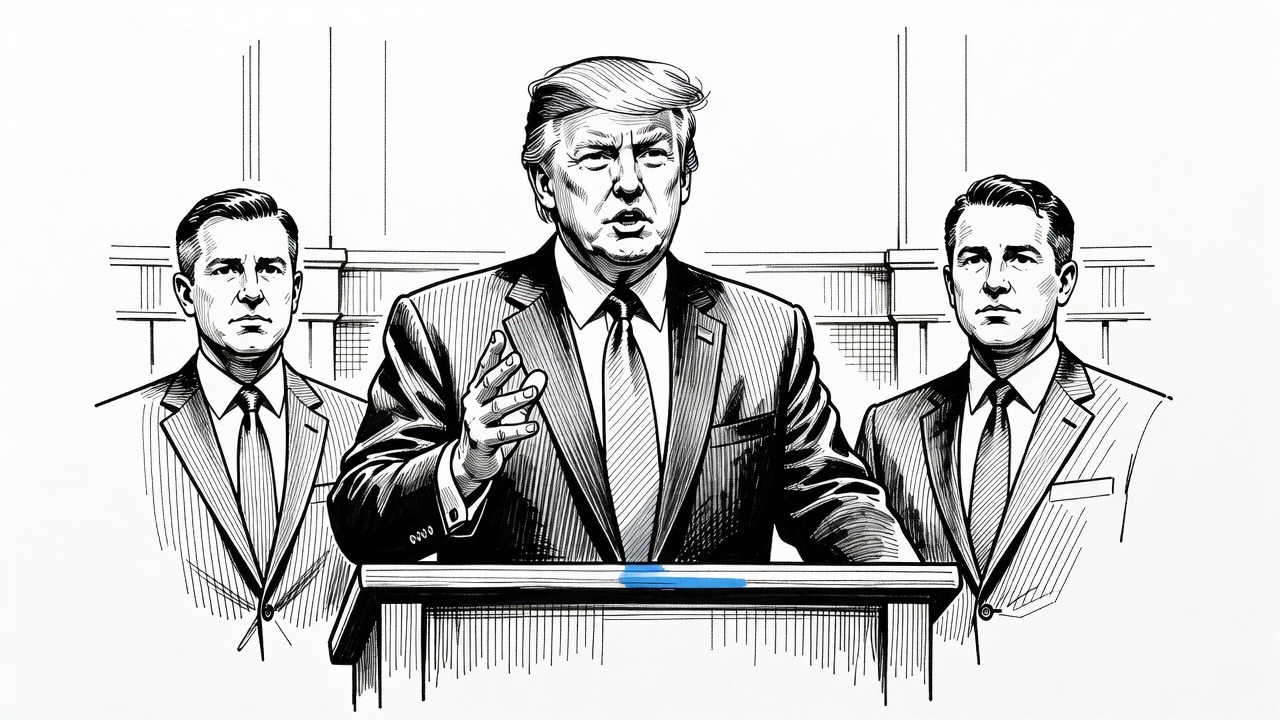
The most revealing thing about the Super Intelligence Force is not that Washington has decided to do something about artificial intelligence. It is the shape of the something.
President Trump has created a federal task force devoted to AI policy and development, placed the Director of National Intelligence at its head, and named Jay Clayton the administration's artificial intelligence czar. Around him sit the chairman of the Federal Trade Commission, the Pentagon's under secretary for research and engineering, and the director of the Office of Personnel Management. The mission, as described, is to coordinate federal efforts to keep the United States in the lead and to protect national interests, while engaging technology companies, critical-infrastructure operators, consumer organizations, public-interest groups, and religious organizations. The announcement follows an industry deal on voluntary safety standards that Trump has called morally binding. Clayton says the task force will review existing laws and consider what Congress might be asked to do.
There is a conservative case for part of this, and it should be made without flinching. Artificial intelligence will be turned to intelligence collection, cyber operations, and military advantage by governments that do not share our constraints. Critical infrastructure is on the list, which is where it belongs. Limited government is not ornamental government. Securing systems the public cannot secure alone, and denying a strategic rival a monopoly on the decisive technology of the age, are reasons the state exists. If this force stays inside defense, counterintelligence, and infrastructure resilience — and reports its ambitions to Congress rather than substituting for Congress — it is not a betrayal of liberty. It is a core duty.
The announcement does not stay inside that fence. Policy and development is a wider assignment than security. Development is a question of how the technology is built, by whom, and on whose terms. A czar is not a scheduler. In Washington the title has always meant a problem has been handed to someone with permission to wander across jurisdictions until the problem, or the rest of the government, gives way. Bodies created at this altitude do not retire when the headline fades. They acquire staff, a stakeholder community, and a bureaucratic interest in remaining indispensable. The next president will not inherit a press release. He or she will inherit a claim.
The phrase that ought to bother a rule-of-law conservative is morally binding. Voluntary standards are a gift when firms adopt them because engineers, customers, and insurers conclude the standards are sound. That is civil society and the market doing work no statute has to do. They are something else when a president declares them morally obligatory and a task force led by the nation's intelligence chief is the forum in which that morality will be interpreted. Conservatives have argued for years that informal pressure on technology companies is still an exercise of public power — that it skips statutes, ducks judicial review, and leaves people living under rules nobody enacted. The argument was not a complaint about one party. It was a complaint about method. Method does not become innocent because the White House has changed hands.
Nor should anyone confuse the guest list with the public. Companies, infrastructure operators, consumer and public-interest groups, and religious organizations will all be engaged, and some of them have a serious claim to be heard. Churches and other religious bodies are right to treat a technology that can counterfeit persons and reorder work as a question of dignity, truth, and family, not merely of throughput. But a federal table set for every organized interest is also the classic antechamber to a negotiated settlement, in which the people in the room write terms the people outside the room will have to live by. Free enterprise is general rules and open competition. Corporate privilege is a reserved chair. The announcement will not tell us which one this becomes. The process will.
Clayton's willingness to examine current law and to contemplate action by Congress is the sentence that still sounds like a republic. The legislature can draw lines an executive task force should not improvise: what the government may do with these systems against Americans, what concrete harms create liability, what security duties attach to the machines that run essential services, and what the state may not demand of private labs in the name of national leadership. A task force that tees up those choices is staff work democracy can use. A task force that acts first and leaves Congress to unwind it later will have followed the oldest routine in the capital.
American leadership in AI is not the hard question. Nearly everyone claims to want it. The hard question is what leadership is being asked to mean — firms racing under law that is public, limited, and difficult to bend, or a standing federal force that folds security, competition policy, personnel, and moral suasion into a single office and calls the combination coordination. One of those is a strategy. The other is a precedent. Precedents have a longer life than announcements.
How it may affect me
For most Americans, nothing about daily life changes the morning after a task force is announced. The consequences arrive later, and they arrive as incentives.
If the Super Intelligence Force confines itself to the work government is actually for, the practical gain is real: closer attention to how foreign adversaries and domestic failures could use AI against power systems, hospitals, finance, and defense. Ordinary people rarely see that protection. They notice its absence.
If the mandate spreads from security into development, the costs will not be evenly shared. Large technology firms can staff a relationship with a czar's office, help shape standards described as morally binding, and then absorb the resulting expectations as a cost of doing business. A startup cannot. What begins as voluntary coordination can become a quiet barrier to entry — not through a tax anyone voted for, but through access, contracts, and the understanding that official favor follows official morals. That is how markets get politically distorted while everyone involved insists they remain free.
Workers have a stake of a different kind. The presence of the government's personnel chief on an AI task force means the federal workforce itself is in view: hiring, evaluation, and the use of automated judgment inside the administrative state. Private employers will be watching the same conversation. Guidance that was never enacted can still become the safe way to manage people. Employees will experience that not as a white paper but as a decision about a job, a shift, or a record they cannot easily contest.
Families and religious communities should care about the forum as much as the outcome. Questions about truth, children, and human dignity deserve a public argument. They get a weaker one if they are folded into a stakeholder process and returned as consensus. The right that matters here is the right to know which rules bind, who made them, and how they can be changed.
The risk, then, is not that America takes AI seriously. It is that Americans wake up inside a system of coordination they never clearly authorized — safer in some infrastructures, narrower in some opportunities, and governed less by law than by the habits of a task force that was never meant to be temporary.