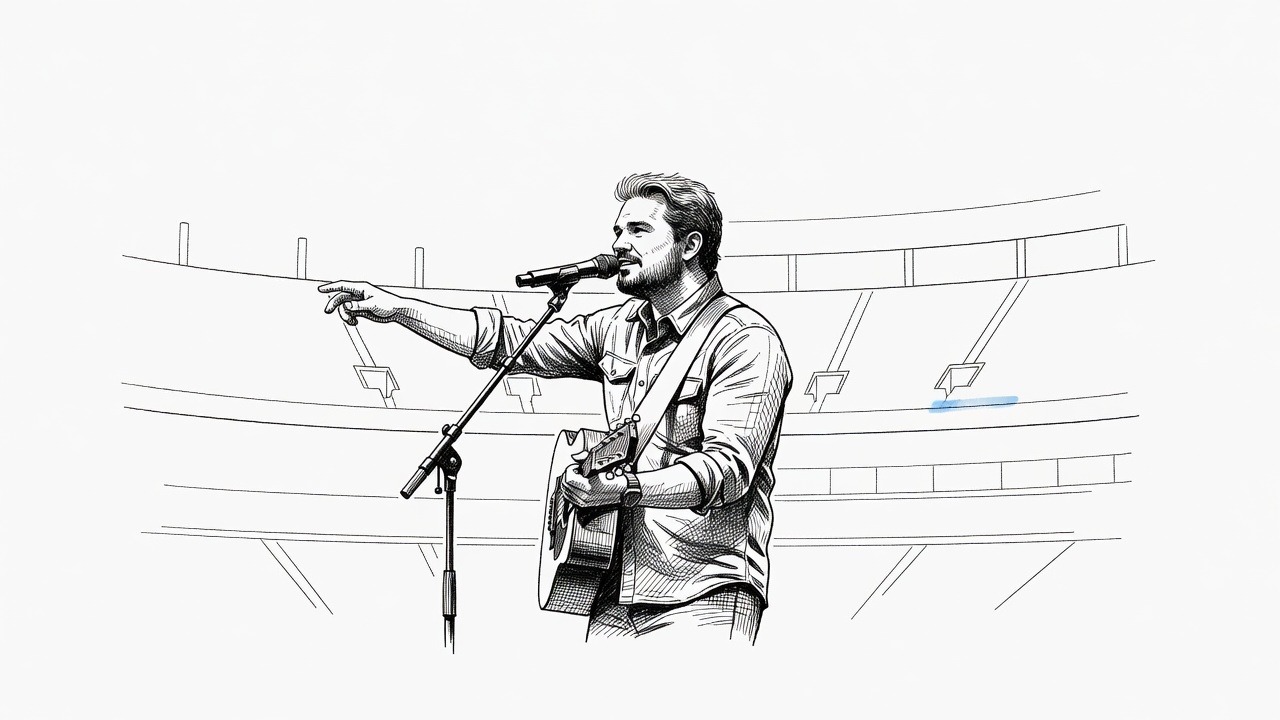
Zach Bryan did not tuck a political opinion between songs. He wore it. So did several members of his band. The shirt said “Free Palestine,” and the stage belonged to Gillette Stadium — a private venue whose owner, Robert Kraft, had already drawn a line on this subject.
Weeks earlier, Kraft barred Macklemore from opening for Ed Sheeran at that same stadium. His stated reason was not vague discomfort. He said Macklemore’s stage material and broader record of rhetoric had crossed an acceptable line and were offensive to the Jewish community. Macklemore had made pro-Palestinian statements at another stadium, then tried to hold a distinction: antisemitism is real, he said, but criticism of Israel and support for Palestinians should not be treated as hatred of Jews. Kraft had already decided that Macklemore’s version of that rhetoric failed as a booking standard for his building.
That is an owner’s right, and it is the correct kind of right. Gillette Stadium is not a public park. The First Amendment does not entitle an artist to someone else’s stage, someone else’s crowd, or someone else’s property. Bryan is free to hold his view and free to wear the shirt on his own time. Fans are free to applaud, walk out, or never buy another ticket. Kraft is free to refuse the message. Liberty includes the right to decline a platform, not only the right to demand one.
Which is why Friday is the issue. The story does not tell us what Kraft knew, approved, or intends to do before Saturday’s second show. What it does show is the contrast sitting in plain sight: a venue owner who said this kind of rhetoric was out of bounds, and a headliner who performed in the slogan itself, with his band dressed to match, on night one of two. A printed shirt is not gentler than a shouted lyric because the wearer is a country singer rather than a rapper. “Free Palestine” is a political demand, not a wardrobe detail. Kraft had already treated related stage rhetoric as offensive to the Jewish community. Popularity does not amend that standard.
Fans paid for a concert. They got a concert that doubled as a political display. If the line Kraft announced was real, it does not become optional when the draw is large or the message is cotton instead of a microphone. Consistent private rules are how an owner keeps the authority to set any. Selective ones are how that authority is given away.
How it may affect me
If you bought a ticket, the immediate effect is that a night sold as entertainment was also used as a political platform — by the headliner and by members of the band, not by a stranger in the crowd. You can cheer that, ignore it, or decide the next ticket is not worth it. That choice is the cleanest accountability a private market offers, and it does not require a new rule from the state.
What may follow is a test of whether the owner’s stated standard still means anything. If this kind of message is tolerated after Macklemore was barred for related rhetoric, patrons — including Jewish fans who took Kraft at his word — could reasonably conclude that the line moves with the size of the draw. If he enforces it around Saturday’s show, the precedent runs the other way: a private venue can still refuse a message without asking the government to police speech.
Either result reaches past one artist. It tells ticket buyers whether a stadium seat is a concert or a campaign stop, and it tells other performers whether a house rule is a rule or a press release. You are not obligated to subsidize the confusion.