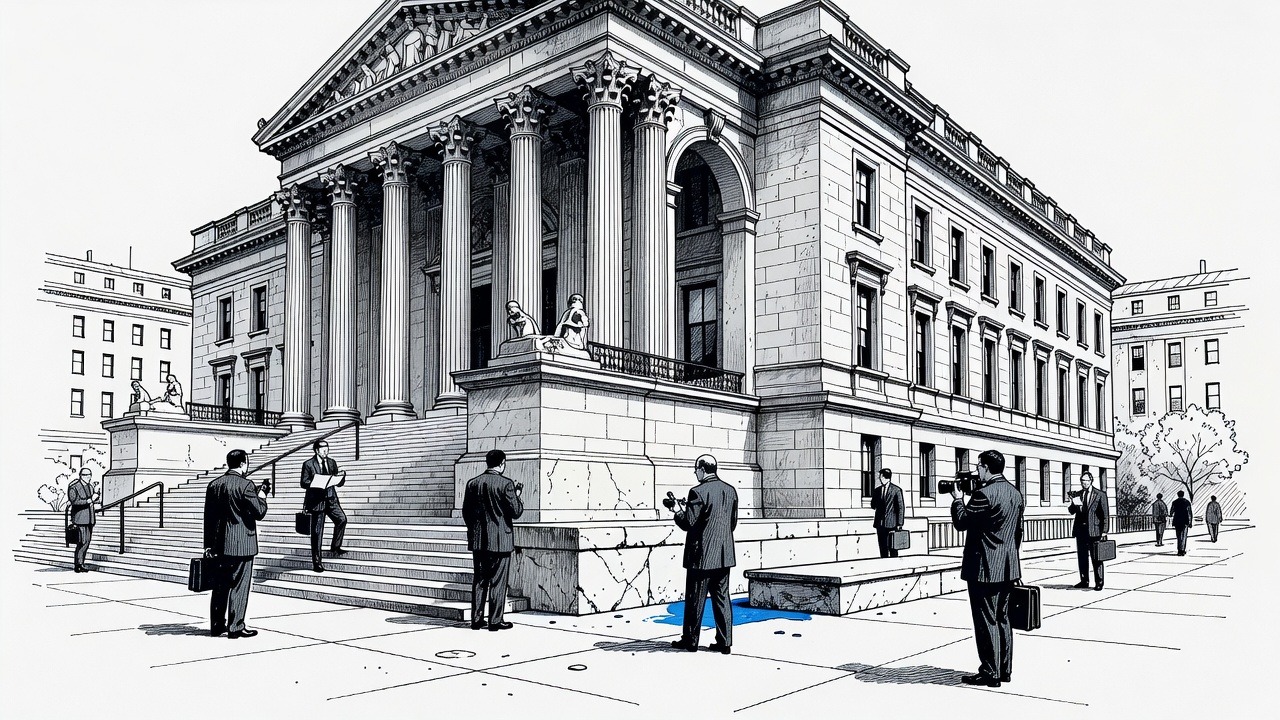
The security incident near RAF Fairford is a test of whether Britain can do two jobs at once: police a live terrorism inquiry without inflating it, and take an allied warning about Iran seriously without outsourcing the verdict to Tehran. Counterterrorism officers have arrested a 27-year-old dual U.K.-Iranian national on suspicion of preparing terrorist acts, after five British men were held near the base on suspicion of terrorism and explosives offenses, another British man was questioned under caution, and two London properties were searched. That is an investigation. It is not a conviction, and it is not a nothing.
RAF Fairford hosts U.S. warplanes. An incident on its doorstep is therefore not a parish nuisance. Prime Minister Andy Burnham said there were strong indications Iran had played a role. U.S. Homeland Security Secretary Markwayne Mullin said American authorities had expected Iran or its proxies to attempt an attack on an American asset in Britain and had already shared intelligence with British counterparts. Those are official claims, not courtroom findings. They are also the sort of warning a serious country does not file under speculation simply because the accused government says so.
Iran's reply is the convenient one. Foreign Minister Aragachi treated the five men's release as proof the accusations were unfounded. The embassy in London called the claims speculation. Bail is a legal restraint, not an exoneration. Police found gasoline in the three vans and did not find explosives or improvised explosive devices. That gap matters. It is why a rule-of-law state lets people go pending further inquiry rather than announcing a bomb plot the search did not support. It does not license the leap Iran wants: that no device means no threat, no Iranian role, and no reason for the later arrest. A foreign ministry does not grade another country's evidence.
The conservative conclusion is narrower than the headlines and stricter than the denials. Guarding a base that hosts allied aircraft is a core duty of the state, not an optional expansion of power. So is refusing to treat dual nationality as guilt, or suspicion as proof. Charge individuals for what can be shown. Keep exchanging the intelligence Washington says it already passed to London. Do not let the absence of an assembled device become an excuse for pretending the threat picture Burnham and Mullin described can be closed by a press statement. Deterrence fails if police invent a case. It also fails if governments treat a denial from the government they have just accused as the end of the story.
How it may affect me
Most people will not see the base, the vans, or the interview rooms. They may still pay for how this is handled. In the near term, that can mean tighter checks around military sites, more visible policing where officers judge the risk real, and slower movement for communities that live beside aircraft that are not only British. Those frictions fall first on people near the wire. Everyone else feels them mainly if an attack succeeds or if a temporary security response hardens into standing powers the evidence never justified.
Further out, the risk is bad incentives. If bail — granted after gasoline was found and explosives were not — is read as proof that nothing happened, anyone testing how close they can get to an allied base may conclude that a clean search is a political win. If Burnham's strong indications and Mullin's expectation of an Iranian or proxy attack are treated as already proved, the public is taught to confuse an intelligence warning with a verdict, and people the evidence does not support can be swept up with the rest. The outcome that serves ordinary readers is unglamorous: allied intelligence actually used, police who can tell gasoline from a device, and charges aimed at individuals rather than nationalities. A base hosting U.S. warplanes is part of how Britain is defended. Leaving its security to dueling press statements would be the more expensive choice.