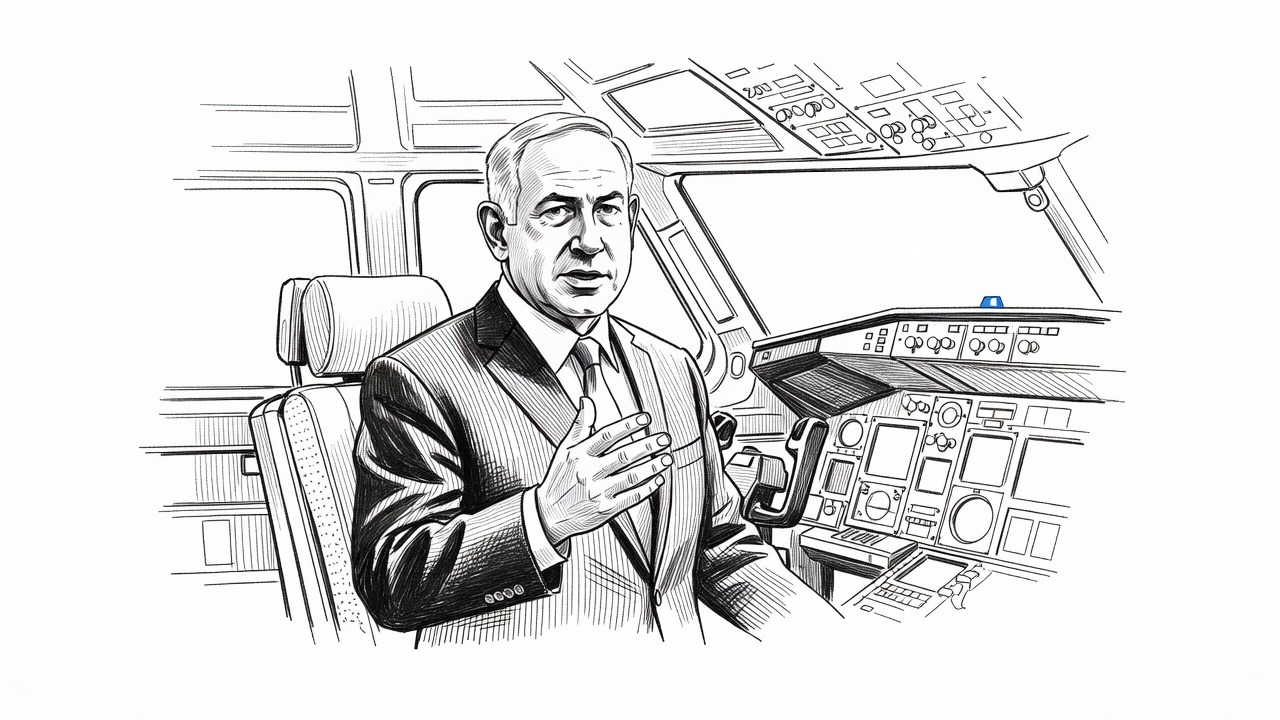
Strip away the politics for a moment and look at what actually happened here: a commercial aircraft experienced a violent in-flight incident involving a member of its own flight crew, and nobody died. The captain was stabbed, two crew members were hospitalized, the plane diverted to the nearest usable airport in Tabuk, and it landed. That is not an accident. Cockpit procedures, crew training, and diversion protocols exist precisely for low-probability, high-consequence scenarios like this one, and on the available facts, they functioned. That's worth saying plainly before anything else, because insider-threat incidents are the hardest category of aviation security to defend against. You can run every passenger through a metal detector and a watchlist, but a trained, credentialed co-pilot who passed background checks is already inside the system you built to keep threats out. This incident is a reminder that aviation security isn't just a perimeter problem; it's a personnel-vetting and ongoing-monitoring problem, and that's a much harder institutional challenge than screening luggage.
Now the harder part: the political framing. Prime Minister Netanyahu's characterization of the suspect's motive, including the claim of 'Islamist radical indoctrination,' is presented as derived from questioning of the suspect, but it is also a statement from the head of a government with an obvious interest in how this story is understood internationally, in the middle of an active, incomplete investigation. That doesn't mean it's false. It does mean it should be treated as a claim from an interested party pending independent verification, not as an established fact. Governments investigating attacks on their own national carriers have every incentive to settle on a clear narrative quickly; the incentive to get the narrative right and the incentive to get it out first are not always the same thing. The responsible read here is that we have an allegation of motive, not a confirmed one, and 'the suspect acted alone' is still an open question according to Israeli officials themselves. Treat the investigation as ongoing, because it is.
The regional dimension deserves a sober look too. A suspect who is an Omani national, a flight operating between Dubai and Tel Aviv, and a diversion to Saudi Arabia together describe a Gulf aviation and diplomatic environment that is more interconnected, and therefore more exposed to this kind of incident rippling across borders, than it was a decade ago. That interconnection is mostly a good thing economically and diplomatically. But it also means an incident like this doesn't stay contained to one airline or one government's jurisdiction; it becomes a multi-country investigation requiring cooperation between Saudi, Israeli, and Omani authorities who do not always have smooth working relationships. Whether that cooperation happens competently and transparently will tell us more about regional institutional capacity than any single press statement will.
How it may affect me
For ordinary travelers, the immediate effect is likely to be tighter scrutiny of flight crews, not just passengers, on routes touching Israel and the Gulf, at least in the near term. Expect airlines and regulators in the region to quietly review co-pilot vetting, psychological evaluation protocols, and cockpit-access procedures, since this incident exposes a gap that passenger-facing security measures can't close. That could mean modest delays or additional crew checks on affected routes, though it's unlikely to produce sweeping changes to how passengers themselves are screened, since the threat vector here was internal to the crew, not the cabin.
Longer term, and more speculatively, how this is resolved matters. If the investigation independently confirms a clear motive and establishes whether the suspect acted alone, that outcome could shape security cooperation and information-sharing between Gulf states and Israel going forward, which in turn affects flight availability and route confidence on these connections. If the investigation instead remains murky or contested, that uncertainty itself has a cost: insurers, airlines, and regulators may respond to ambiguity by tightening procedures more broadly and more cautiously than the facts strictly require, which is a cost ordinary travelers and crew would likely bear in time and inconvenience.