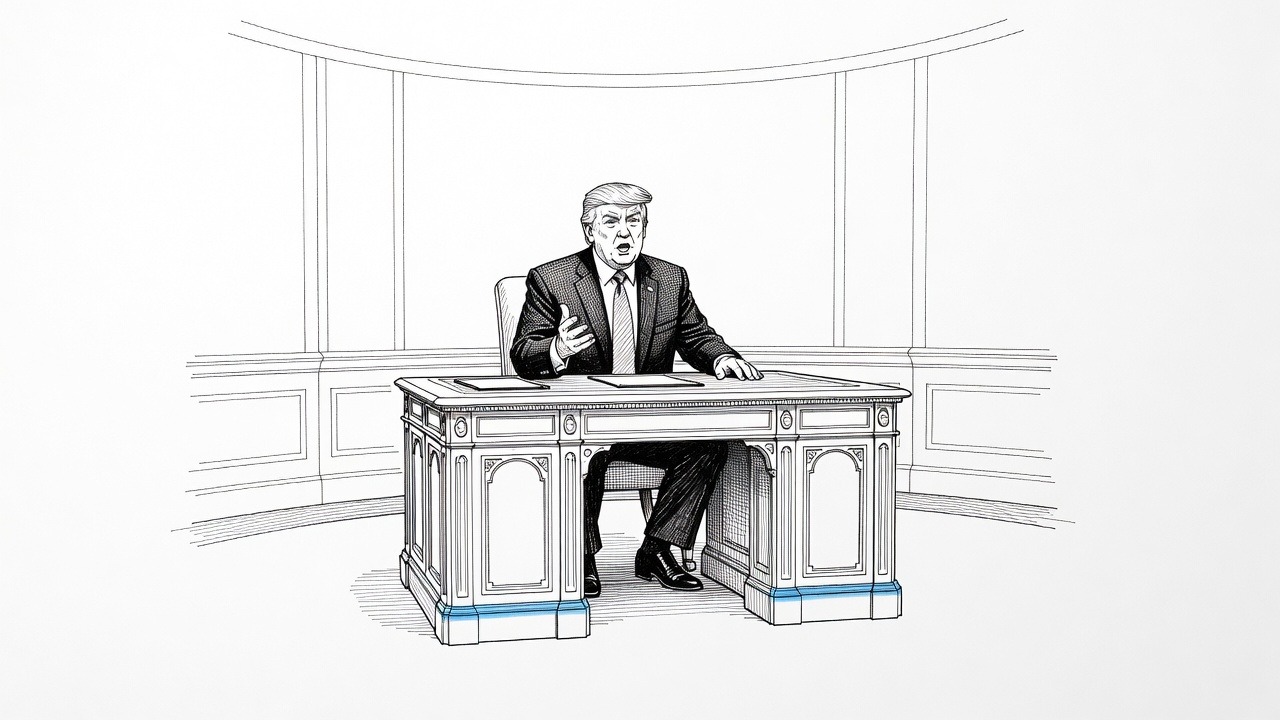
President Trump did the politically useful thing. Speaking from the Oval Office, he said he was unaware of the reported remarks, called the two-day Dallas convention highly successful, and said it helped other candidates. That is message discipline, not a cover-up. A party trying to win a Senate race does not profit from turning a private fundraiser aside into a public autopsy, and Trump is scheduled to campaign in Texas this week. The White House had already declined to comment. Letting the visit, not the leak, set the tone is the sound instinct: unity in service of the larger contest, not a loyalty test over contested audio.
The recording itself deserves adult skepticism, not partisan gullibility in either direction. Accounts say audio from a private fundraiser captured Ken Paxton suggesting polling declined after the convention. Three people familiar with the event confirmed he attended, and two corroborated the comments. His campaign called the material manipulated and intended to create a false narrative, without specifying whether it contends the audio was altered. Those are not the same claim. Attendance can be real while a quote remains disputed, and "manipulated" can mean edited, stripped of context, or simply weaponized. Until the difference is shown, the remarks should be treated as alleged, not established. Republicans also should not outsource judgment to unnamed corroborators or to a campaign denial. Both sides of that dispute have incentives.
What is not ambiguous is the competitive picture actually on the table. A ReconMR Texas Poll found 49 percent of likely voters for Democrat James Talarico and 43 percent for Paxton. Paxton's campaign cites an internal poll with him ahead by three. Campaigns rarely volunteer the survey that flatters the opponent, so an internal lead is a data point, not a rebuttal. A public poll of likely voters showing the Democrat ahead in a Texas Senate race is a problem of candidate strength, turnout, and message. It is not explained away by blaming a convention, and it is not invented by the existence of a leak. Trump's defense of the gathering is fair if, as he said, the event helped other candidates. It does not erase a six-point public-poll gap, and it does not require anyone to treat internal numbers as independent. Conservatives who care whether this seat stays competitive should watch the spread, and the visit, more closely than the fight over who winced at a fundraiser.
How it may affect me
For many readers, especially in Texas, the immediate effect may be distraction: a dispute over reported private remarks can crowd out the actual choice between Paxton and Talarico. Whether that noise changes enthusiasm around Trump's scheduled campaign visit is an open question. A visit that reinforces the convention as successful, as Trump described it, could steady Republican voters. A visit consumed by the audio fight could do the opposite, and could leave the campaign arguing with itself instead of with the voters a public poll currently shows on the other side.
If the ReconMR numbers are nearer the truth than the campaign's internal poll, a Texas Senate race some might have assumed was settled could instead be competitive, with possible consequences for which party has more say in the Senate. That is a risk, not a result. One public poll and one internal poll do not decide an election. Readers outside Texas may still feel it indirectly, because national attention, donor money, and presidential time tend to follow races that look close.
The smaller lesson is about private political speech. Remarks at a fundraiser can surface quickly, campaigns will contest them, and anonymous corroboration will be offered as proof. Readers do not have to choose between believing every leak and believing every denial. What is worth watching is whether the controversy fades once Trump is on the ground in Texas, or whether it hardens into a story that Paxton's own side thinks the convention hurt him — a story his campaign calls false, and that Trump, for now, has declined to indulge.