Putin Orders Increase in Russian Military Personnel as Fighting Continues in Ukraine

Illustration for: Putin Orders Increase in Russian Military Personnel as Fighting Continues in Ukraine
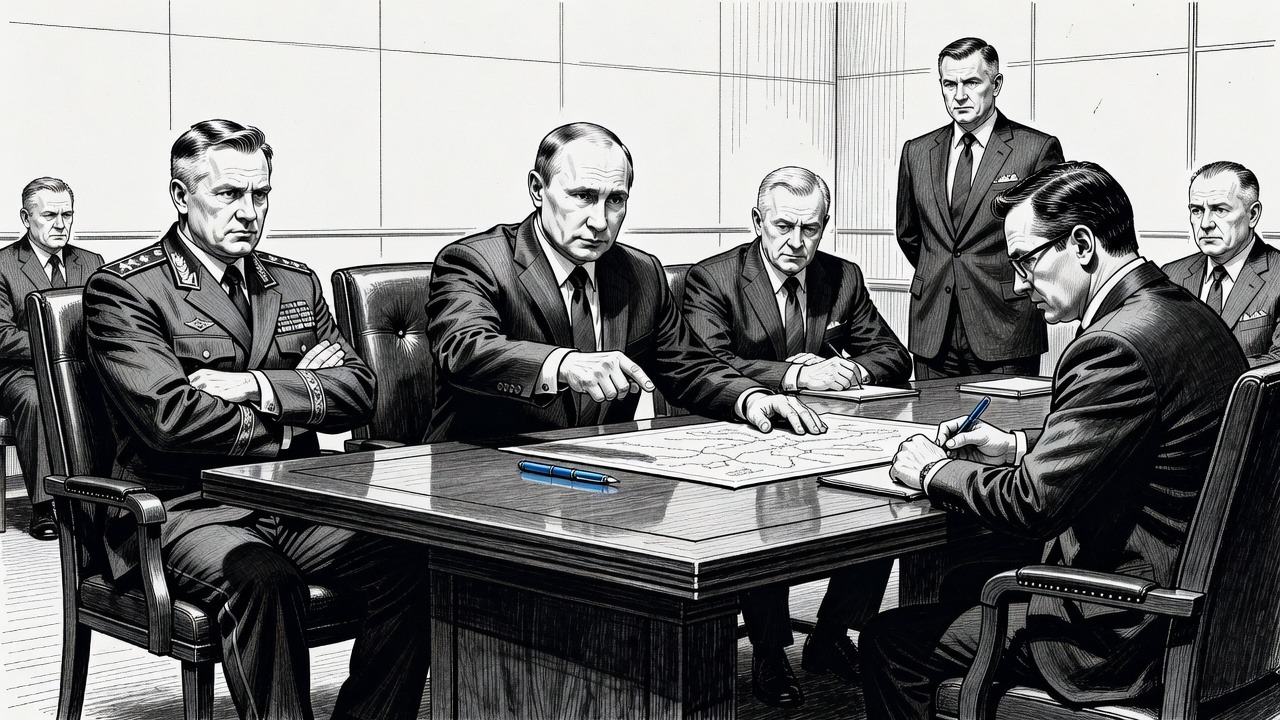
AI-generated illustration. Visual interpretation does not represent real individuals or scenes.

THE BARE STORY

Russian President Vladimir Putin issued a decree ordering an expansion of Russia’s armed forces to 2,441,630 personnel, including 1,550,500 active servicemen, according to the decree published Monday. The measure would add 15,500 active troops, and the Kremlin gave no official explanation for the increase.

The order comes as Russian attacks continued across Ukraine. Ukrainian authorities reported deaths and injuries in strikes on Kyiv, Dnipro, Kharkiv and the Chernihiv region. Russia’s Defense Ministry said its forces had struck targets in Kyiv, Odesa, the Black Sea and the port of Chornomorsk.

Ukraine and Russia also reported military gains and attacks that could not be independently verified. Russia’s Defense Ministry said Russian forces had taken two villages, while Ukraine’s Third Army Corps said it had regained territory in the Donetsk region.

Ukrainian President Volodymyr Zelenskyy said Russia was conducting a new mobilization effort and claimed that North Korean troops were in Russia or being prepared for deployment. He also said Ukraine had struck Russian defense and oil-related facilities. Diplomatic efforts toward a settlement remain stalled, according to the summaries.

Same Facts. Different Perspectives.

Three AI models. Three viewpoints. One factual foundation.

Strip away the drama and what you have is a bureaucratic decree, not a mobilization crisis. Putin's order adds 15,500 active servicemen to a force already north of a million and a half — a rounding adjustment, not a surge. That modesty is itself the story. The Kremlin learned in 2022 that visible, disruptive mobilization triggers exactly the kind of domestic unrest and emigration it can't afford politically. A quiet decree that pads the books through contract recruitment and paperwork is a far lower-risk way to offset battlefield attrition than another draft announcement. The absence of an official explanation isn't evidence of something sinister being hidden so much as evidence that Moscow has settled into a strategy of managing this war's costs incrementally, out of public view, rather than confronting them head-on.

On the battlefield claims, treat both sides' assertions with the same skepticism. Villages 'taken,' territory 'regained' — none of it independently verified, and wartime claims from either government's defense ministry are a communications tool as much as a military update. That's not cynicism for its own sake; it's just what the evidence quality actually supports right now.

The more consequential detail is the diplomatic paralysis. Talks aren't stalled because of miscommunication — they're stalled because both governments still calculate that continued fighting offers better terms than compromise does today. Russia's incremental troop growth and continued strikes on infrastructure suggest it believes attrition still favors its position. Ukraine's claims of Russian mobilization and North Korean troop involvement, if accurate, point to a war that is becoming more internationalized and harder to wind down through bilateral negotiation alone — which should temper any expectation that a settlement is close. Institutions built for peace talks require both sides to believe the marginal cost of continued war exceeds the marginal gain. Nothing in this decree, or in the continued strikes, suggests either side has reached that point yet.

How it may affect me

For ordinary Ukrainians, this changes little in the immediate term: strikes on cities and energy-adjacent targets like Odesa and Chornomorsk continue, and the war's daily toll on civilians is unlikely to ease. For global energy and commodity markets, continued strikes on oil-related facilities and ports are worth watching — sustained disruption to Black Sea shipping or Russian refining capacity could feed into fuel price volatility beyond the region, though the scale of impact remains uncertain and speculative at this stage. The quiet nature of Russia's troop increase suggests the Kremlin is not preparing for an imminent major escalation requiring broad public mobilization, which may modestly reduce near-term risk of a wider disruptive call-up inside Russia — but this is an inference, not a guarantee. If North Korean troop involvement is confirmed over time, it would signal that outside actors are helping sustain Russia's personnel needs, which could prolong the conflict's duration rather than shorten it. For anyone hoping for a near-term diplomatic resolution, the stalled talks and continued positioning by both sides suggest that hope should be tempered; the practical planning horizon for affected populations and markets remains one of continued uncertainty rather than imminent settlement.

Read the story at

Note: All TheBareNews content is AI-generated. For additional context, reporting, and updates, you are invited to explore the news outlets linked above.

Stories You May Have Missed