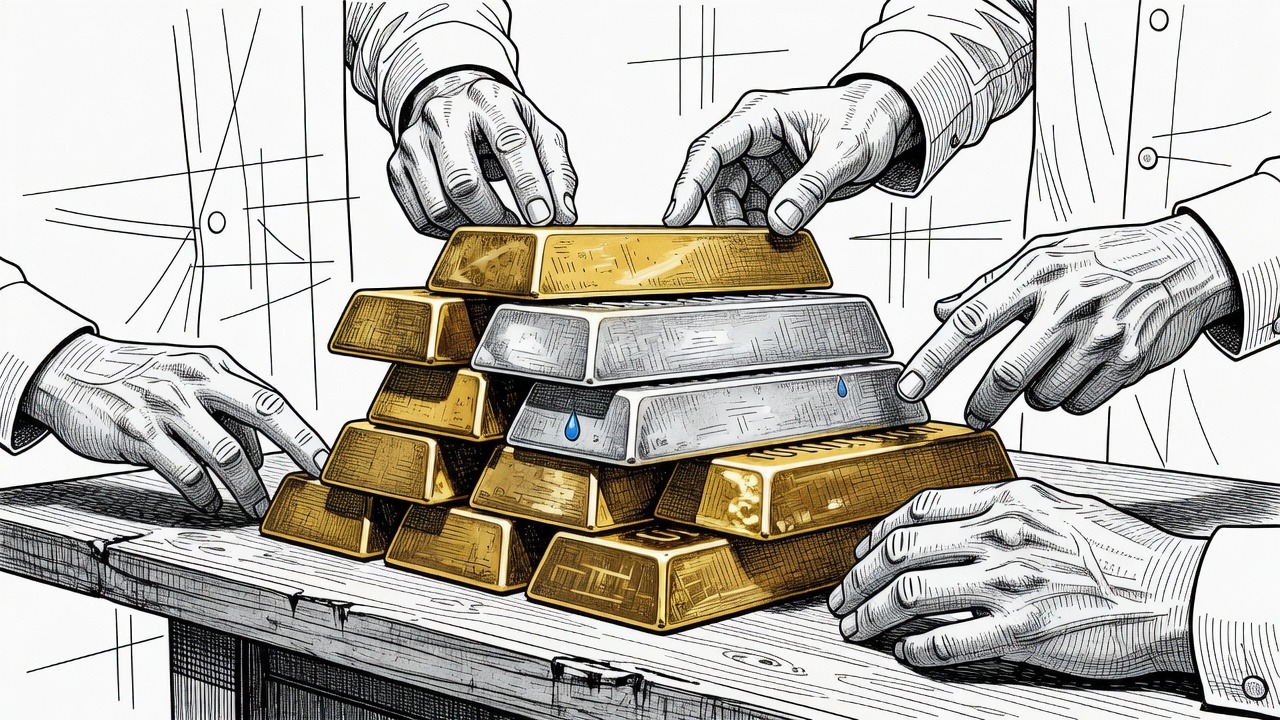
The headline pairing here is the interesting part: gold and silver getting hammered on the same morning inflation worries are supposedly building. That's not the usual script. Precious metals are the classic inflation hedge; you'd expect them to catch a bid when oil jumps 4% and price pressures are back in the conversation. Instead they fell hard — gold down over 3%, silver down nearly 5% — while yields rose across the entire curve, from the two-year to the thirty-year.
The more plausible read is that this isn't really an inflation story at all, it's a real-yields story. When nominal Treasury yields rise faster than inflation expectations, the opportunity cost of holding a non-yielding asset like gold goes up, and investors rotate out. The article also flags 'pressure on global government bond markets,' which is the more consequential detail buried in this piece. Rising yields driven by strong growth are one thing. Rising yields driven by markets demanding more compensation to absorb government debt issuance are another, and they carry worse implications for ordinary borrowing costs without the offsetting benefit of a stronger job market.
A single day's 3-5% move in metals is not evidence that the multi-month rally into the $4,000-plus gold range was a mirage, and it's not evidence the inflation-hedge thesis is dead. Metals that run hard tend to correct hard; that's ordinary market mechanics, not a verdict. What deserves more scrutiny than the metals selloff is why yields are climbing across every maturity simultaneously, including the short end usually anchored by Fed policy expectations. That pattern looks less like optimism about growth and more like a market recalibrating how much inflation risk and fiscal risk it wants to be paid for holding government paper — and reassessing how much room the Fed actually has to cut.
Treat today's price action as a repricing of real rates and risk appetite, not as a settled judgment on where inflation is headed. The oil move alone — a 4% jump in WTI — is itself an inflationary input that could show up in headline CPI before the ink dries on any 'inflation fears are overblown' narrative built on the gold selloff.
How it may affect me
The immediate effect for households runs through borrowing costs, not portfolios. Treasury yields, especially the 10-year, feed directly into mortgage rates, auto loans, and other consumer credit — so a move like this, if it holds beyond a single session, could make financing a home or car modestly more expensive in the near term, independent of anything the Federal Reserve does with its policy rate. The 4% jump in oil is the more immediate pocketbook risk: higher crude tends to show up at the gas pump and in shipping-dependent goods prices within weeks, not months.
For anyone holding gold or silver as a hedge — directly or through retirement accounts with commodity exposure — this is a reminder that these assets can move sharply against expectations, and a single volatile session shouldn't be read as confirmation that the inflation-protection thesis behind owning them has failed. It's also not confirmation that it's still working; the honest answer is that it's genuinely uncertain until the yield move and its underlying cause (growth strength versus fiscal/debt concerns) become clearer over the coming weeks. People nearing retirement or otherwise sensitive to bond-market and precious-metals volatility may want to avoid overreacting to one day's numbers in either direction.