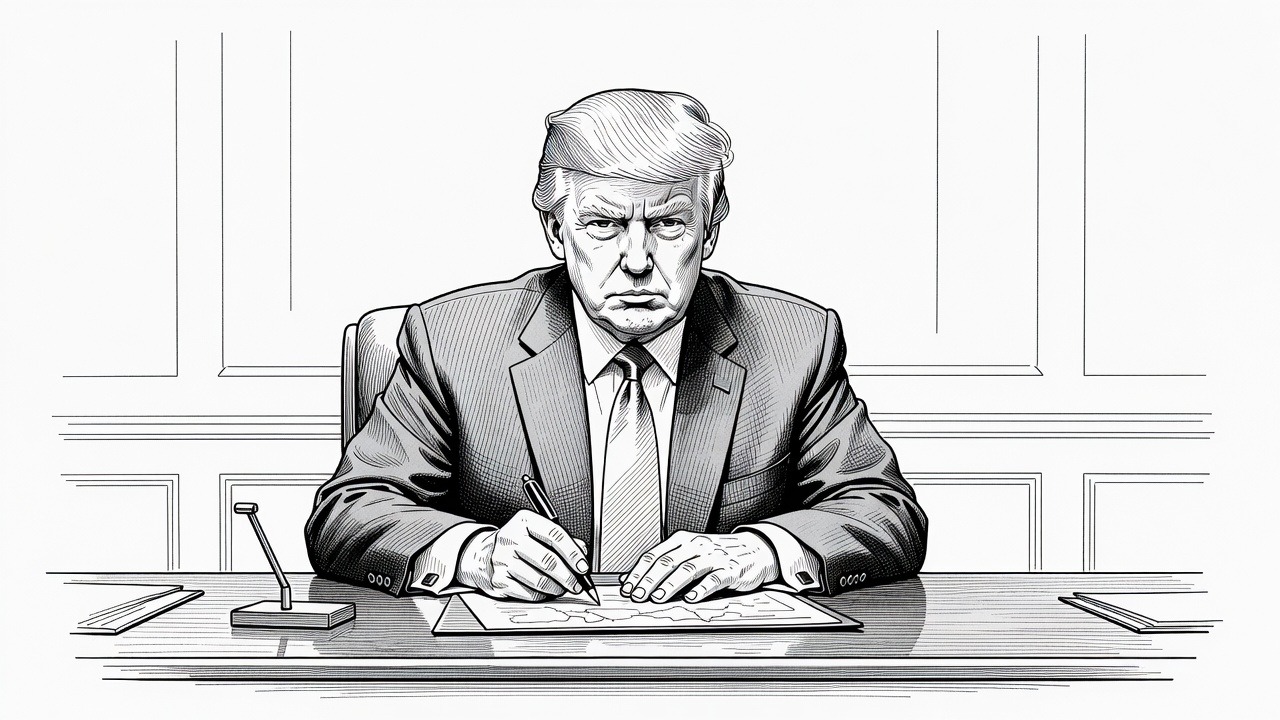
Donald Trump has pardoned or commuted the sentences of people who assaulted police officers on January 6, along with a rotating cast of political allies and donors. He now stands at a Justice Department podium and treats clemency as a moral obscenity. Mercy, apparently, is a prerogative of the president's friends.
That hypocrisy is the least important thing about Monday's event, but it is revealing. Trump's argument is not about public safety. Nobody disputes that the 548 people on California's death row will die in prison. The only thing Newsom's plan takes away is the state's promise to kill them. When the objection is to the *absence of killing* rather than the absence of punishment, you are no longer talking about deterrence or justice. You are talking about vengeance and calling it a policy.
The strongest case against Newsom is not Trump's. It is the democratic one: California voters rejected repeal in 2012 and again in 2016, and in 2016 they also passed a measure meant to speed executions. A governor commuting an entire death row looks like overriding the voters. I take that seriously. A term-limited governor should not settle by fiat a question he never persuaded the public to settle. If liberals want abolition, we should win it at the ballot box.
But the democratic argument cuts less cleanly than the death penalty's defenders pretend. What did California voters actually get? California has not executed anyone since 2006. Its death row became a warehouse where people age and die of natural causes, while victims' families are dragged back through appeals for decades with no end in sight. Voters were sold a punishment that the state has not delivered in twenty years. A sentence that is imposed with great ceremony and never carried out is not a sentence. It is a theatrical prop. Life without parole, carried out immediately and certainly, may be the only version of this punishment the state can honestly deliver.
That is also what the grieving families deserve to hear. Their pain is real, and no one should lecture them. But grief does not make a policy correct. Some victims' relatives want the execution. Others beg for the process to end so they can stop reliving the worst day of their lives every time a court calendar turns. A justice system that treats the first group as the only authentic voice is making a choice about whose suffering counts.
Then there is the problem that no podium speech can wish away: the state gets it wrong. Close to 200 people have been exonerated from death rows across the country since the 1970s. Every one of them was convicted by a system that was certain. Prison can be undone when the evidence changes. An execution cannot. Trump's order to "accelerate" executions is an order to compress the time in which errors can be caught, and he issues it at the head of a Justice Department that has spent months demonstrating how casually it treats evidence, process and the rule of law when politics demands it.
Expanding capital crimes only deepens the danger. Prosecutors are being told to seek death in the most emotionally charged cases, the murder of a child or a killing after a sexual assault. These are exactly the cases where public fury is hottest and the pressure to name a culprit, any culprit, is strongest. History shows that this is where wrongful convictions pile up.
So here is where the Left should stand. Newsom is right on the substance and should have made the case openly, years ago, instead of leaving it to executive action and a court review. Trump is wrong in a way that matters, because he is turning the machinery of death into a show of strength. A government that cannot reliably deliver a parking ticket without error should not be racing to deliver irreversible punishment faster.
Mercy is not weakness. The president who hands it out freely to his allies knows that better than anyone.