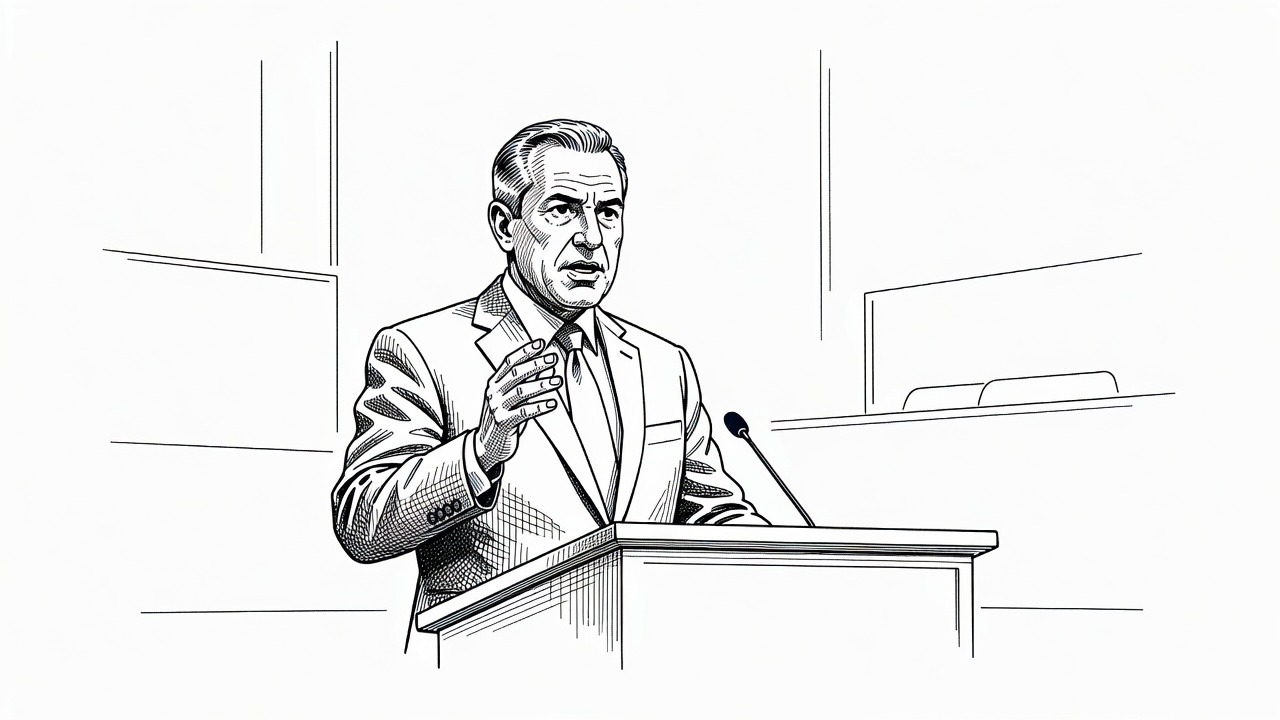
Imagine the reverse. A Hezbollah media officer walks into a school in northern Israel, films herself with the pupils, and posts it for Israel's Independence Day. No one would call it outreach. It would be a scandal, a security alarm and a week of cable segments about terror and indoctrination. Everyone understands that instantly. It is harder to see when the uniform is Israeli and the children are Lebanese.
We should be precise about what happened. An Arabic-language spokeswoman for the Israeli military, Lt. Col. Ella Waweya, appeared before schoolchildren in the southern village of Dibil and published the footage on Lebanon's Independence Day. The education minister says her ministry knew nothing about it. The municipality says the school never gave permission. We don't know every detail of how she got in the room. We do know the children had no say in whether they became content.
That is the point. This was not a cultural exchange. The army in question has spent more than a year bombing southern Lebanon, has kept troops on Lebanese ground despite the November 2024 ceasefire, and continues to strike the country regularly. Children in that region have heard those aircraft. Some have lost relatives to them. A teacher or principal facing an officer from that army cannot say no the way a free adult can. Consent given in the shadow of occupation is not consent. It is compliance, and compliance filmed for a PR campaign is exactly what it looks like.
The timing makes it worse. Wishing Lebanon a happy Independence Day while your military holds ground inside it is not goodwill. It is a taunt dressed as friendship, a message to Lebanese viewers that the Israeli army can reach their classrooms whenever it chooses. That is what makes the stunt effective as influence work. It is also what makes it a violation.
The Israeli response is revealing. The army says it is reviewing whether Waweya had authorization to *publish* the material. Notice what is being examined: the post, not the visit. The question is whether the paperwork was in order, not whether an officer from a foreign army should have been using Lebanese schoolchildren as props. A military that treated this as a real breach would be asking the second question.
The strongest defense I can imagine is that this was harmless: smiling kids, a friendly gesture, and a Lebanese government pressured by Hezbollah into theatrical outrage. Hezbollah does exploit civilians and children for its own messaging, and that is indefensible too. But that argument proves my point. If using children for political messaging is wrong when Hezbollah does it, it is wrong when a state with F-35s does it. A rule that applies only to enemies is not a principle. Prime Minister Nawaf Salam is right that this violates children's rights. Defending children's dignity should not depend on who is holding the camera.
Salam's position is also uncomfortable, and it should be noted. His government is trying to assert state authority over a south that has been shredded by war, while the country's sovereignty is violated daily by a neighbor with overwhelming force. Condemnation is nearly all he can offer. That weakness is why the stunt worked: it showed that Lebanon's institutions cannot control who enters their schools.
The broader lesson is the one we should apply everywhere. Children in conflict zones are not an audience, a backdrop or a branding opportunity for anyone's army. Schools are supposed to be the one place where the war does not follow them. When a uniformed spokesperson walks in with a camera, that protection is gone, and a ceasefire that allows it is not worth the name.