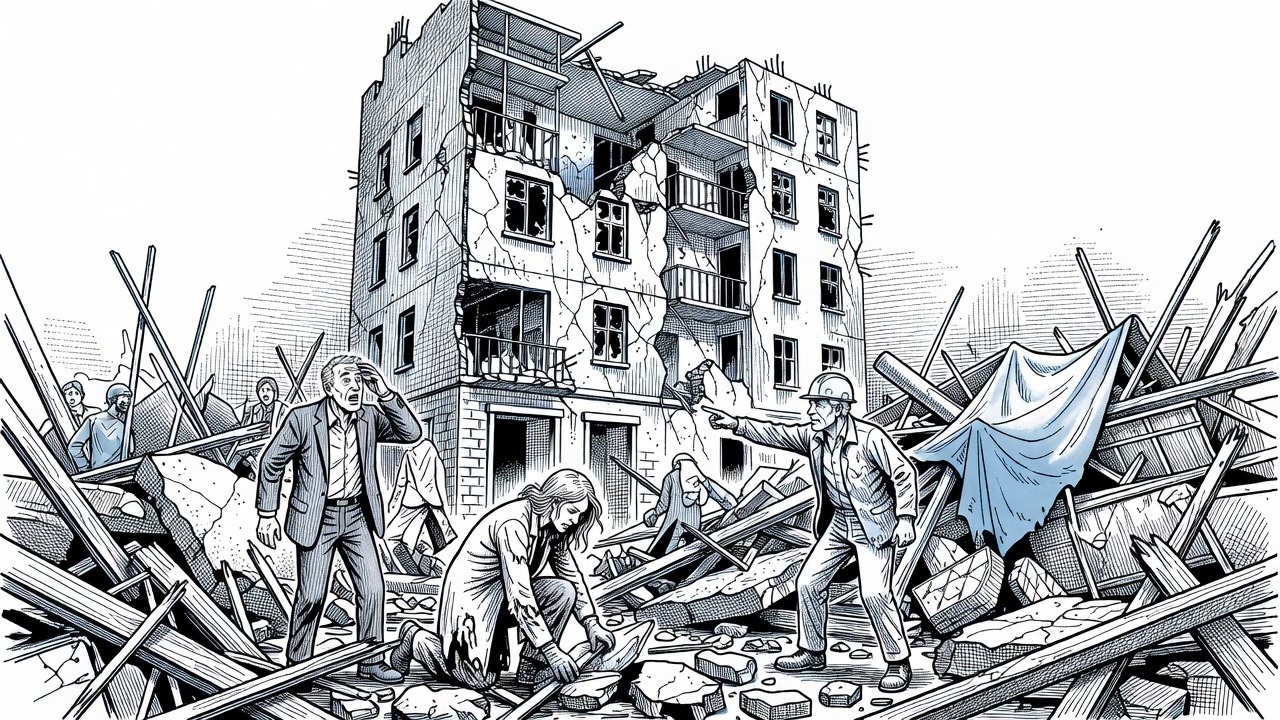
Ten or more people are dead because a missile or drone hit a nine-story... we do not yet know the exact kind of building, only that it was an apartment block in Dymer, and that it fell down. Rescuers are digging through concrete for people who went to bed in their homes. Fifteen people, three of them children, were wounded at a supermarket in Vyshneve. Nobody has to speculate about the military value of a supermarket.
This is not a new kind of story, and that is the problem. We have read it for years: Dnipro, Odesa, the children's hospital in Kyiv, now a suburb whose name most Americans will forget by tomorrow. Repetition numbs us, and the numbness is itself a political force. It makes the war feel like weather rather than a choice made daily by a government in Moscow.
The American Left has to be honest about its own part in that numbness. A strand of left opinion, which I have shared at moments, treats this war chiefly as a problem of American policy: the cost of aid, NATO's role, the arms industry's profits. Those questions are legitimate. Scrutinizing the Pentagon's contractors is a duty, not a betrayal. But there is a version of anti-war politics that quietly deletes the Ukrainians. It talks about "ending the war" as if one side were not the one dropping ordnance on apartment stairwells. Peace is not a neutral word when the terms are set by the army that wants the territory.
The Left's deepest tradition is anti-imperialism. It was supposed to mean something when a large power declares that a neighboring country has no right to exist as it chooses and then flattens its cities to make the point. Ukrainian unions, who have organized under martial law and been stripped of labor protections by their own government, and Ukrainian socialists, who fight in the army and criticize Kyiv's economic policy, have never found this confusing. They know the difference between a flawed government they can vote against and an occupier they cannot.
So the demand is not complicated. Air defense saves apartment buildings. Interceptors are the difference between a night of sirens and a night of rubble. Every delay in delivering them, every congressional stall, every White House suggestion that Kyiv and Moscow are equally responsible for the shape of the conflict, has a body count, and this morning's count is at least ten.
Democrats should say so without flinching, and without the vague, committee-drafted language that has become their habit on this issue. If you believe, as most of the party says it does, that borders cannot be redrawn by force, then you do not get to treat sustained support as a line item to be rationed by polling. Nor can you let the Trump administration's transactional approach, which treats a invaded country as a bargaining chip and a minerals deal, pass as realism. Realism would acknowledge that a Russia rewarded for bombing civilians will bomb more of them, and not only in Ukraine.
There is also a plain moral reflex that politics should not be allowed to dull. Somewhere in Dymer a family is waiting for a rescuer to reach a voice under the slabs. Our job is not to find the most sophisticated way of looking away. It is to make sure the next building stands.