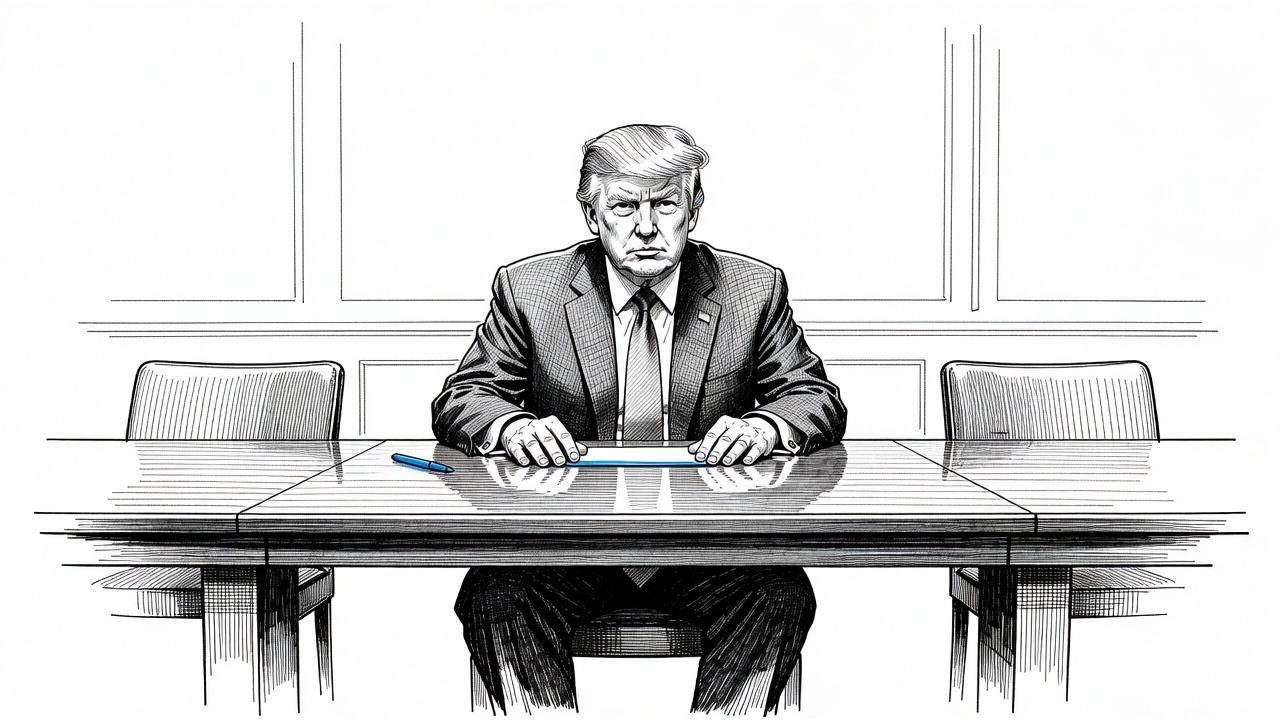
The most important sentence in this story isn't about Donald Trump or Kim Jong Un. It's Victor Cha's. A former U.S. official, and no dove, says Washington should accept that North Korea's nuclear status is irreversible and pursue arms control instead of denuclearization. When that view comes from the establishment's own side, the fiction at the center of American Korea policy is finished.
For thirty years, denuclearization has been the stated goal of Democratic and Republican administrations alike. Clinton bargained for it. Bush denounced it into oblivion. Obama waited for it with "strategic patience." Trump tried to charm it into existence. Biden mostly ignored the problem. Over those decades, North Korea went from a handful of plutonium rods to an arsenal widely estimated in the dozens of warheads, with missiles that can reach American cities. That is what the consensus produced. We kept demanding the one outcome Pyongyang will never give, and in the meantime we got nothing.
The reporting doesn't spell out Kim's conditions. But the picture is clear enough. He wants to be treated as the nuclear state he already is, and Washington wouldn't do it. So there was no summit.
Meanwhile, the things officials reportedly considered offering were sensible. Formally ending the Korean War, which stopped in 1953 with an armistice and never a peace, costs America nothing but the habit of hostility. Liaison offices are the most basic diplomatic plumbing. They create channels that work when something goes wrong, which is exactly what you want with a nuclear-armed state that has no reliable line to Washington. The Left has argued for these steps for decades and been called naive for it. The naive position was always the other one: believing sanctions and speeches would make a regime disarm the thing that guarantees its survival. Libya and Ukraine taught Pyongyang what happens to countries that give up their weapons. Pyongyang remembers.
Trump deserves no special credit here. His method is a vanity project. He showed up in Asia hoping for a photo, with no visible groundwork behind it. We have seen this before. In Singapore he got a handshake and a vague communiqué. In Hanoi in 2019 the talks collapsed because no one had done the staff-level work. A leader-to-leader meeting should be the last step of a negotiation, not a substitute for it. A summit with no agreement behind it gives Kim legitimacy at no cost, and it teaches him that American attention is a prize to be rationed.
But Democrats should resist the cheap satisfaction of simply mocking the failure. Calling Trump a showman is easy, and it dodges the harder question: what is our alternative? Reflexive opposition to any contact with Kim is how Washington talked itself into an arms race on autopilot. If the Left means what it says about diplomacy over escalation, it has to say plainly that arms control with a nuclear North Korea is the realistic path. That means freezing production, capping missile tests, verification, and sanctions relief in exchange. It will be called appeasement. Nobody got safer from the alternative.
The stakes are not abstract. Pyongyang has deepened its partnership with Moscow, including sending troops to fight in Ukraine, and every year of drift gives it more partners, more technology, more leverage. Seoul's government wants engagement. Ordinary Koreans on both sides of the DMZ live with the consequences of a war that has been technically unfinished for seventy years.
A serious American policy would stop treating a ceremonial goal as a precondition for talking. It would do the unglamorous work first, with career diplomats, allies in the room, and a willingness to say aloud what Cha just said. Declaring the old goal dead is not surrender. It is the first honest step toward making anyone safer.