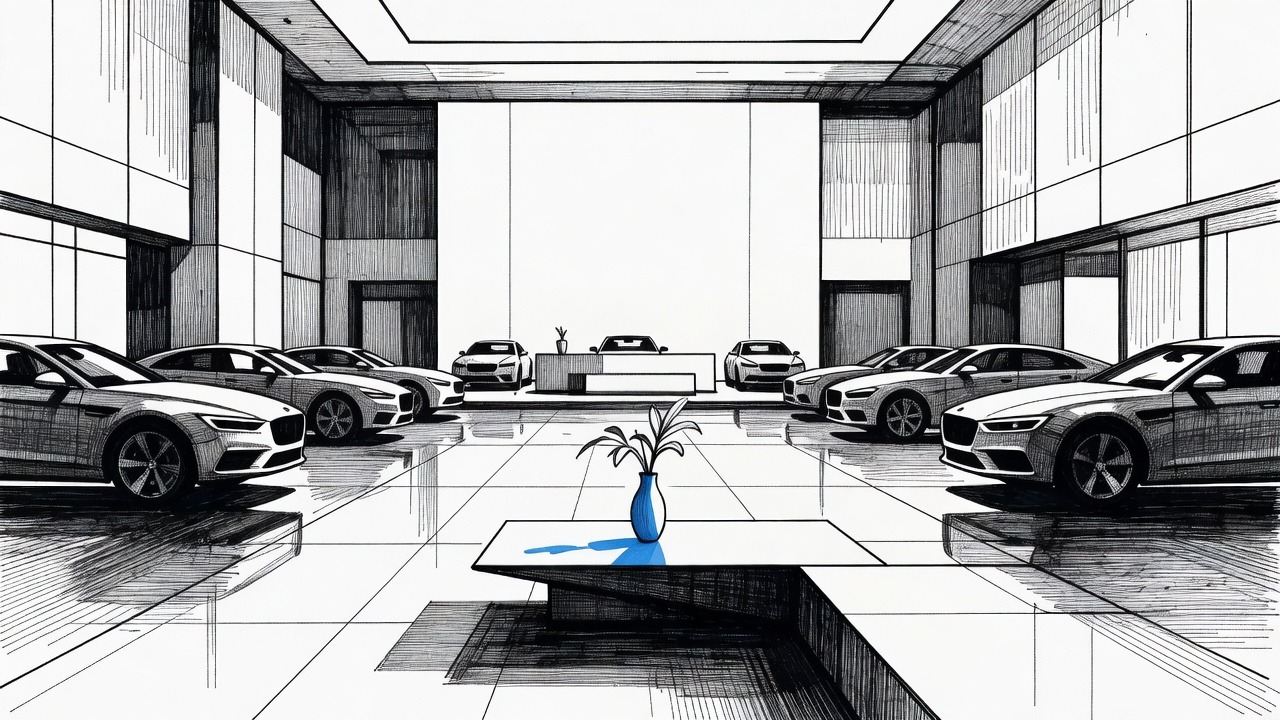
The most revealing number in China's October retail data is not the national 0.4% gain. It is the 21% collapse in car sales in both Beijing and Shanghai, the country's richest and most cosmopolitan markets, in the same month food and clothing sales ticked up.
People in those cities are still eating and still buying shoes. What they have stopped doing is committing to big purchases. That is not what a confident consumer looks like. It looks like a household that does not trust its own future.
The usual explanation is technical. Government trade-in subsidies pulled car purchases forward, the boost is fading, and the comparison with last year is harsh. That is probably part of it. But it concedes the larger point: Beijing has been trying to buy a consumer economy with coupons. Subsidies produce a spike, the spike ends, and the underlying weakness returns. National sales excluding cars rose only 2.5%, and Shanghai has now posted seven straight months of decline. This is not a blip.
The deeper problem is who holds the money and the risk. Household consumption in China is only around 40% of GDP, far below other large economies. That is not a cultural quirk of thrifty Chinese families. It is a policy choice, repeated for decades: pour resources into factories, infrastructure and exports, and treat the household as what is left over. Families save heavily because they must. Pensions for rural and non-working residents are tiny. Health and elder care costs fall largely on the family. Migrant workers in big cities still face a hukou system that rations access to schooling and services. And for the urban middle class, the main store of wealth was an apartment, which is worth less than it was in 2021. Beijing and Shanghai have the most housing wealth in the country, and also the most to lose when it shrinks. It would be strange if their shoppers felt expansive.
There is a bitter irony here. This is a state that calls itself socialist, and its economy tells workers to wait. The Communist Party can mobilize capital for electric vehicles, solar panels and shipyards on a scale no Western government can match. Yet it has been far slower to do the least glamorous thing a government can do to raise consumption: guarantee people a decent retirement, medical coverage and a stable place to live, so they feel safe spending what they earn. A real left-wing economics would start there. Wages and social insurance come first, and the car loan comes after.
Western politicians should take note, because this is not only China's problem. Washington and Brussels denounce Chinese overcapacity and respond with tariffs. But overcapacity has a mirror image: a country that makes far more than its own people can afford to buy has to push the surplus abroad. Tariffs treat the symptom while leaving the cause in place. Ordinary Chinese households, squeezed at home, and workers in Ohio or Germany, squeezed by the flood of exports, are on opposite sides of the same imbalance. Neither chose it.
We should be careful about cheering a rival's stumble. A Chinese economy that stagnates on weak demand exports its deflation, strains global manufacturing and turns political anger outward. The better outcome is a China whose people share more of what they produce.
Beijing knows this, which is why "boosting consumption" appears in speech after speech. The test is whether it will move real money into pensions, health care and wages rather than another round of purchase incentives. Until it does, retail data will keep showing the same thing: people spend when they feel secure and hold back when they do not.
How it may affect me
Weak Chinese household demand tends to push more Chinese-made goods, especially cars and electronics, into export markets at lower prices. That can mean cheaper imports for buyers, but also more pressure on manufacturers and jobs elsewhere, and a greater chance of new tariffs.