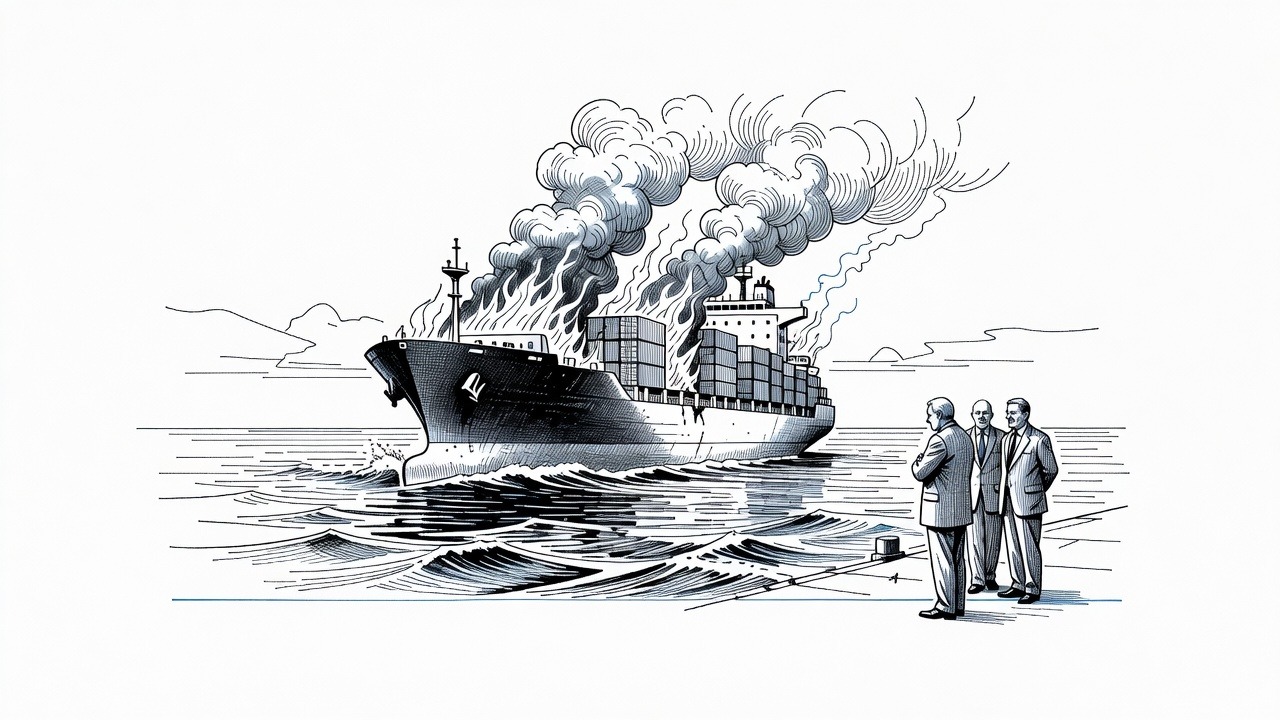
Here is what we know about the Sparta II: it was burning, it drifted into Finnish waters, and Finland is now preparing for an oil spill. Here is what we have only from a Russian governor: that two drones hit it. Nobody has publicly proven who sent them, and a regional official in a country that lies for a living is not evidence. Anyone on my side of the aisle who treats the claim as settled, in either direction, is doing propaganda, not politics.
But the fire matters regardless of who started it, because of who ends up holding the bill.
The Sparta II belongs to Oboronlogistika, a company tied to Russia's Defense Ministry. Washington has sanctioned it since 2022. That is nearly four years of a designated military-linked shipper moving freely enough to be sailing toward Kaliningrad, burning in the Gulf of Finland, and threatening Finnish shores. The sanctions regime is supposed to be how the West constrains Putin's war without firing a shot. Instead we get a lesson in how much sanctions are announced and how little they are enforced. A listing is a press release. A blockade of a sanctioned military carrier would be a policy. We keep choosing the press release.
The Left has been right to back Ukraine's defense against an invasion that was imperial, brutal and unprovoked. Being right about that doesn't excuse us from asking what the war costs people who never voted for it. The Baltic is shallow, brackish and slow to heal; its water takes decades to turn over. A bunker fuel spill there is not a news cycle. It means oiled birds, closed fisheries, ruined coastlines and a cleanup financed by Finnish and Estonian taxpayers, not by a Moscow defense contractor. The people most exposed are coastal communities, small fishermen and municipal workers. Nobody asked them if the war could spread to their water.
That is the collective-action problem in miniature. Moscow has turned the Baltic into a gray zone, running a shadow fleet of aging, poorly insured tankers and shipping military cargo through crowded, fragile lanes. Finland has already dealt with suspected sabotage of undersea cables by vessels tied to that fleet. If someone is now striking Russian ships near NATO waters, the risk of an environmental disaster rises along with the risk of miscalculation. A burning hull doesn't care whose flag it flew or whose drone lit it.
So my side should say three things plainly.
First, attribution matters. If Ukraine or anyone else is attacking ships in a way that endangers a NATO member's coastline, its allies are owed an explanation and a seat at the table. Solidarity isn't a blank check. Democratic governments that supply, fund and shelter this war are accountable to their own publics for where it spreads.
Second, Russia carries the primary blame for the conditions that make this plausible. A state that invades its neighbor, arms itself through civilian-looking shipping and hides behind opaque corporate shells gets no lecture about proper conduct at sea from me.
Third, if governments are serious about the Baltic, they should treat it like the shared public good it is. That means real enforcement against sanctioned and uninsured vessels, mandatory insurance and inspection regimes that make the shadow fleet unprofitable, and funded spill-response capacity before the next ship burns, not after. It is cheap compared with a ruined coastline, and it asks the shipping industry to carry costs it has spent years pushing onto everyone else.
The easy reaction is to cheer when a Defense Ministry vessel goes up in flames. I understand the impulse. But ecosystems don't take sides, and the Finnish family living near the spill will not be comforted that the ship was sanctioned. If this war is a fight for a rules-based order, then the rules have to protect the sea and the people who live beside it.