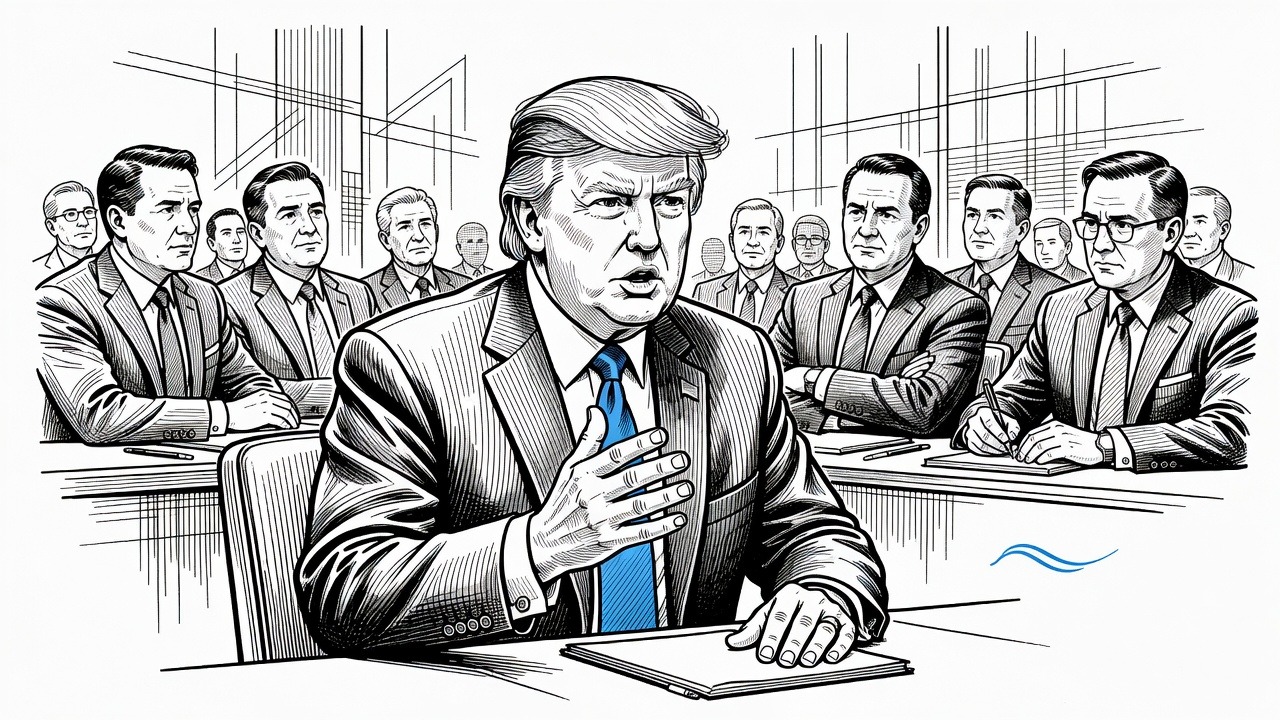
Here is what we know about the most consequential technology conversation of the year: Trump says it happened over dinner, that regulation should be "prudent," and that the fate of a former Nvidia chief executive is a "tragedy." That is the whole public record. No readout, no agenda, no commitments, nothing a worker, a voter or a member of Congress could hold anyone to.
Consider the priorities on display. Artificial intelligence is already reshaping hiring, customer service, entry-level white-collar work, power grids and the information people use to decide how to vote. The people who will absorb those changes have not been consulted about any of it. Yet the one human detail Trump chose to share was sympathy for a fallen tech executive. The president did not mention the people whose jobs are in the path of this technology. He mentioned the man who sells the picks and shovels.
Then there is "prudently." It sounds responsible, and it commits to nothing. This is an administration that has spent its time in office treating AI rules as an obstacle: it has moved to override state efforts to regulate the technology and has bent export policy toward what chipmakers want. Having dismantled the guardrails at home, Trump now invokes caution abroad. The word is cover, a reassuring noise from a man who has shown little interest in the substance.
I would also not trust the warm glow of a Trump–Xi dinner. When two leaders who face little domestic accountability on this issue agree that AI should be handled "prudently," the question is whose prudence and whose interests. Governments love technologies that watch, sort and control populations, and neither Washington nor Beijing is innocent there. The danger is not that the two superpowers fail to talk. It is that they talk in private, and what comes out is a shared understanding that the public, labor and civil society are outside the room.
The argument for secrecy and speed is always the race: if we regulate, China wins. That claim has been used to justify nearly every demand from the AI industry, from lax rules to subsidized chips to tolerance for enormous energy use. But Trump has just told us he is chatting with Xi about governing the technology together. Either the race is existential or the two sides can sit down and set rules. The industry's lobbyists and the White House cannot have it both ways, invoking an arms race when rules are proposed and talking cooperation when it flatters a summit.
Democrats should not feel smug, because this vacuum is partly theirs. Too many in the party answer AI with panels, listening tours and vague talk of "responsible innovation," which is the same mush as "prudent." The Left has a real agenda available: worker voice in how AI is deployed on the job, transparency about what these systems are trained on and used for, public accountability for the energy and water they consume, and a refusal to let a handful of firms and two governments settle the terms. Until Democrats say that plainly and loudly, Trump gets to fill the silence with dinner-table anecdotes.
We should demand more than a president's account of what he said over dinner. If AI governance is being discussed at the summit level, there should be a public agenda, congressional oversight and a seat for the people who will live with the results. Otherwise "prudence" will mean what it usually means when the powerful use it: protect the people who already have the most.