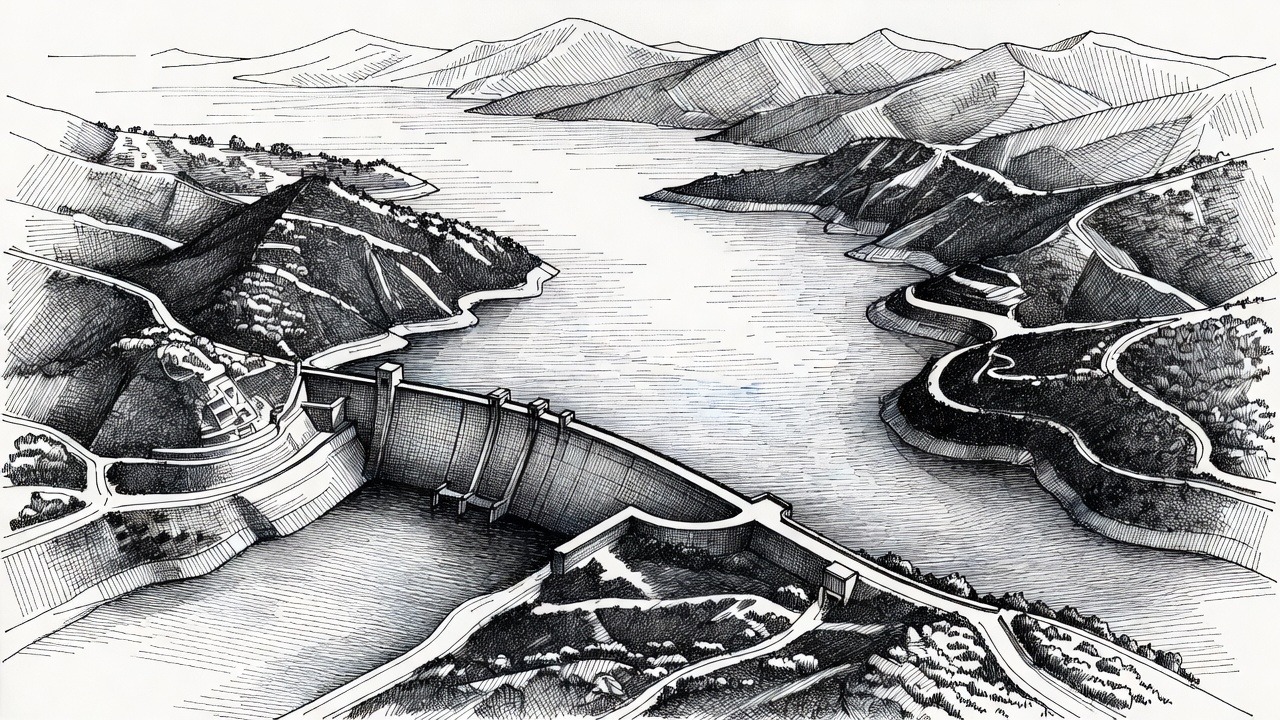
Here is what we know. A government agency surveyed reservoirs across Taiwan for solar potential between 2022 and 2024. The survey ended. Nobody has installed anything at Feitsui. Yet Taipei Mayor Chiang Wan-an says he heroically blocked panels there three times. Either he defeated a plan that never existed, or he is describing routine paperwork as an attack on the capital's water. Neither is a flattering look.
The politics are easy to read. Feitsui supplies drinking water to millions of people in greater Taipei, so "they want to cover your reservoir" is a political gift, short and visceral. It asks nothing of the mayor. He gets to be the protector of the faucet, and the other side has to explain a feasibility study. The KMT has run this play for years: oppose the gas terminal, oppose the wind farm, oppose the transmission line, then demand to know why Taiwan's energy transition is behind schedule.
That last point is the real story. Taiwan imports nearly all its energy. Its grid runs on liquefied natural gas that arrives by ship across waters Beijing could squeeze whenever it chose. The Maanshan nuclear plant has now shut down, and its advocates have no ready answer for what replaces the power. Renewable targets have been missed more than once. Anyone who says they take Taiwan's security seriously has to say where the electrons come from, and "not there" is not an energy policy. Surveying every large body of water for solar potential is not radical. It is what a responsible government does when land is scarce, mountains are steep, and the grid is exposed.
But the Left should not let itself off easily, because the Democratic Progressive Party has helped make this kind of demagoguery work. Too often, green energy in Taiwan has been rolled out in ways that treat local worry as ignorance: solar farms spreading over farmland and fish ponds, ecological concerns waved away as obstruction, communities told the transition is happening and they should adjust. When people have been steamrolled before, they do not hear "it's only an assessment" as reassurance. They hear a bureaucracy that has not earned the benefit of the doubt.
That matters here because drinking water is the one place where public suspicion is not irrational. A protected watershed is not a rooftop. Floating panels raise real questions about water quality, ecology, maintenance and emergency access, and a city has every right to demand rigorous answers before anything goes near its main supply. A mayor who says "show me the evidence" is doing his job. A mayor who implies the evidence was being forced on him, when the central government says it was a survey, is doing something else.
Premier Cho Jung-tai is right that the dispute has been inflated. He would be more convincing if his government had made the survey's scope and conclusions public and plain from the start, rather than leaving a vacuum that opponents fill with their worst-case story. Calling it "political manipulation" is accurate but incomplete, since manipulation only works when trust is thin. A government that wants to build a cleaner, more secure grid has to treat trust as infrastructure, as essential as the cables.
The lesson for the Left is blunt. Energy security is national security, and the people who block every option while offering none are not protecting Taiwan. They are borrowing against its future for a news cycle. But the answer is not to outshout them. It is to publish the data, put water safety first, and show that the transition serves ordinary people before asking for their consent. Chiang can keep blocking things that were never proposed. The grid will not wait for him.