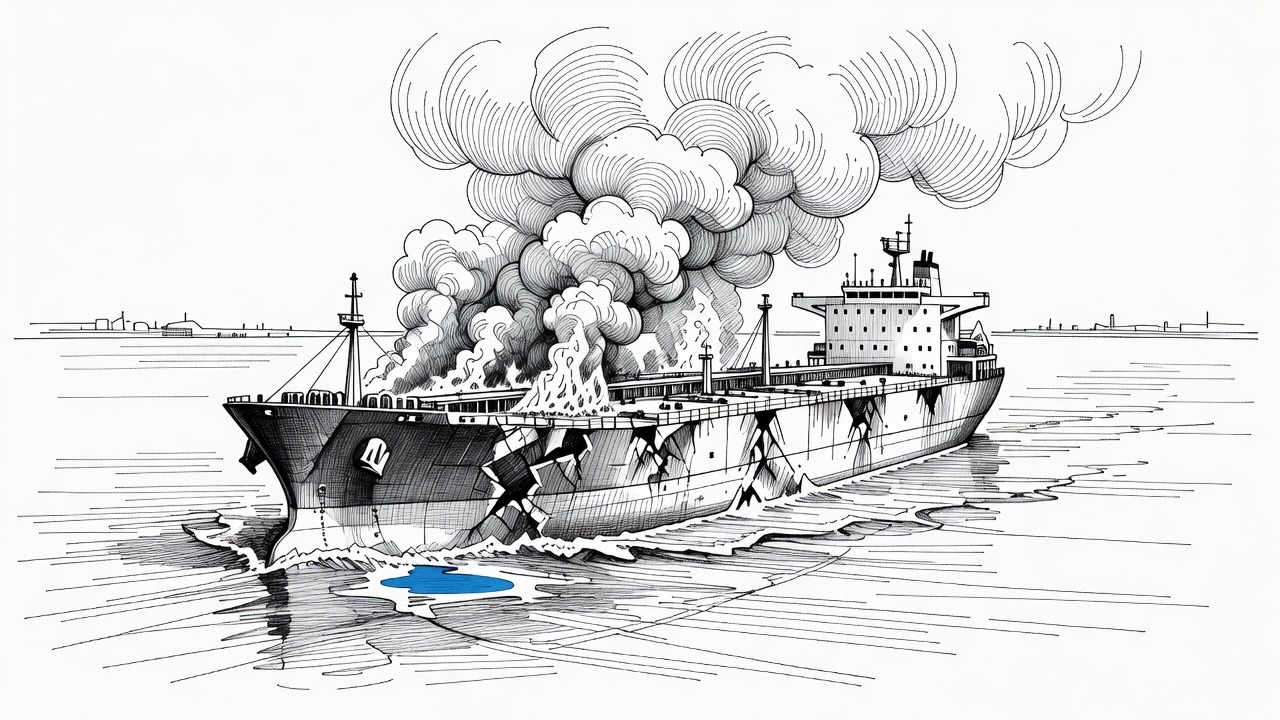
Pay attention to who is on those tankers. They are not oil executives or admirals. They are working seafarers, most of them from poorer countries, hired on contract to move a commodity through a waterway that two or more governments now treat as a chessboard. We don't yet know the nationalities of the crews on these four ships, and that is part of the point: the people standing next to the fire have no say in the geopolitics, and the public rarely learns their names. When a tanker hits a mine and catches fire, the person nearest the flames is the one with the least power over how it got there.
Start with what we don't know, because the Bare Story is honest about it. Iran's navy says four tankers struck mines. A separate maritime monitor reports a tanker hit by an unidentified projectile. Those are different weapons, and nobody has publicly established who deployed them. Iran's Revolutionary Guards declared the southern route "closed" and told ships to coordinate with its forces first. Anyone who claims certainty about responsibility from a wire report is selling something.
What we do know is that Iran's demand is coercion. Insisting that commercial shipping seek military permission to use an international strait is a shakedown, and the Left should say so without squirming. Opposing American militarism has never required flattering a government that jails its own protesters and now threatens civilian crews. You can say both things at once.
But the second thing matters more. About a fifth of the world's oil moves through this chokepoint, and for forty-five years Washington's answer has been the same: a naval guarantee, issued under the Carter Doctrine, that American force will keep the crude flowing. That guarantee has been sold as stability. Look at what it has actually bought: repeated Gulf crises, trillions in military spending, and a standing invitation for every regional power to hold the global economy hostage by threatening one narrow channel. The arrangement hasn't made us safe. It has made us hostage to the same threat for decades.
The cost of that hostage-taking never lands on the people who profit from it. When Hormuz seizes up, oil majors and traders do fine. Volatility is their business. The person who pays is the home health aide filling a tank in a car she can't afford to replace, the family whose heating bill jumps, the farmer watching diesel and fertilizer costs climb. Drill-baby-drill is no shield here. Oil is priced globally, and America being a large producer doesn't stop a Gulf scare from hitting the pump in Ohio.
This is where my own side deserves a harder look. Democrats are quick to demand that Congress be consulted before any new Middle East escalation, and they're right. War powers aren't a suggestion, and a conflict that touches the strait should not be started or widened by a president with a press release. But the party has been timid about the only real exit, which is to make the world need this strait less. Every solar farm, transmission line, heat pump and electric bus is a small act of national security. The Republican majority has spent the past year gutting precisely those incentives while praising "energy dominance." You cannot claim to protect Americans from Gulf shocks while dismantling the tools that would make those shocks matter less.
The lesson of this week is not that we need more warships in a narrow channel full of mines. It is that an economy built on a single fragile artery will keep bleeding whenever somebody decides to cut it. Protect the crews, demand that Congress own any American role, and treat the energy transition as the hard-nosed security policy it is. The alternative is another round of fire at sea, and another bill sent to people who never had a vote.
How it may affect me
If disruption persists, expect higher gasoline, diesel and shipping costs, since oil prices respond globally to Hormuz risk, not just to U.S. supply. Effects depend on how long the route stays contested. Drivers and small businesses with fuel-heavy costs would feel it first.