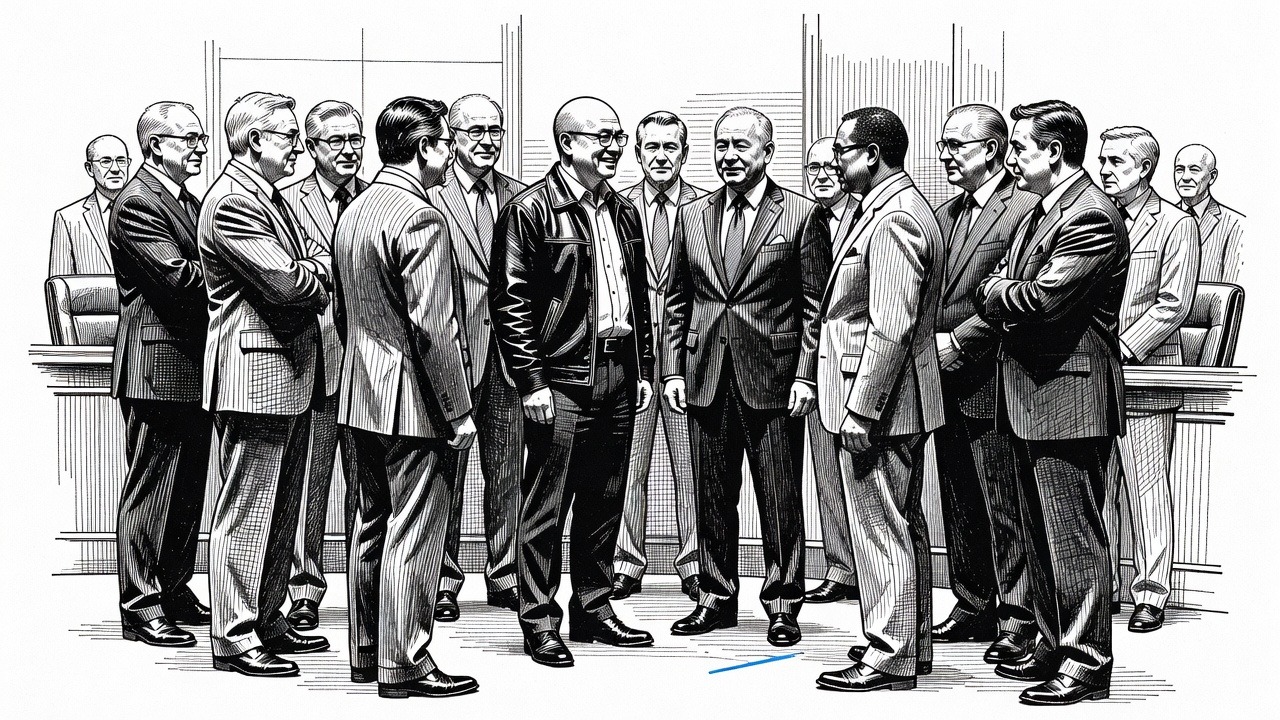
Wall Street will spend this week asking whether Colette Kress can calm the market after Jensen Huang's exit. That is the wrong question. The right one is why a single company's earnings call has become a matter of national security, retirement security and electricity policy, and why none of those are being decided by the public.
Start with the numbers. Analysts expect $109.1 billion in revenue in one quarter, up 91%. Wall Street treats that as a scoreboard. It is also a measure of dependence. A large share of the stock market, the data-center building boom and the political fantasy of an AI-driven economy rests on one supplier of one kind of chip. When the founder of such a company leaves and the CFO steps in as interim chief, markets get nervous. In a sane economy, that kind of concentration would worry us more than any succession plan.
Now the Bessent angle, which deserves more attention than it is getting. The Treasury Secretary is asking whether Nvidia did enough to stop chips from reaching China through intermediary shell companies. Nvidia says it has essentially no China data-center sales and has seen no evidence of diversion. Maybe so. But that is exactly the kind of claim a company would make, and exactly the kind a government is supposed to verify rather than just ask about.
This administration has little standing to play the stern enforcer. It is the same administration that turned export controls into a bargaining chip, agreeing to let Nvidia sell advanced chips to China in exchange for the government taking a cut of the revenue. Once a restriction can be bought, it is no longer a security policy. It is a toll booth. And when the toll booth is the policy, a question about shell companies sounds less like vigilance and more like leverage, a reminder to the company of who holds the pen.
That is the pattern the Left should name plainly. Rules on the most strategically important technology on earth are being set through private understandings between a company and a White House that rewards favor. Congress is largely absent. Voters are not consulted. Whether a chip that could train a military-grade model ends up in Shenzhen depends on deal-making and on how well an executive stays on the right side of the administration. That is government by personal relationship, and it is corrosive whether you worry about China or about corruption.
The other half of the story is who pays for the boom. The data centers that drive Nvidia's growth are rising in towns that are being asked to absorb higher power demand, strained grids and generous tax breaks. The profits flow up and out. The costs show up on utility bills. The jobs that come with a server farm are a rounding error next to the subsidies it receives. Nobody voted for that bargain either.
None of this requires hostility to the technology or to the people who built it. Huang and his engineers made something extraordinary. But extraordinary companies are exactly the ones that need public rules, because they can afford to ignore everything else. We need export enforcement that does not depend on anyone's mood, audits of the supply chain that do not depend on the company's own assurances, and a serious conversation about what communities get when they host the infrastructure.
Interim CEO Kress will say the right things on the call. Demand is strong, compliance is strict and growth continues. Investors will cheer or sulk. The harder test belongs to Washington, which has to decide whether the world's most important chip company answers to law or to leverage. So far, the evidence points the wrong way.
How it may affect me
If you own an index fund or a 401(k), you likely hold a sizable stake in Nvidia, so a bad earnings reaction can move your retirement balance. If you live near a planned data center, check your utility commission's filings for rate changes and local tax-break terms.