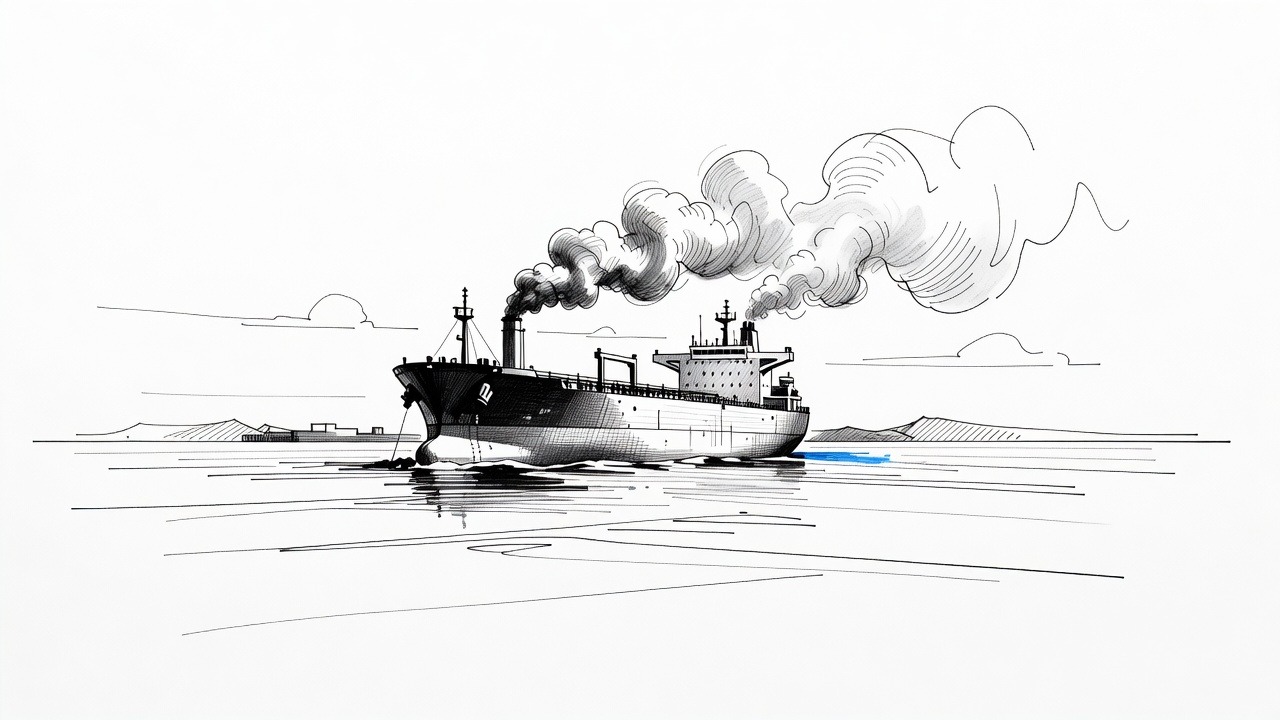
Read the dispatch closely and notice what it cannot tell you. A tanker burns in the engine room. One account says a projectile hit it. Another, from the Revolutionary Guard, says it struck mines while sailing dark, and offers no photograph. Drones go up at a base in Bahrain, and each side narrates the episode to suit itself. Nobody outside the military chain of command can say with confidence who did what or why. That fog is the story. A country is deep in a war that its own citizens are barely allowed to see, much less judge.
The United States is blockading Iranian ports, with more than twenty vessels reported in the Gulf and the Gulf of Oman. A blockade is not a diplomatic gesture. It is an act of war, whatever euphemism the briefers prefer. Yet the public debate has the texture of a weather report: another incident, another intercept, talks "stalled." Under the Constitution, the power to take the country into war belongs to Congress, not to a president improvising escalation from the Situation Room. Where is the debate? Where is the vote? Where is the definition of victory?
That last question matters most, because the story offers a brutal answer to the premise that force would make the nuclear problem go away. Iran now says IAEA inspectors will not see its damaged nuclear sites until the war has permanently ended and its conditions are met. Whatever one thinks of Tehran, which is a repressive government that deserves no romance, look at what has happened to the world's eyes on that program. Inspectors were the one tool that could verify what exists and what doesn't. The war has pushed them out. We are bombing and blockading our way into greater ignorance, then calling it strength.
The Right's answer is that Iran is the aggressor, that its drones are aimed at American-linked installations, and that pressure is the only language Tehran understands. Fine. Iran's behavior is not in dispute, and no one on the Left should pretend the Guard are peacemakers. But "they started it" is not a strategy. Pressure is meant to lead somewhere, and nothing here suggests a destination. Talks are stalled, the blockade continues, drones keep flying, and fighting spills into Yemen and beyond. A policy with no exit is not toughness. It is drift with a very large budget.
Who pays for the drift? Not the officials who chose it. The crew of that burning tanker are almost certainly working people from somewhere far from Washington or Tehran, doing a job in one of the most dangerous waterways on earth. This time everyone was accounted for. That is luck, not policy. Service members at that base in Bahrain are on the receiving end of the escalation too. And Americans will pay at the pump and in the grocery aisle when the world's most important oil chokepoint becomes a shooting gallery.
The quiet scandal is on our own side of the aisle. Too many Democrats have treated this as a subject to be handled with a carefully worded statement. If the party that ran against forever wars cannot force a vote on a blockade and a shooting conflict, it has no standing to complain when the next escalation arrives uninvited. Demand a war powers vote. Demand a public account of the objectives. Demand that diplomacy, including the dull, humiliating work of restoring inspections, be treated as the main effort rather than an afterthought.
Wars rarely announce the moment they became unmanageable. They just keep producing incidents like this one, each small enough to shrug off, until shrugging is the only habit left.
How it may affect me
The Strait of Hormuz carries roughly a fifth of the world's oil, so attacks or fears of attacks on tankers can raise crude prices, shipping costs and insurance premiums. Over time that can show up in gasoline, diesel and the price of goods moved by sea. The effect depends on how long disruptions last.