Start with what we know and what we don't. Jensen Huang has resigned. The allegations about his personal relationships, including claims involving employees and a Singapore executive that U.S. officials reportedly suspected of ties to Chinese intelligence, are allegations. Beijing calls the espionage claim unfounded. Nobody should be convicted by headline.
But the more important story isn't whether every detail holds up. It's that the fate of a company at the center of the AI economy turned on one man's private conduct, and nobody with a duty to check him appears to have done so until the press did.
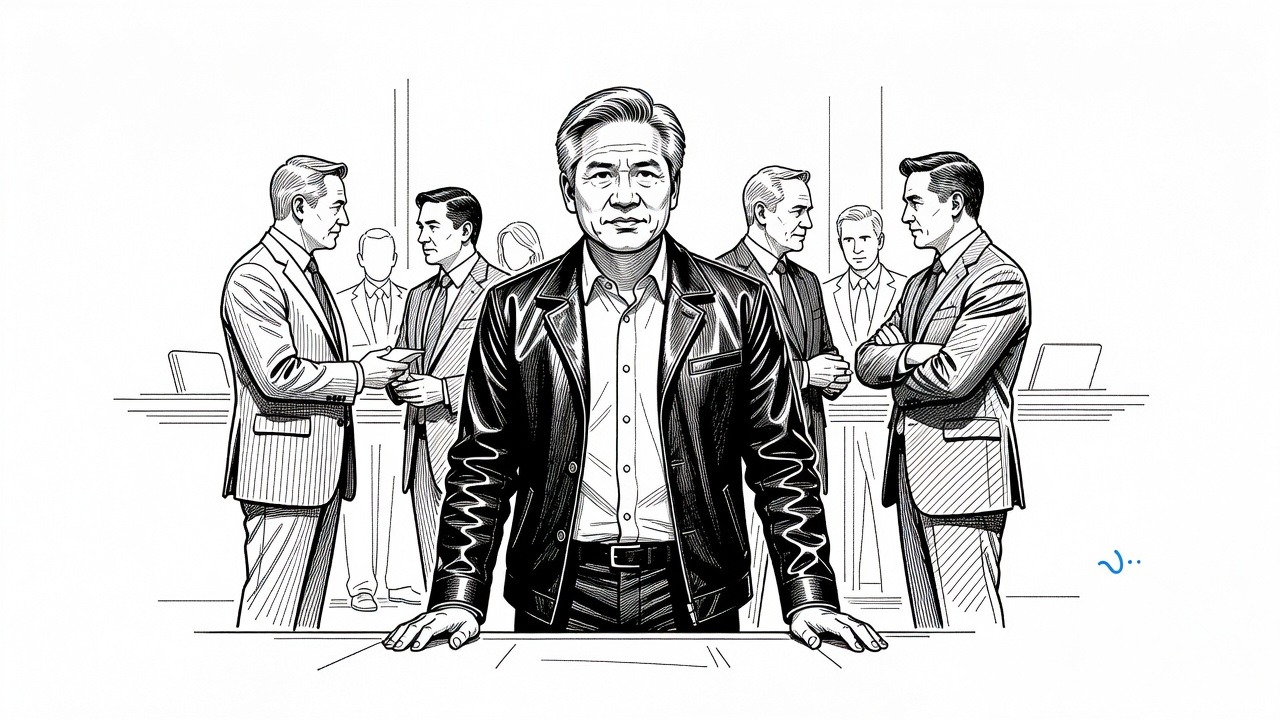
For years the business class has sold us the founder as a force of nature. Huang, with the leather jacket and the keynote swagger, was treated as proof that genius should be left alone. His company became so valuable that pension funds and index funds can't avoid it. His lobbying against tighter limits on chip sales to China was framed as common sense from the man who knew best. The message to regulators and the public was always the same: trust him.
Now we're told the operational impact will be limited because the product roadmap is set. That is reassuring to shareholders and damning as governance. If the company can run without him, why was so much of the market's faith, and so much of Washington's deference, staked on his personal judgment? And if it can't, what does it say that a firm this central to national infrastructure ran on one person's character and discretion?
The allegations involving employees deserve particular seriousness. When a chief executive has power over careers, pay and reputations, relationships with subordinates are never a purely private matter. That isn't prudishness. It's the lesson workplaces supposedly learned years ago: consent is complicated by hierarchy, and the people with the least power carry the risk. The employees at the center of this are the ones whose interests the market is least interested in. Shareholders will ask what this does to the stock. The more important question is whether anyone inside Nvidia could have raised a concern and been heard.
The national security angle should embarrass everyone who treated export controls as a nuisance. Nvidia's chips are among the most strategically sensitive products on earth. Yet the way this episode is described, a possible intelligence exposure at the top was surfaced through reporting, not through any visible corporate or governmental safeguard. I'd say the same of any CEO of a company this critical, regardless of party or nationality. The Trump administration, which has bargained over chip access to China like a trade in used cars, including taking a cut of sales, hardly has standing to lecture anyone on seriousness.
Liberals should resist the easy move too. It's tempting to enjoy a billionaire's fall. The harder and better demand is structural: boards with real independence, whistleblower channels that actually work, mandatory disclosure of conflicts for executives at firms with national-security significance, and a public conversation about AI that doesn't hinge on whether we like the person on the stage.
Colette Kress is now interim chief, and 'interim' is the operative word. Nvidia will search for a new face, and the market will price in a new myth. The lesson we should take is the opposite one: no company this important should depend on a myth at all. The public bears the consequences of AI's concentrated power. It should not have to hope that the founder behind it is who he says he is.
How it may affect me
If you own an S&P 500 or total-market index fund, including through a 401(k), you likely hold Nvidia in a large weighting, so its swings can move your retirement balance. Watch the Nov. 17 earnings report for signs of customer or supplier hesitation. Avoid reacting to a single day's drop, since broad funds are built to absorb company-specific shocks.